Stock Analysis · Country Garden Services Holdings Co Ltd (CTRGF)
Overview
Country Garden Services Holdings Co Ltd is a Chinese property management and community services company. In simple terms, it helps run residential compounds, commercial buildings, public facilities, and surrounding community services after properties have been built. Its activities include basic building management, security, cleaning, maintenance, landscaping, and a wider set of value-added services provided to residents, businesses, and developers.
The business is part of the broader real estate services industry rather than homebuilding itself. That distinction matters. Property management can produce recurring service revenue because buildings need to be maintained year after year, even when new construction slows. However, in China, the sector is still closely tied to the health of the housing market because developers remain a source of projects, referrals, and related services.
Based on the company’s annual reporting structure in recent years, revenue mainly comes from three broad areas:
- Property management services: approximately 50% to 60% of revenue. This is the core activity and includes services for residential communities, commercial properties, office buildings, industrial parks, municipal facilities, and other managed projects.
- Community value-added services: approximately 20% to 30% of revenue. These services can include home-related services, local retail support, community media, home furnishing assistance, brokerage-related activity, and other services sold to residents and occupiers.
- Value-added services to non-property owners and other services: approximately 10% to 20% of revenue. This category has included developer-related support and other services tied more directly to property sales, delivery, or consulting.
The broad financial flow shows a business that kept expanding revenue through 2025, but with much weaker profitability than it had earlier in the decade. Sales rose from roughly CNY 29 billion in 2021 to about CNY 47 billion in 2025, while net income fell sharply from above CNY 4.0 billion to below CNY 0.6 billion over the same period. That gap suggests the company has preserved scale but lost pricing power and margin quality.
Key Figures
| Metric | Value | Sector ⓘ |
|---|---|---|
| Date | Oct 17, 2026 | |
| Context | ||
| Sector | Real Estate | |
| Industry | Real Estate Services | |
| Market Cap ⓘ | $2.39B | |
| Beta ⓘ | 1.97 | |
Value (Cheapness) | ||
| P/E Ratio ⓘ | 36.26 | 17.38 |
| P/B Ratio ⓘ | 0.07 | 0.85 |
| FCF Yield ⓘ | 173.48% | 7.38% |
| Dividend Yield ⓘ | 6.34% | 4.85% |
| EBIT / EV ⓘ | N/A | 3.78% |
| PEG ⓘ | 0.64 | |
Growth (Business expansion) | ||
| Revenue Growth ⓘ | 5.70% | 5.30% |
| RPS Growth (5Y CAGR) ⓘ | 11.31% | 6.02% |
| EPS Growth (5Y CAGR) ⓘ | 42.23% | -11.37% |
| BVPS Growth (5Y CAGR) ⓘ | -3.36% | 0.45% |
| Margin Growth (5Y Trend) ⓘ | -16.27% | -0.22% |
| FCF Growth (5Y CAGR) ⓘ | -9.45% | 5.40% |
| DPS Growth (5Y CAGR) ⓘ | 8.25% | 5.02% |
Quality (Business durability) | ||
| ROIC (Latest) ⓘ | N/A | 5.69% |
| ROE (Latest) ⓘ | 5.55% | 7.56% |
| ROA (Latest) ⓘ | 2.67% | 2.85% |
| ROIC (5Y Median) ⓘ | 4.36% | 4.22% |
| ROE (5Y Median) ⓘ | 5.34% | 6.03% |
| ROA (5Y Median) ⓘ | 2.57% | 2.44% |
| Net Debt / EBIT (Latest) ⓘ | -1.57 | 7.59 |
| Net Debt / EBIT (5Y Median) ⓘ | -3.48 | 8.40 |
| Net Debt / EBITDA (Latest) ⓘ | -0.81 | 5.27 |
| Net Debt / Assets ⓘ | -8.80% | 37.76% |
| EBITDA / Interest ⓘ | 27.57 | 4.10 |
| Operating Margin (Latest) ⓘ | 4.27% | 35.29% |
| Operating Margin (5Y Median) ⓘ | 6.54% | 37.31% |
| Debt to Equity (Latest) ⓘ | 7.75% | 88.87% |
| Profit Margin (Latest) ⓘ | 1.12% | 19.61% |
| Free Cash Flow (Latest) ⓘ | $4.15B | |
Momentum (Price trend) | ||
| 3Y Return ⓘ | -24.60% | +30.75% |
| 12M Return (excl. last month) ⓘ | -2.40% | +4.36% |
| 6M Return ⓘ | +10.36% | -2.52% |
| Price vs. 200-Day MA ⓘ | +1.37% | -2.34% |
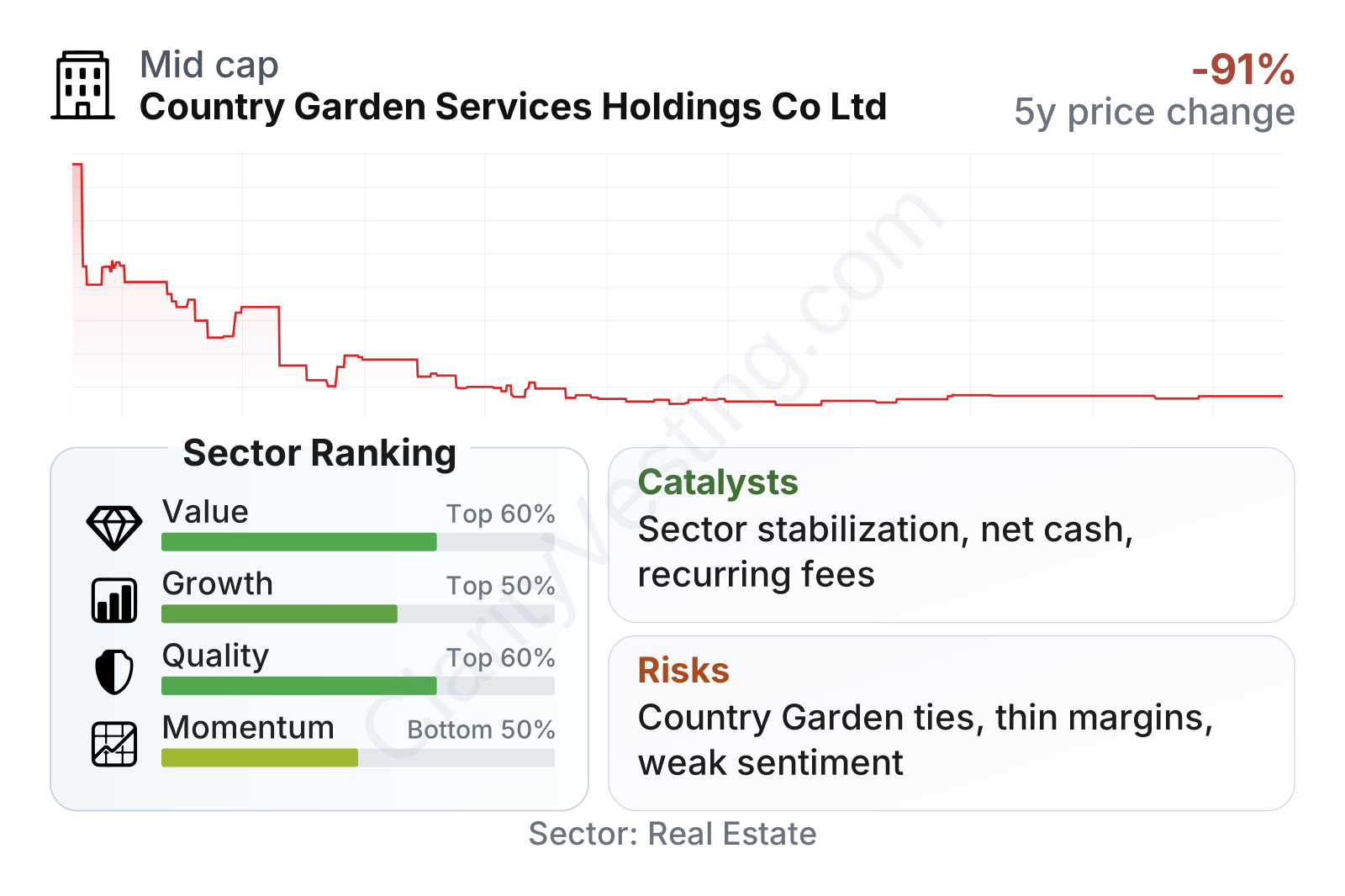
Country Garden Services is now a mid-sized listed company by market value, but its stock has gone through a severe multiyear decline and has only stabilized at a much lower level. The recent profile is mixed. On one hand, revenue growth remains slightly ahead of the sector median, five-year revenue per share growth is strong, leverage is very low, and interest coverage is exceptionally high. On the other hand, profitability is thin: return on equity is about 6%, profit margin is near 1%, and operating margin is far below the sector median.
The quality picture is unusual for a real estate-linked company. Net debt is negative, debt-to-equity is only about 8%, and cash generation remains positive. That balance sheet strength helps explain why the company still looks resilient despite sector stress. At the same time, weaker margins and a falling five-year free cash flow trend show that the business is not converting growth into earnings as efficiently as before.
Growth
Country Garden Services operates in a sector that still has a long-term logic behind it. China has an enormous existing housing stock and a very large base of residential communities that require ongoing management, cleaning, security, maintenance, and resident services. Even if new home sales remain weak, the installed base of properties needing operation does not disappear. That creates a more defensive backdrop than pure homebuilding.
The company’s strategy also makes sense in principle. Property management can become more valuable over time if a company increases the number of projects under management, raises service density in existing communities, and sells more services to residents and commercial clients. This is visible in the steady rise in revenue per share over the last five years, which indicates that growth has not come only from issuing more shares.
A further supportive point is the dividend record. The payout has not been on a smooth upward line, but the longer trend still shows a higher dividend per share than five years ago. In a stressed sector, maintaining a meaningful cash distribution while keeping low leverage suggests the company still has real cash-generating capacity, even if accounting profits have become more volatile.
The main catalyst is not a single product launch but a combination of sector normalization and internal resilience. If China’s property market moves from crisis conditions to a steadier operating environment, property managers with large scale, strong cash positions, and broad service networks could regain confidence faster than highly indebted developers. Another potential tailwind is continued expansion in non-developer-reliant contracts, such as public buildings, urban services, and commercial properties, which would make the revenue base less dependent on the fortunes of affiliated developers.
Recent operating trends also point to an opportunity: revenue has continued to grow modestly, and earnings recovered from the very weak 2023 level in 2024 and remained positive in 2025. That does not mean a full turnaround is complete, but it suggests the company is no longer in the same kind of earnings collapse seen at the height of the real estate downturn.
Risks
This article is for informational purposes only and does not constitute financial advice. Some content is AI-generated. See Disclaimer


