Stock Analysis · CareTrust REIT Inc (CTRE)
Overview
CareTrust REIT is a healthcare real estate investment trust focused mainly on properties used for senior care and other post-acute healthcare services. In simple terms, it owns buildings such as skilled nursing facilities, senior housing communities, and related healthcare properties, then leases them to operators that run the day-to-day care business. That structure matters because CareTrust is primarily a landlord, not a medical provider.
The company’s portfolio is concentrated in needs-based healthcare real estate, especially properties serving older adults. Demand in this area is tied less to short-term consumer trends and more to long-term demographic forces, including an aging U.S. population and rising care needs for seniors.
Based on recent company disclosures, the main revenue sources are largely rental and financing income connected to healthcare properties. The mix can vary by quarter as acquisitions close and financing arrangements change, but the business is generally organized around the following streams:
- Rental income from skilled nursing facilities: likely the largest contributor, representing the majority of total revenue. This comes from triple-net leases, where tenants usually cover property-level expenses such as maintenance, insurance, and taxes.
- Rental income from senior housing and other healthcare properties: a smaller but meaningful share, tied to assisted living, memory care, and other healthcare-related real estate.
- Interest and other investment income: income from real estate-secured loans, mezzanine financing, and similar arrangements with healthcare operators.
- Other operating and contractual revenue: a limited contribution compared with lease revenue, including property-related reimbursements or other ancillary items when applicable.
For a REIT like CareTrust, the big picture is straightforward: capital is raised, deployed into healthcare real estate, and then converted into recurring lease and financing income. The business model is attractive when management can acquire properties at solid yields, keep rent collection stable, and maintain a strong balance sheet while expanding the portfolio.
The multi-year income flow points to a business that stayed profitable at the operating level and then accelerated sharply more recently. Revenue and operating income improved meaningfully by 2025, although some line items moved unusually from year to year, so long-term readers should place more weight on the broader trend of rising scale and stronger earnings power than on any single annual jump.
Key Figures
| Metric | Value | Sector ⓘ |
|---|---|---|
| Date | Oct 03, 2026 | |
| Context | ||
| Sector | Real Estate | |
| Industry | REIT - Healthcare Facilities | |
| Market Cap ⓘ | $8.64B | |
| Beta ⓘ | 0.79 | |
Value (Cheapness) | ||
| P/E Ratio ⓘ | 22.86 | 17.35 |
| P/B Ratio ⓘ | 1.88 | 0.86 |
| FCF Yield ⓘ | 4.99% | 7.47% |
| Dividend Yield ⓘ | 3.94% | 4.75% |
| EBIT / EV ⓘ | 4.17% | 3.81% |
| PEG ⓘ | 1.26 | |
Growth (Business expansion) | ||
| Revenue Growth ⓘ | 43.50% | 5.30% |
| RPS Growth (5Y CAGR) ⓘ | 4.22% | 5.96% |
| EPS Growth (5Y CAGR) ⓘ | -2.86% | -11.41% |
| BVPS Growth (5Y CAGR) ⓘ | 19.84% | 0.41% |
| Margin Growth (5Y Trend) ⓘ | 27.13% | 0.53% |
| FCF Growth (5Y CAGR) ⓘ | 25.90% | 5.40% |
| DPS Growth (5Y CAGR) ⓘ | 4.92% | 5.02% |
Quality (Business durability) | ||
| ROIC (Latest) ⓘ | 7.87% | 5.77% |
| ROE (Latest) ⓘ | 8.42% | 7.64% |
| ROA (Latest) ⓘ | 6.45% | 2.85% |
| ROIC (5Y Median) ⓘ | 4.21% | 4.20% |
| ROE (5Y Median) ⓘ | 5.81% | 6.03% |
| ROA (5Y Median) ⓘ | 4.53% | 2.45% |
| Net Debt / EBIT (Latest) ⓘ | 2.79 | 7.57 |
| Net Debt / EBIT (5Y Median) ⓘ | 3.18 | 8.41 |
| Net Debt / EBITDA (Latest) ⓘ | 2.19 | 5.12 |
| Net Debt / Assets ⓘ | 19.49% | 37.84% |
| EBITDA / Interest ⓘ | 10.44 | 4.11 |
| Operating Margin (Latest) ⓘ | 76.23% | 35.40% |
| Operating Margin (5Y Median) ⓘ | 50.30% | 36.59% |
| Debt to Equity (Latest) ⓘ | 26.83% | 89.06% |
| Profit Margin (Latest) ⓘ | 62.19% | 19.99% |
| Free Cash Flow (Latest) ⓘ | $431.35M | |
Momentum (Price trend) | ||
| 3Y Return ⓘ | +102.93% | +30.60% |
| 12M Return (excl. last month) ⓘ | +20.69% | +7.55% |
| 6M Return ⓘ | -1.31% | +0.69% |
| Price vs. 200-Day MA ⓘ | -6.10% | -2.30% |
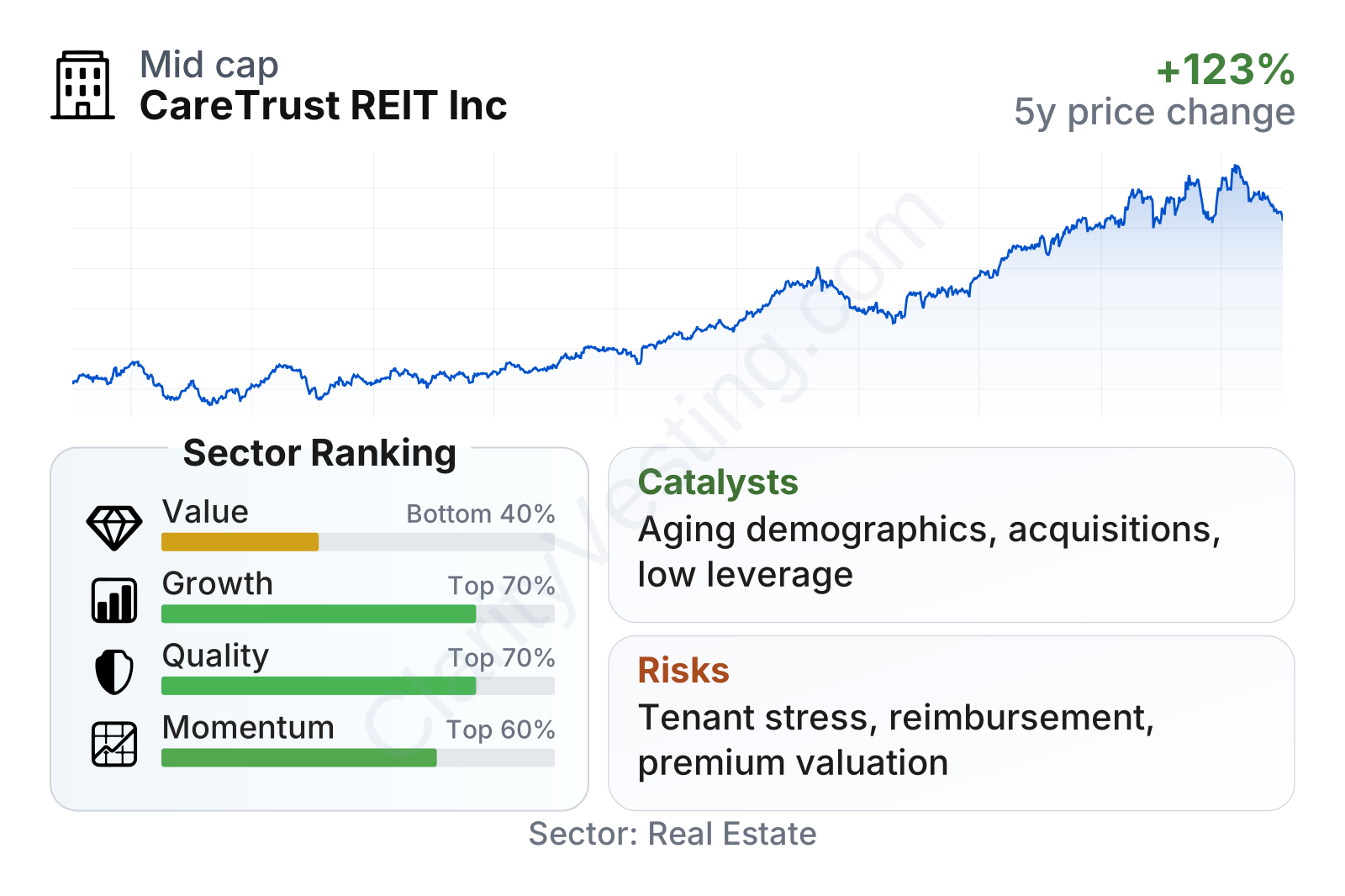
CareTrust stands out more on business quality and growth than on cheapness. Recent revenue growth is far above the sector median, profitability is notably strong, and leverage remains well below many peers. The tradeoff is valuation: earnings, book value, free cash flow yield, and dividend yield all suggest the market is assigning a premium compared with much of the real estate sector.
The stock’s longer-term price trend has also been strong. Over roughly the last three years, the share price has more than doubled, which signals that the market has already recognized much of the company’s recent operational progress. Even so, the company’s beta remains below 1, meaning the stock has historically moved less than the broader market.
Growth
CareTrust operates in a part of real estate with a credible long-term growth backdrop. Healthcare facilities tied to senior care benefit from aging demographics, rising longevity, and ongoing demand for post-acute care. Skilled nursing in particular is not a fashionable property type, but it serves an essential role in the healthcare system. That can create opportunities for specialized landlords willing to understand operator risk and structure deals carefully.
The company’s strategy appears coherent for this environment. It focuses on healthcare real estate where operational complexity can keep less specialized capital away. That allows a disciplined buyer to find acquisitions, recapitalizations, and loan investments that may offer stronger returns than more crowded property categories. CareTrust has also built a reputation for working with operators in a flexible way, which can help it source transactions and reposition troubled assets.
Revenue per share was uneven over the last several years, but the latest period shows a strong rebound. That matters because share issuance is common across REITs; per-share growth gives a clearer picture of whether expansion is actually benefiting existing shareholders rather than simply making the company larger.
Dividend per share has trended upward over time, with the latest year showing a noticeable step up. In a REIT, that usually signals management’s confidence in cash generation, although the current yield is lower than the sector median because the stock price has risen so much.
A major recent catalyst is portfolio expansion. CareTrust has been active in acquisitions and investments that broaden its property base and tenant relationships. In a fragmented healthcare real estate market, scale can matter: a larger platform can spread overhead, improve access to capital, and create more deal flow. If the company continues adding assets while keeping tenant health intact, that could support further growth in rent, cash flow, and dividends.
Another positive element is the company’s financial flexibility. Compared with many REIT peers, CareTrust has operated with relatively moderate leverage and strong interest coverage. That gives it room to pursue deals when weaker competitors or overstretched owners need capital, which can be especially valuable in healthcare real estate where financing conditions often create transaction opportunities.
Risks
This article is for informational purposes only and does not constitute financial advice. Some content is AI-generated. See Disclaimer