Stock Analysis · Custom Truck One Source Inc (CTOS)
Overview
Custom Truck One Source is a specialized equipment company serving utility, telecommunications, rail, forestry, and infrastructure customers. Its business model combines equipment rental, equipment sales, parts and service, and financing support. In simple terms, it provides the trucks and heavy equipment that customers need to build, maintain, and repair essential networks such as electric grids, broadband lines, and rail systems.
The company’s main appeal is that it operates across much of the equipment life cycle. A customer can rent a truck for a short-term project, buy new or used equipment for long-term use, come back for maintenance and replacement parts, and in some cases use financing arranged by the company. That creates multiple revenue streams around a similar customer base.
Based on the company’s recent filings and business disclosures, revenue is mainly generated from the following activities:
- Equipment sales: approximately 55% to 65% of revenue. This includes new and used specialty trucks and heavy equipment sold to utilities, telecom, rail, and other industrial customers.
- Equipment rentals: approximately 20% to 30% of revenue. This includes truck and equipment rentals for project-based needs, storm response, and temporary fleet capacity.
- Parts and services: approximately 10% to 15% of revenue. This covers maintenance, repair, inspections, refurbishment, and replacement components.
- Other, including financing and ancillary activities: generally a small share of revenue, but potentially important for supporting sales and customer relationships.
This mix matters because sales can drive scale, while rentals and service can add recurring activity and stronger customer retention. Over the last several years, the company has expanded revenue meaningfully, but profitability has been much less stable than top-line growth.
The long-term financial picture shows a business that increased revenue from roughly $1.2 billion in 2021 to nearly $1.9 billion in 2025. Gross profit also improved over that period, but interest expense rose sharply, which has limited the conversion of operating gains into net earnings. That tension between business expansion and financing cost is central to the investment case.
The operating profile improved a lot after 2021, but the company still gives up a large portion of operating profit to interest expense. That helps explain why revenue has grown strongly while net income and free cash flow have remained uneven.
Key Figures
| Metric | Value | Sector ⓘ |
|---|---|---|
| Date | Oct 03, 2026 | |
| Context | ||
| Sector | Industrials | |
| Industry | Rental & Leasing Services | |
| Market Cap ⓘ | $2.10B | |
| Beta ⓘ | 1.35 | |
Value (Cheapness) | ||
| P/E Ratio ⓘ | 102.44 | 22.45 |
| P/B Ratio ⓘ | 2.56 | 1.98 |
| FCF Yield ⓘ | -5.21% | 6.31% |
| Dividend Yield ⓘ | N/A | 1.96% |
| EBIT / EV ⓘ | 3.72% | 4.81% |
| PEG ⓘ | N/A | |
Growth (Business expansion) | ||
| Revenue Growth ⓘ | 10.20% | 9.10% |
| RPS Growth (5Y CAGR) ⓘ | 15.42% | 7.75% |
| EPS Growth (5Y CAGR) ⓘ | -28.02% | -13.59% |
| BVPS Growth (5Y CAGR) ⓘ | 0.10% | 6.22% |
| Margin Growth (5Y Trend) ⓘ | 15.59% | 0.72% |
| FCF Growth (5Y CAGR) ⓘ | N/A | 10.98% |
| DPS Growth (5Y CAGR) ⓘ | N/A | 9.48% |
Quality (Business durability) | ||
| ROIC (Latest) ⓘ | 5.94% | 10.92% |
| ROA (Latest) ⓘ | 0.60% | 5.41% |
| ROIC (5Y Median) ⓘ | 3.43% | 9.21% |
| ROA (5Y Median) ⓘ | -0.83% | 4.94% |
| Net Debt / EBIT (Latest) ⓘ | 13.83 | 2.07 |
| Net Debt / EBIT (5Y Median) ⓘ | 15.46 | 2.28 |
| Net Debt / EBITDA (Latest) ⓘ | 5.28 | 1.43 |
| Net Debt / Assets ⓘ | 67.02% | 19.27% |
| EBITDA / Interest ⓘ | 3.02 | 9.53 |
| Operating Margin (Latest) ⓘ | 8.59% | 10.50% |
| Operating Margin (5Y Median) ⓘ | 7.65% | 10.27% |
| Debt to Equity (Latest) ⓘ | 297.33% | 65.48% |
| Profit Margin (Latest) ⓘ | 1.05% | 6.62% |
| Free Cash Flow (Latest) ⓘ | -$109.27M | |
Momentum (Price trend) | ||
| 3Y Return ⓘ | +46.94% | +58.56% |
| 12M Return (excl. last month) ⓘ | +50.00% | +15.63% |
| 6M Return ⓘ | +38.66% | +4.19% |
| Price vs. 200-Day MA ⓘ | +7.39% | +0.93% |
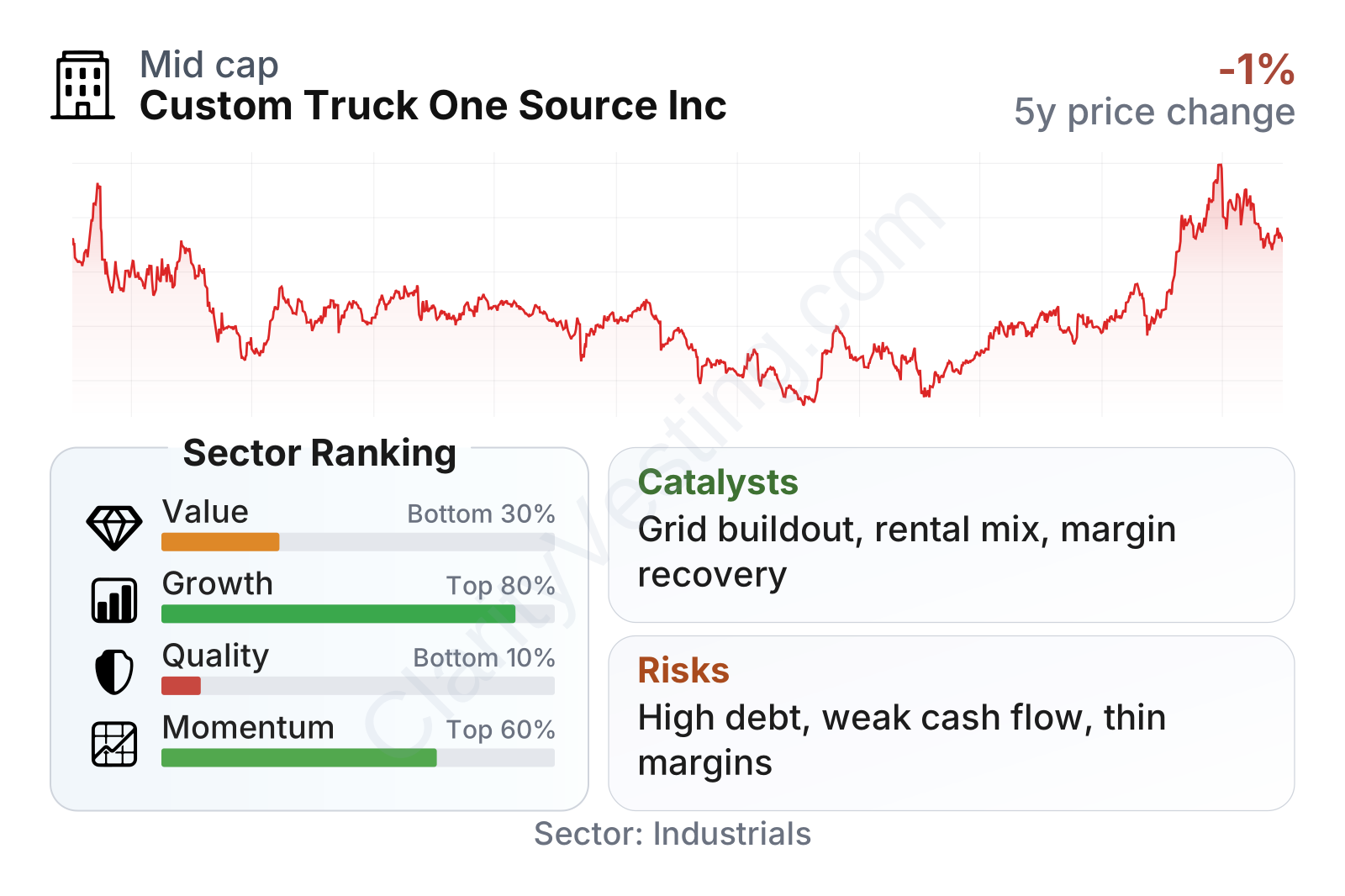
Custom Truck One Source is a mid-sized industrial company with a stock that has been volatile. After a long weak stretch through 2024 and early 2025, the share price rebounded strongly into 2026. Momentum has improved, but the fundamental profile remains mixed: growth ranks above much of the sector, while quality and valuation metrics look less favorable.
The company’s latest factor profile reflects that contrast clearly. Growth measures are relatively solid, helped by revenue expansion and improving operating margin trends over several years. At the same time, return on capital, return on assets, leverage, and free cash flow compare poorly with the sector median. The valuation picture is also demanding, with the earnings multiple far above the sector median and free cash flow still negative.
Growth
Custom Truck One Source operates in markets tied to power infrastructure, grid maintenance, telecom buildouts, rail work, and other specialized fleet needs. Those are generally attractive end markets for long-term demand because utilities and communications networks require ongoing maintenance and modernization. Storm hardening, grid reliability work, broadband expansion, and equipment replacement cycles all support a need for specialized trucks and access equipment.
The company’s strategy also makes sense on paper. It is not relying on a single product line or a single type of customer relationship. Instead, it combines sales, rental, service, and financing around a specialized equipment base. That can deepen customer ties and create repeat business even when buying activity slows. The rental fleet is particularly important because it gives the company exposure to recurring project work and emergency response demand.
Revenue growth has not been perfectly smooth, but the broader direction remains constructive. After a strong expansion phase in 2022 and 2023, growth cooled in 2024 and then turned positive again through 2025 and the first half of 2026. The latest year-over-year pace is around 10%, which is slightly above the sector median and suggests that demand has stabilized after a softer period.
Free cash flow is a more complicated part of the picture. The trend has improved significantly from the deeper outflows seen in earlier periods, but it remains negative on a trailing basis. For a company with a rental fleet and equipment-heavy model, some cash pressure is expected because fleet growth and maintenance require capital. Still, long-term investors usually want to see that fleet investment eventually translates into durable cash generation, and that proof is not fully in place yet.
A meaningful catalyst is the company’s exposure to utility and telecom infrastructure spending. If power grid upgrades, storm resilience investment, and broadband deployment remain active, demand for bucket trucks, digger derricks, cranes, and related specialty equipment can continue to support both sales and rentals. Another potential tailwind is operational leverage: if revenue rises while overhead stays relatively contained, operating profit can improve faster than sales. Because interest costs are large, even modest margin improvement can have a noticeable effect on earnings.
Recent company updates in 2026 point to continued business activity rather than a major break in direction. The main opportunity is not a single headline event, but the combination of recovering growth, stronger stock momentum, and exposure to end markets with multi-year infrastructure needs.
Risks
This article is for informational purposes only and does not constitute financial advice. Some content is AI-generated. See Disclaimer