Stock Analysis · China Taiping Insurance Holdings Co Ltd (CTIHY)
Overview
China Taiping Insurance Holdings Co. Ltd. is a Hong Kong-listed insurance group with deep roots in mainland China and a broader presence across Asia. The company operates through life insurance, property and casualty insurance, reinsurance, pension-related business, and asset management. In simple terms, it collects premiums from individuals and businesses, invests part of that money, and earns income both from underwriting insurance policies and from managing financial assets.
Its business mix is still centered on life and health protection products, which typically drive the largest share of premiums and earnings in Chinese insurance groups. Property and casualty insurance adds diversification through motor, commercial, and specialty coverage, while reinsurance and asset management bring additional income streams and support the group’s capital deployment.
Based on the company’s recent annual disclosures, the main sources of revenue are broadly organized as follows:
- Life insurance: approximately 70% to 80% of insurance service and premium-related revenue. This includes long-term protection, savings-type policies, annuities, and health coverage.
- Property and casualty insurance: approximately 10% to 20%. This usually includes motor, accident, liability, engineering, and commercial lines.
- Reinsurance: approximately 5% to 10%. This business insures other insurers and helps spread risk.
- Asset management, pension, and other operations: generally a smaller share of reported revenue, but strategically important because they support fee income and investment returns.
The business has become more profitable over the last few years. Revenue and operating income improved meaningfully from 2023 through 2025, and net income rose sharply by 2025 after a weak 2022. That pattern suggests both recovery in the insurance franchise and support from the investment side of the balance sheet.
The longer-term operating picture shows a clear rebound after 2022. Revenue recovered strongly in 2023 and kept accelerating through 2024 and 2025, while operating income and net income improved at an even faster pace. For an insurer, that combination usually points to better underwriting discipline, healthier product mix, and improved investment contribution.
Key Figures
| Metric | Value | Sector ⓘ |
|---|---|---|
| Date | Nov 21, 2026 | |
| Context | ||
| Sector | Financial Services | |
| Industry | Insurance - Life | |
| Market Cap ⓘ | $8.02B | |
| Beta ⓘ | 1.01 | |
Value (Cheapness) | ||
| P/E Ratio ⓘ | 1.95 | 12.01 |
| P/B Ratio ⓘ | N/A | 1.48 |
| FCF Yield ⓘ | 412.08% | 8.77% |
| Dividend Yield ⓘ | 7.03% | 3.01% |
| EBIT / EV ⓘ | N/A | 8.31% |
| PEG ⓘ | N/A | |
Growth (Business expansion) | ||
| Revenue Growth ⓘ | 22.20% | 6.70% |
| RPS Growth (5Y CAGR) ⓘ | -13.52% | 12.35% |
| EPS Growth (5Y CAGR) ⓘ | 33.80% | -0.27% |
| BVPS Growth (5Y CAGR) ⓘ | -17.15% | 4.83% |
| Margin Growth (5Y Trend) ⓘ | 19.17% | -4.16% |
| FCF Growth (5Y CAGR) ⓘ | 12.45% | 4.69% |
| DPS Growth (5Y CAGR) ⓘ | -3.32% | 8.82% |
Quality (Business durability) | ||
| ROIC (Latest) ⓘ | N/A | 9.49% |
| ROE (Latest) ⓘ | 84.70% | 14.02% |
| ROA (Latest) ⓘ | 2.17% | 1.53% |
| ROIC (5Y Median) ⓘ | 7.60% | 7.80% |
| ROE (5Y Median) ⓘ | 11.57% | 12.09% |
| ROA (5Y Median) ⓘ | 0.52% | 1.28% |
| Net Debt / EBIT (Latest) ⓘ | N/A | 0.88 |
| Net Debt / EBIT (5Y Median) ⓘ | 3.80 | 0.73 |
| Net Debt / EBITDA (Latest) ⓘ | 1.56 | 0.71 |
| Operating Margin (Latest) ⓘ | N/A | 23.37% |
| Operating Margin (5Y Median) ⓘ | 14.53% | 24.29% |
| Debt to Equity (Latest) ⓘ | 179.96% | 59.34% |
| Profit Margin (Latest) ⓘ | 22.71% | 26.65% |
| Free Cash Flow (Latest) ⓘ | $33.06B | |
Momentum (Price trend) | ||
| 3Y Return ⓘ | +131.03% | +73.29% |
| 12M Return (excl. last month) ⓘ | +181.14% | +18.35% |
| 6M Return ⓘ | -13.87% | +3.24% |
| Price vs. 200-Day MA ⓘ | -15.37% | +2.17% |
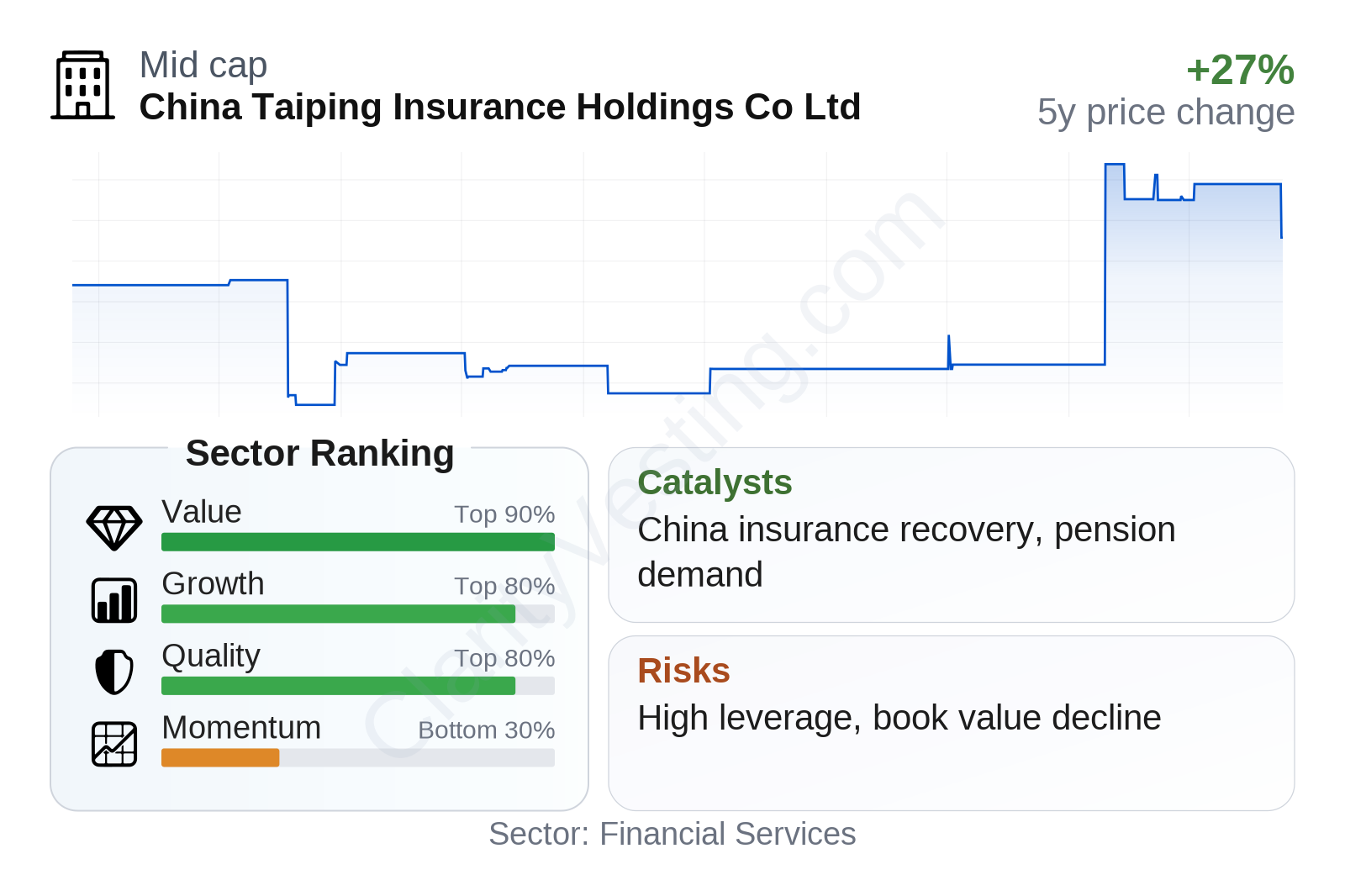
China Taiping sits in the larger end of the listed insurance universe, with stock-price volatility close to the broader market rather than at an extreme. The most striking feature in the current metrics is valuation: earnings and book-based multiples are far below sector norms, while the dividend yield is above the sector median. Quality and growth indicators are more mixed than the valuation signals, but recent profitability and price performance have improved enough to place the company in the stronger part of the sector on several measures.
The share price history also reflects that mixed profile. After a long period of weakness and stagnation, the stock rebounded sharply in 2026. That move likely reflects a market reassessment of earnings power rather than a steady rerating over many years, which is important context for long-term readers.
Growth
China Taiping operates in a sector that still has structural room to expand. China’s life and health insurance market benefits from aging demographics, rising household wealth, greater awareness of retirement planning, and a healthcare system that leaves room for private protection products. Pension-related services and long-duration savings products are especially relevant as the country continues to deal with retirement funding pressures.
The group’s strategy also makes industrial sense. A large life insurance operation provides recurring premium inflows, while asset management and pension businesses can deepen customer relationships and generate fees. Reinsurance and property-casualty operations add diversification, reducing dependence on a single product line. For a long-term business model, that breadth matters because insurance profitability can shift with claims cycles, regulation, and investment markets.
The recent earnings trend is encouraging. Earnings per share rose materially between late 2024 and mid-2025, and the five-year earnings-per-share growth rate is well ahead of the sector median. Revenue growth over the last year also outpaced the sector. At the same time, that growth should be read carefully: some of the improvement reflects recovery from a weaker base rather than a perfectly smooth upward path.
Book value per share tells a more complicated story. It has moved down over the last several years despite the profit recovery. For insurers, book value matters because it reflects capital strength and the value of invested assets after liabilities. A falling book value does not automatically mean deterioration, but it does suggest that market gains in earnings have not yet translated into a steadily compounding balance sheet on a per-share basis.
One potentially important catalyst is the broader normalization of China’s insurance market after years of pressure from low confidence, property-related financial stress, and capital-market volatility. If long-term savings demand continues to shift toward large branded insurers with broad distribution, China Taiping could benefit. Another favorable signal is the improvement in operating margin trend over five years, which suggests management has been rebuilding profitability rather than relying only on top-line growth.
Risks
This article is for informational purposes only and does not constitute financial advice. Some content is AI-generated. See Disclaimer