Stock Analysis · Cintas Corporation (CTAS)
Overview
Cintas Corporation is a business services company that helps workplaces run safely, cleanly, and consistently. Its best-known activity is renting, cleaning, and replacing uniforms for employees, but the company also provides entrance mats, towels, restroom supplies, first aid and safety products, fire protection services, and other facility-related support. The customer base is broad, covering manufacturing, healthcare, hospitality, education, retail, and many other industries. That diversity matters because Cintas is not tied to one narrow end market.
The business model is built around recurring service routes. Cintas picks up used products, launders or replenishes them, and delivers them back on a regular schedule. This creates repeat revenue, long customer relationships, and a large route network that is difficult and expensive to replicate at national scale.
Based on the company’s latest fiscal year disclosures, revenue is mainly generated from the following activities:
- Uniform Rental and Facility Services: about 79% of revenue. This is the core business and includes uniform rental, floor mats, mops, shop towels, aprons, and restroom cleaning supplies and services.
- First Aid and Safety Services: about 11% of revenue. This segment includes first aid cabinets and replenishment, safety products, training, and related compliance support.
- Fire Protection Services: about 10% of revenue. This includes inspection, testing, installation, and maintenance of fire extinguishers, suppression systems, alarms, and related equipment.
Cintas has steadily expanded beyond uniforms into a broader workplace-services platform. That matters for long-term analysis because it increases cross-selling opportunities: a customer using Cintas for uniforms can later add first aid, safety, or fire protection services without changing provider.
The multi-year profit flow shows a business that has not only increased sales but also expanded earnings faster than costs. Revenue has climbed from roughly $7.9 billion in fiscal 2022 to more than $11.2 billion in fiscal 2026, while operating income and net income have risen even faster, pointing to improving efficiency and pricing strength.
Key Figures
| Metric | Value | Sector ⓘ |
|---|---|---|
| Date | Oct 24, 2026 | |
| Context | ||
| Sector | Industrials | |
| Industry | Specialty Business Services | |
| Market Cap ⓘ | $86.18B | |
| Beta ⓘ | 0.92 | |
Value (Cheapness) | ||
| P/E Ratio ⓘ | 42.81 | 22.29 |
| P/B Ratio ⓘ | 17.10 | 1.98 |
| FCF Yield ⓘ | 2.36% | 6.26% |
| Dividend Yield ⓘ | 0.88% | 1.92% |
| EBIT / EV ⓘ | 3.42% | 4.83% |
| PEG ⓘ | 3.14 | |
Growth (Business expansion) | ||
| Revenue Growth ⓘ | 10.90% | 9.30% |
| RPS Growth (5Y CAGR) ⓘ | 10.49% | 7.76% |
| EPS Growth (5Y CAGR) ⓘ | -35.37% | -13.17% |
| BVPS Growth (5Y CAGR) ⓘ | 12.72% | 6.13% |
| Margin Growth (5Y Trend) ⓘ | 2.94% | 0.74% |
| FCF Growth (5Y CAGR) ⓘ | 9.74% | 10.79% |
| DPS Growth (5Y CAGR) ⓘ | 18.07% | 9.41% |
Quality (Business durability) | ||
| ROIC (Latest) ⓘ | N/A | 10.75% |
| ROA (Latest) ⓘ | 19.83% | 5.41% |
| ROIC (5Y Median) ⓘ | 25.22% | 9.37% |
| ROA (5Y Median) ⓘ | 17.17% | 4.95% |
| Net Debt / EBIT (Latest) ⓘ | 0.91 | 2.04 |
| Net Debt / EBIT (5Y Median) ⓘ | 1.12 | 2.27 |
| Net Debt / EBITDA (Latest) ⓘ | 0.77 | 1.39 |
| Net Debt / Assets ⓘ | 23.17% | 19.27% |
| EBITDA / Interest ⓘ | 30.12 | 9.58 |
| Operating Margin (Latest) ⓘ | 23.39% | 10.49% |
| Operating Margin (5Y Median) ⓘ | 21.69% | 10.30% |
| Debt to Equity (Latest) ⓘ | 52.10% | 64.82% |
| Profit Margin (Latest) ⓘ | 17.82% | 6.67% |
| Free Cash Flow (Latest) ⓘ | $2.03B | |
Momentum (Price trend) | ||
| 3Y Return ⓘ | +81.47% | +67.77% |
| 12M Return (excl. last month) ⓘ | -0.63% | +12.05% |
| 6M Return ⓘ | +25.57% | 0.00% |
| Price vs. 200-Day MA ⓘ | +16.73% | +0.67% |
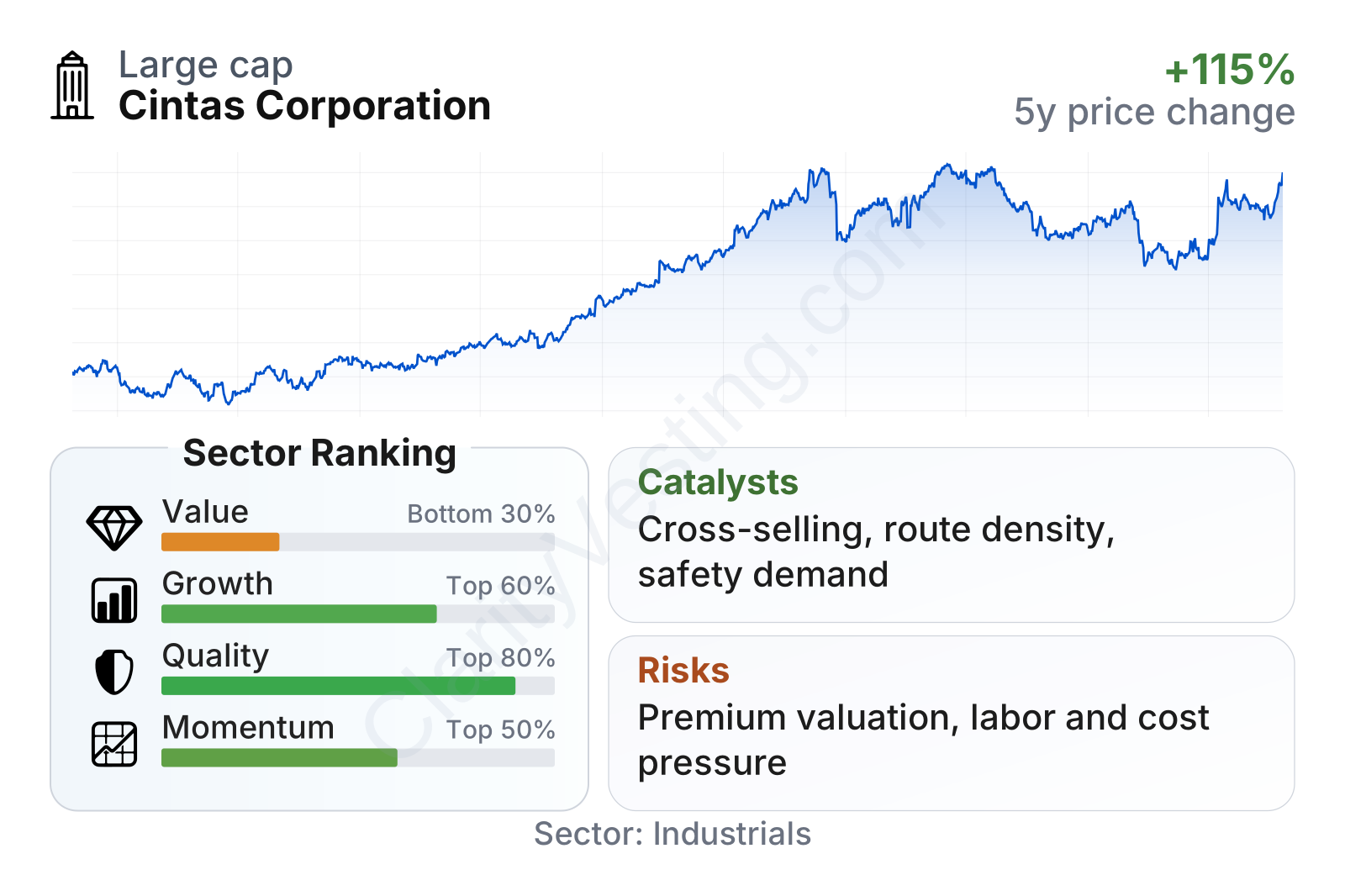
Cintas stands out more for quality than for cheapness. The company ranks in the top tier of its sector on profitability and capital efficiency, with returns on assets and long-term operating margins far ahead of typical industrial service peers. Growth is solid rather than spectacular, while valuation metrics sit in the expensive end of the sector. The market appears to be assigning a premium to consistency, margins, and recurring revenue rather than to rapid cyclical expansion.
Its market value places it among the larger companies in the business services space, and its beta near 0.9 suggests share-price swings have been somewhat lower than the broader equity market. That does not remove risk, but it fits the profile of a mature, steady operator rather than a highly volatile industrial name.
Growth
Cintas operates in a sector with durable long-term demand rather than explosive disruption. Workplaces continue to need uniforms, hygiene products, safety supplies, and fire compliance services regardless of economic fashion. Demand also benefits from structural trends: tighter workplace safety expectations, greater outsourcing by employers, rising hygiene standards, and growing compliance requirements in regulated environments such as healthcare and food service.
The company’s strategy is straightforward and sensible for long-term expansion. It keeps adding customers through its route-based sales network, raises revenue per customer by cross-selling more services, and uses scale to improve route density and plant efficiency. This is a powerful model because additional services sold to an existing client usually come with lower customer-acquisition cost than winning a brand-new account.
Recent revenue growth has stayed close to high-single-digit to low-double-digit levels, which is healthy for a company of this size. It also compares favorably with the broader sector median. That pattern suggests growth is not being driven by a one-time spike but by a fairly repeatable combination of customer retention, incremental pricing, and added service penetration.
Cash generation has also moved higher over time, reaching roughly $2.0 billion on a trailing basis. Strong free cash flow is important here because this is a service business that still requires investment in vehicles, facilities, inventory, and technology. Cintas has been able to grow while still producing meaningful cash, which supports dividends, share repurchases, acquisitions, and debt management.
A notable catalyst is the company’s ability to keep broadening its customer relationship once it is already inside an account. First aid, safety, and fire protection are practical extensions of the uniform and facility-services relationship, and each extension can raise revenue without needing a completely different distribution footprint. Another positive factor is the fragmented nature of many local service categories, which leaves room for share gains by a scaled national operator.
Recent company communications have also continued to emphasize healthy demand, customer retention, and route productivity. While none of these are dramatic headline events, they are meaningful because Cintas tends to compound through execution rather than through a single transformative catalyst.
Risks
This article is for informational purposes only and does not constitute financial advice. Some content is AI-generated. See Disclaimer