Stock Analysis · CSX Corporation (CSX)
Overview
CSX Corporation is one of the largest freight railroad companies in the United States. It operates a rail network concentrated in the eastern half of the country, connecting major population centers, ports, industrial hubs, and inland distribution points. In simple terms, CSX gets paid to move goods by rail: raw materials, manufactured products, containers from ships, vehicles, chemicals, and energy-related cargo.
The business is built around moving large volumes over long distances at a lower fuel cost per ton-mile than trucking. That gives railroads an important role in the U.S. supply chain, especially for heavy and bulk commodities. CSX also runs intermodal services, which means transporting shipping containers and trailers that can move between ships, trucks, and trains.
Based on the company’s recent annual reporting, revenue is mainly generated from the following categories:
- Merchandise: about 59% of revenue. This is the largest segment and includes chemicals, agricultural and food products, minerals, metals and equipment, fertilizers, forest products, and other industrial shipments.
- Intermodal: about 16% of revenue. This covers containers and trailers, often tied to consumer goods, imports, retail replenishment, and domestic freight moving in combination with trucking.
- Coal: about 15% of revenue. This includes export coal and domestic coal shipments to utilities, industrial users, and transload customers.
- Truckload and other: about 10% of revenue. This comes mainly from CSX’s trucking and logistics operations and other ancillary services.
That mix matters because it shows CSX is not only a coal railroad. Coal is still meaningful, but the company today is more broadly tied to industrial freight, consumer supply chains, and port activity.
The long-term financial picture also shows a business with very high operating profitability for the transportation sector, although earnings have come under pressure more recently as revenue softened and costs did not improve at the same pace.
Over the last several years, revenue peaked in 2022 and then gradually eased, while profit remained strong but moved lower. The broad takeaway is that CSX still converts a large share of sales into operating income and cash, yet its margin structure has been less favorable than it was at its peak.
Key Figures
| Metric | Value | Sector ⓘ |
|---|---|---|
| Date | Oct 03, 2026 | |
| Context | ||
| Sector | Industrials | |
| Industry | Railroads | |
| Market Cap ⓘ | $86.94B | |
| Beta ⓘ | 1.21 | |
Value (Cheapness) | ||
| P/E Ratio ⓘ | 27.28 | 22.45 |
| P/B Ratio ⓘ | 6.14 | 1.98 |
| FCF Yield ⓘ | 5.78% | 6.31% |
| Dividend Yield ⓘ | 1.15% | 1.96% |
| EBIT / EV ⓘ | 4.79% | 4.81% |
| PEG ⓘ | 1.72 | |
Growth (Business expansion) | ||
| Revenue Growth ⓘ | 10.10% | 9.10% |
| RPS Growth (5Y CAGR) ⓘ | 8.02% | 7.75% |
| EPS Growth (5Y CAGR) ⓘ | -16.54% | -13.59% |
| BVPS Growth (5Y CAGR) ⓘ | 4.22% | 6.22% |
| Margin Growth (5Y Trend) ⓘ | -12.73% | 0.72% |
| FCF Growth (5Y CAGR) ⓘ | -15.20% | 10.98% |
| DPS Growth (5Y CAGR) ⓘ | 8.81% | 9.48% |
Quality (Business durability) | ||
| ROIC (Latest) ⓘ | 11.98% | 10.92% |
| ROA (Latest) ⓘ | 7.32% | 5.41% |
| ROIC (5Y Median) ⓘ | 17.58% | 9.21% |
| ROA (5Y Median) ⓘ | 8.72% | 4.94% |
| Net Debt / EBIT (Latest) ⓘ | 3.64 | 2.07 |
| Net Debt / EBIT (5Y Median) ⓘ | 3.13 | 2.28 |
| Net Debt / EBITDA (Latest) ⓘ | 2.74 | 1.43 |
| Net Debt / Assets ⓘ | 41.03% | 19.27% |
| EBITDA / Interest ⓘ | 7.91 | 9.53 |
| Operating Margin (Latest) ⓘ | 34.79% | 10.50% |
| Operating Margin (5Y Median) ⓘ | 38.47% | 10.27% |
| Debt to Equity (Latest) ⓘ | 137.46% | 65.48% |
| Profit Margin (Latest) ⓘ | 22.21% | 6.62% |
| Free Cash Flow (Latest) ⓘ | $5.02B | |
Momentum (Price trend) | ||
| 3Y Return ⓘ | +57.74% | +58.56% |
| 12M Return (excl. last month) ⓘ | +57.36% | +15.63% |
| 6M Return ⓘ | +13.96% | +4.19% |
| Price vs. 200-Day MA ⓘ | +5.72% | +0.93% |
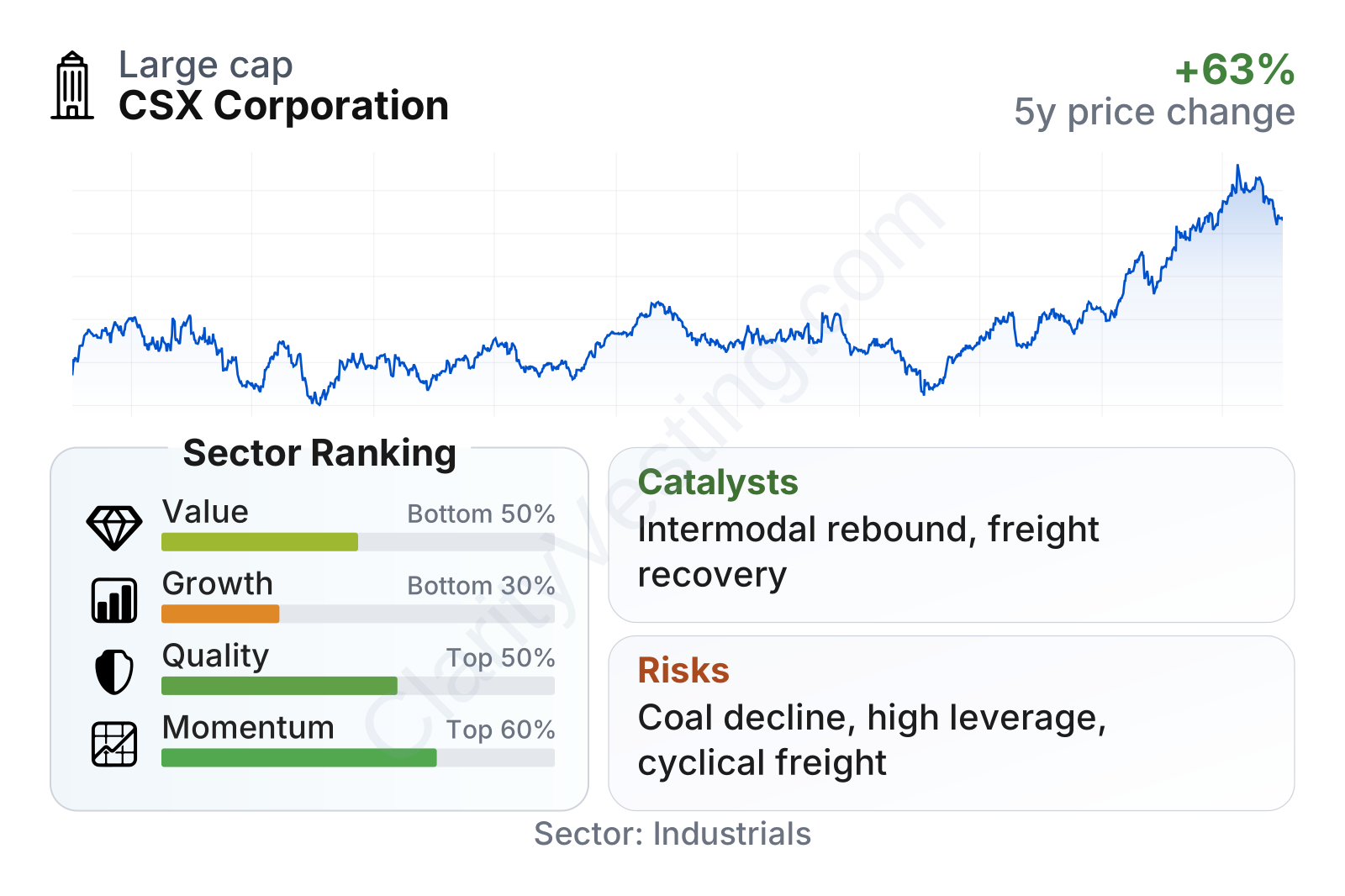
CSX is a very large railroad operator with a stock that has performed strongly over the last year and stayed above its longer-term trend. On profitability and capital efficiency, it remains better than many industrial peers, with returns on assets and invested capital ahead of sector medians. The weaker area is growth: longer-term earnings and free cash flow trends have been softer than the broader sector, while valuation multiples sit somewhat above average. In short, the market is still assigning a premium to a business that remains high quality, but not one currently showing standout growth.
Growth
Railroads are not a fast-growth industry in the way software or semiconductors can be, but they are part of a durable sector that remains essential to the economy. Freight rail benefits from scale, hard-to-replicate infrastructure, and fuel efficiency. Over long periods, growth usually comes from pricing, productivity gains, market share shifts from trucking, intermodal expansion, and volume tied to industrial production and trade flows.
CSX’s strategy is logical for that environment. The company continues to focus on network efficiency, service reliability, terminal productivity, and disciplined pricing. For a railroad, these are not small operational details; they directly affect how many cars can be moved, how quickly assets turn, and whether customers choose rail over other transport options. Intermodal is especially important because it gives CSX exposure to e-commerce, imports, and highway-to-rail conversion.
Recent revenue trends show why the growth case needs nuance. Growth was very strong in 2021 and 2022, turned negative through much of 2023 to 2025, and then improved again in 2026, with the latest year-over-year pace back around 10%. That rebound suggests freight conditions are recovering, but it does not yet erase the slower stretch that came before it.
Cash generation has also improved after a weaker period. Trailing free cash flow has recovered sharply from the low point reached in 2025 and is now back above $4 billion, with the latest reading around $5 billion. For a capital-intensive business such as rail, that matters because free cash flow is what remains after maintaining and improving the network.
Several potential catalysts can support future growth. First, intermodal demand can rise if customers look for lower-cost transportation options versus long-haul trucking. Second, export coal volumes can improve when global energy demand strengthens, even though coal is no longer the company’s dominant business. Third, infrastructure investment, manufacturing activity, and port throughput in the eastern U.S. can all support merchandise traffic. CSX has also highlighted network projects and terminal investments designed to improve capacity and fluidity, which can help volume growth without requiring a completely new rail footprint.
A notable recent development is the broader recovery in rail traffic and service normalization across parts of the industry. For CSX, the recent return to positive revenue growth and stronger share-price momentum indicate the market is recognizing improving conditions, especially if industrial shipments and intermodal continue to stabilize.
Risks
This article is for informational purposes only and does not constitute financial advice. Some content is AI-generated. See Disclaimer