Stock Analysis · Corbion NV (CSNVY)
Overview
Corbion is a Dutch specialty ingredients and biobased chemicals company. Its core expertise is fermentation, a process used to turn natural raw materials such as sugar into ingredients and materials with specific functional properties. In simple terms, Corbion helps food last longer, supports animal nutrition, supplies ingredients for pharmaceuticals and personal care, and develops biobased materials that can replace some petroleum-based plastics.
The business is mainly organized around two engines: food and biochemical ingredients on one side, and lactic-acid-based bioplastics on the other. The company has spent years building know-how in preservation, fermentation, algae-based nutrition, and biopolymer technology. That gives it exposure to both defensive end markets like food preservation and more future-oriented themes such as sustainable packaging.
Based on recent company reporting, Corbion’s revenue mix is roughly as follows:
- Functional Ingredients & Solutions: about 70% to 75% — food preservation, bakery ingredients, meat preservation systems, emulsifiers, and other ingredient solutions used by food manufacturers.
- Health & Nutrition: about 15% to 20% — ingredients for nutrition, pharmaceuticals, personal care, and feed applications, including omega-3 solutions from algae.
- Sustainable Materials Solutions: about 10% to 15% — lactic acid derivatives and bioplastics, especially PLA-related materials used in packaging and other applications.
This mix matters because it combines steadier cash-generating activities with a smaller but more cyclical and higher-upside sustainability segment. Over the last several years, revenue has moved down from the 2022 peak, but gross profit has held up better than sales, suggesting product mix and pricing discipline have partly offset volume pressure.
The longer-term pattern shows a business that became more efficient after the spike in raw-material inflation seen earlier in the decade. Revenue is below the 2022 high, but cost of revenue has fallen faster, which has helped gross profit recover. Operating profit remains less stable than gross profit, reflecting spending on commercial capabilities, research, and the still-developing sustainable materials platform.
Key Figures
| Metric | Value | Sector ⓘ |
|---|---|---|
| Date | Oct 17, 2026 | |
| Context | ||
| Sector | Basic Materials | |
| Industry | Specialty Chemicals | |
| Market Cap ⓘ | $1.50B | |
| Beta ⓘ | 0.87 | |
Value (Cheapness) | ||
| P/E Ratio ⓘ | 20.97 | 16.90 |
| P/B Ratio ⓘ | 2.01 | 1.65 |
| FCF Yield ⓘ | 11.71% | 5.76% |
| Dividend Yield ⓘ | 2.85% | 2.13% |
| EBIT / EV ⓘ | N/A | 6.30% |
| PEG ⓘ | 1.32 | |
Growth (Business expansion) | ||
| Revenue Growth ⓘ | -2.20% | 11.10% |
| RPS Growth (5Y CAGR) ⓘ | 4.93% | 4.49% |
| EPS Growth (5Y CAGR) ⓘ | -4.87% | -13.47% |
| BVPS Growth (5Y CAGR) ⓘ | 8.23% | 5.51% |
| Margin Growth (5Y Trend) ⓘ | 1.99% | -1.54% |
| FCF Growth (5Y CAGR) ⓘ | N/A | 0.37% |
| DPS Growth (5Y CAGR) ⓘ | 2.62% | 6.08% |
Quality (Business durability) | ||
| ROIC (Latest) ⓘ | N/A | 9.26% |
| ROA (Latest) ⓘ | N/A | 4.91% |
| ROIC (5Y Median) ⓘ | 7.36% | 7.70% |
| ROA (5Y Median) ⓘ | 5.84% | 3.86% |
| Net Debt / EBIT (Latest) ⓘ | 2.69 | 1.40 |
| Net Debt / EBIT (5Y Median) ⓘ | 5.59 | 1.70 |
| Net Debt / EBITDA (Latest) ⓘ | 1.46 | 0.95 |
| Net Debt / Assets ⓘ | 32.34% | 13.69% |
| EBITDA / Interest ⓘ | 7.79 | 12.34 |
| Operating Margin (Latest) ⓘ | 7.84% | 13.20% |
| Operating Margin (5Y Median) ⓘ | 8.02% | 11.80% |
| Debt to Equity (Latest) ⓘ | 68.49% | 40.56% |
| Profit Margin (Latest) ⓘ | 4.96% | 6.43% |
| Free Cash Flow (Latest) ⓘ | $175.58M | |
Momentum (Price trend) | ||
| 3Y Return ⓘ | +47.32% | +68.89% |
| 12M Return (excl. last month) ⓘ | +13.80% | +30.21% |
| 6M Return ⓘ | +24.27% | -4.16% |
| Price vs. 200-Day MA ⓘ | +14.06% | -1.27% |
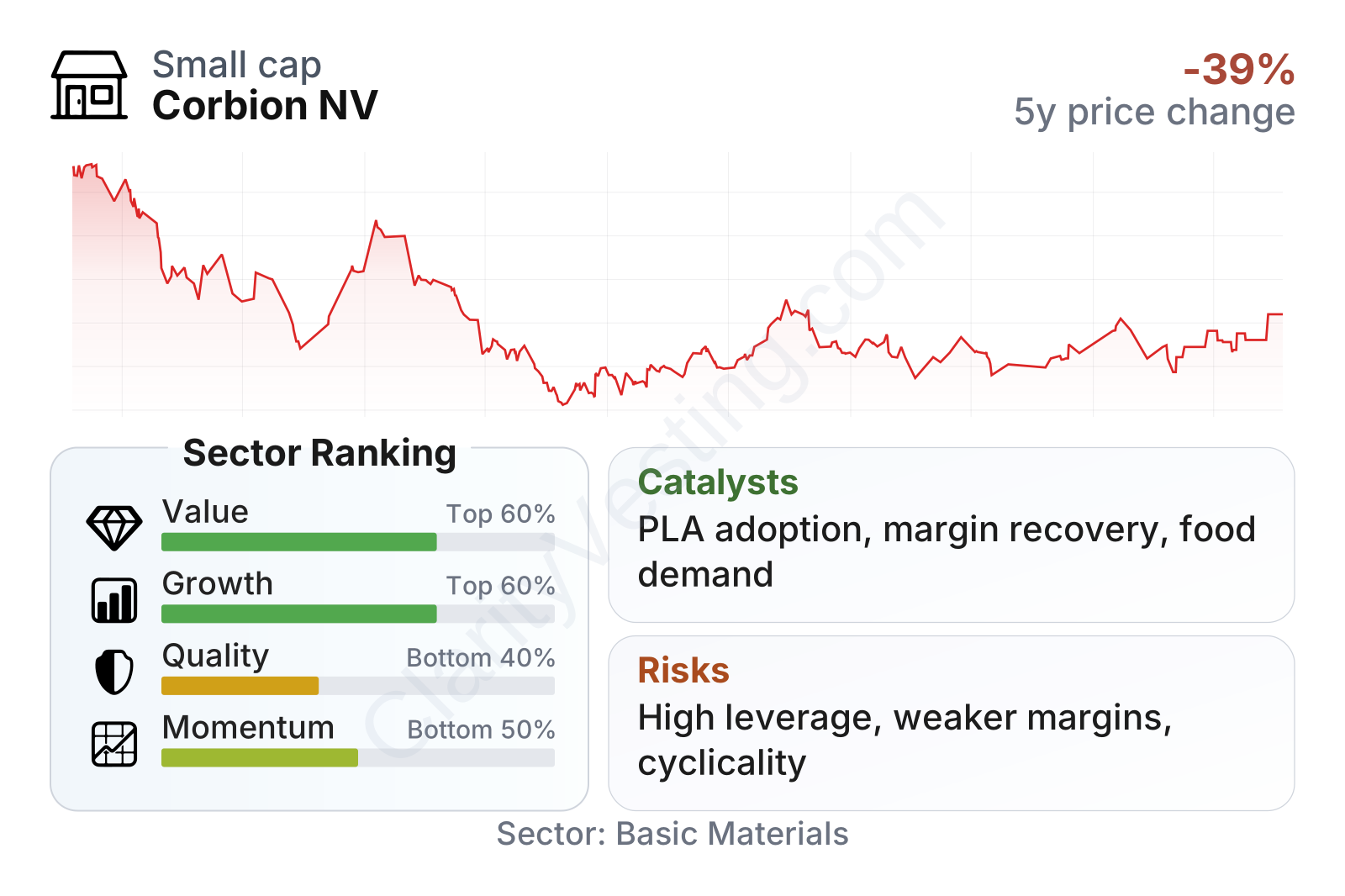
Corbion is a mid-sized specialty chemicals company with a share price that remains far below its 2021 level, even after a recovery over the last two years. That backdrop helps explain the current profile: valuation looks only moderately above sector averages on earnings and book value, while cash generation appears stronger than many peers. The company ranks relatively well on value and acceptable on growth, but profitability and balance-sheet efficiency lag the sector median.
One useful contrast stands out. Recent revenue growth has been slightly negative, yet the five-year trend in revenue per share is still positive and ahead of the sector median. Operating margins have also improved over five years, even if they remain below the broader specialty chemicals group today. In other words, this is not a fast-growing company at the moment, but it has shown some ability to rebuild earnings quality after a difficult period.
Free cash flow is a bright spot. The cash flow yield is well above the sector median, and the dividend yield is also somewhat above average. That does not erase the weaker return metrics, but it suggests the business still converts a meaningful share of earnings into cash.
Growth
Corbion operates in markets with attractive long-term demand drivers, although not all of them move at the same speed. Food preservation is supported by global demand for longer shelf life, cleaner labels, and food waste reduction. Health and nutrition benefits from interest in specialized nutrition and alternative sources of omega-3. Sustainable materials is linked to the push for lower-carbon and compostable or biobased packaging, a market that could expand as regulation and customer preferences evolve.
The company’s strategy makes industrial sense because it is built around a common technology base: fermentation and lactic acid chemistry. That allows Corbion to serve multiple end markets with related know-how rather than running unrelated businesses. It also means the company can reuse research, production knowledge, and customer relationships across divisions.
A meaningful catalyst is the ongoing development of biobased materials, especially PLA-related products. This part of the portfolio is smaller than the food ingredients operation, but it addresses a market with stronger structural expansion potential. If adoption rises in packaging, consumer goods, and other applications, Corbion could benefit from both volume growth and greater strategic relevance in sustainable materials.
Another positive sign is that the business has been improving its cost base after the inflationary pressure of recent years. The combination of lower input costs, a more favorable mix, and continued demand in core preservation products could support gradual margin rebuilding. That matters more than short-term revenue swings for a specialty ingredients company, because value creation often depends on pricing power and formulation expertise rather than simple tonnage growth.
Recent company communications have also pointed to portfolio focus and operational discipline rather than empire-building. For a company of Corbion’s size, that is important: growth is more credible when it comes from sharpening the existing platform, improving returns in underperforming areas, and selectively expanding in businesses where the company already has technical depth.
Risks
This article is for informational purposes only and does not constitute financial advice. Some content is AI-generated. See Disclaimer


