Stock Analysis · CSL Ltd (CSLLY)
Overview
CSL Ltd is a global biotechnology company focused on serious and often chronic diseases. Its business is built around plasma-derived therapies, vaccines, and iron deficiency treatments. In practical terms, CSL collects human plasma through a large donor network, turns that plasma into specialized medicines for immune disorders, bleeding disorders, and critical care, and also sells influenza vaccines and kidney disease products through separate divisions.
The company reports through three main operating businesses: CSL Behring, Seqirus, and CSL Vifor. CSL Behring is the core earnings engine and includes immunoglobulins, albumin, hemophilia therapies, and specialty products. Seqirus focuses on influenza vaccines and pandemic preparedness. CSL Vifor adds iron deficiency, nephrology, and cardio-renal products. This mix gives CSL exposure to both defensive hospital and specialty medicine demand and more seasonal vaccine demand.
Based on the latest annual reporting structure, revenue is led by plasma therapies and specialty biopharma, with vaccines and iron deficiency products forming the rest of the group.
- CSL Behring: about 67% to 69% of group revenue. This includes immunoglobulins, albumin, coagulation products, hereditary angioedema treatment, and other plasma-derived therapies.
- Seqirus: about 19% to 21% of revenue. This business includes seasonal influenza vaccines, adjuvanted flu shots for older adults, and pandemic-related preparedness capabilities.
- CSL Vifor: about 12% to 14% of revenue. This includes iron deficiency treatments and therapies linked to nephrology and dialysis care.
That revenue mix matters because it shows CSL is not a single-product company. Even so, plasma remains the center of the business model, and the scale of that operation is difficult for smaller rivals to replicate. Over the last several years, the company has expanded total revenue meaningfully while keeping operating income strong, although the latest period also shows an unusual break between healthy operating profit and negative reported net income, pointing to a one-off or non-operating distortion rather than a collapse in the core business.
Over time, the business has grown from roughly $10 billion in annual revenue to nearly $16 billion, with operating profit also moving higher. The latest period stands out because core operations remained solid, while below-the-line items pushed reported earnings negative. For a long-term view, that makes it important to separate the health of the operating business from accounting noise in a single year.
Key Figures
| Metric | Value | Sector ⓘ |
|---|---|---|
| Date | Oct 24, 2026 | |
| Context | ||
| Sector | Healthcare | |
| Industry | Biotechnology | |
| Market Cap ⓘ | $65.80B | |
| Beta ⓘ | 0.08 | |
Value (Cheapness) | ||
| P/E Ratio ⓘ | N/A | 25.42 |
| P/B Ratio ⓘ | 4.95 | 3.08 |
| FCF Yield ⓘ | 8.30% | 3.12% |
| Dividend Yield ⓘ | 2.07% | 1.85% |
| EBIT / EV ⓘ | 8.22% | 0.56% |
| PEG ⓘ | N/A | |
Growth (Business expansion) | ||
| Revenue Growth ⓘ | 5.50% | 7.50% |
| RPS Growth (5Y CAGR) ⓘ | 30.85% | 8.60% |
| EPS Growth (5Y CAGR) ⓘ | -18.73% | -17.73% |
| BVPS Growth (5Y CAGR) ⓘ | 15.47% | 3.72% |
| Margin Growth (5Y Trend) ⓘ | -2.30% | -0.57% |
| FCF Growth (5Y CAGR) ⓘ | 2.98% | 0.96% |
| DPS Growth (5Y CAGR) ⓘ | 27.75% | 6.69% |
Quality (Business durability) | ||
| ROIC (Latest) ⓘ | N/A | 3.17% |
| ROA (Latest) ⓘ | N/A | 2.98% |
| ROIC (5Y Median) ⓘ | 11.49% | 4.56% |
| ROA (5Y Median) ⓘ | 7.12% | 1.87% |
| Net Debt / EBIT (Latest) ⓘ | 1.51 | 1.34 |
| Net Debt / EBIT (5Y Median) ⓘ | 2.33 | 1.86 |
| Net Debt / EBITDA (Latest) ⓘ | 1.19 | 1.00 |
| Net Debt / Assets ⓘ | 27.89% | 5.06% |
| EBITDA / Interest ⓘ | 11.80 | 9.55 |
| Operating Margin (Latest) ⓘ | 24.37% | 9.25% |
| Operating Margin (5Y Median) ⓘ | 25.64% | 7.33% |
| Debt to Equity (Latest) ⓘ | 73.64% | 26.68% |
| Profit Margin (Latest) ⓘ | -16.33% | 3.34% |
| Free Cash Flow (Latest) ⓘ | $5.46B | |
Momentum (Price trend) | ||
| 3Y Return ⓘ | -2.47% | +51.61% |
| 12M Return (excl. last month) ⓘ | +0.71% | +19.90% |
| 6M Return ⓘ | +50.93% | +10.10% |
| Price vs. 200-Day MA ⓘ | +36.94% | +6.44% |
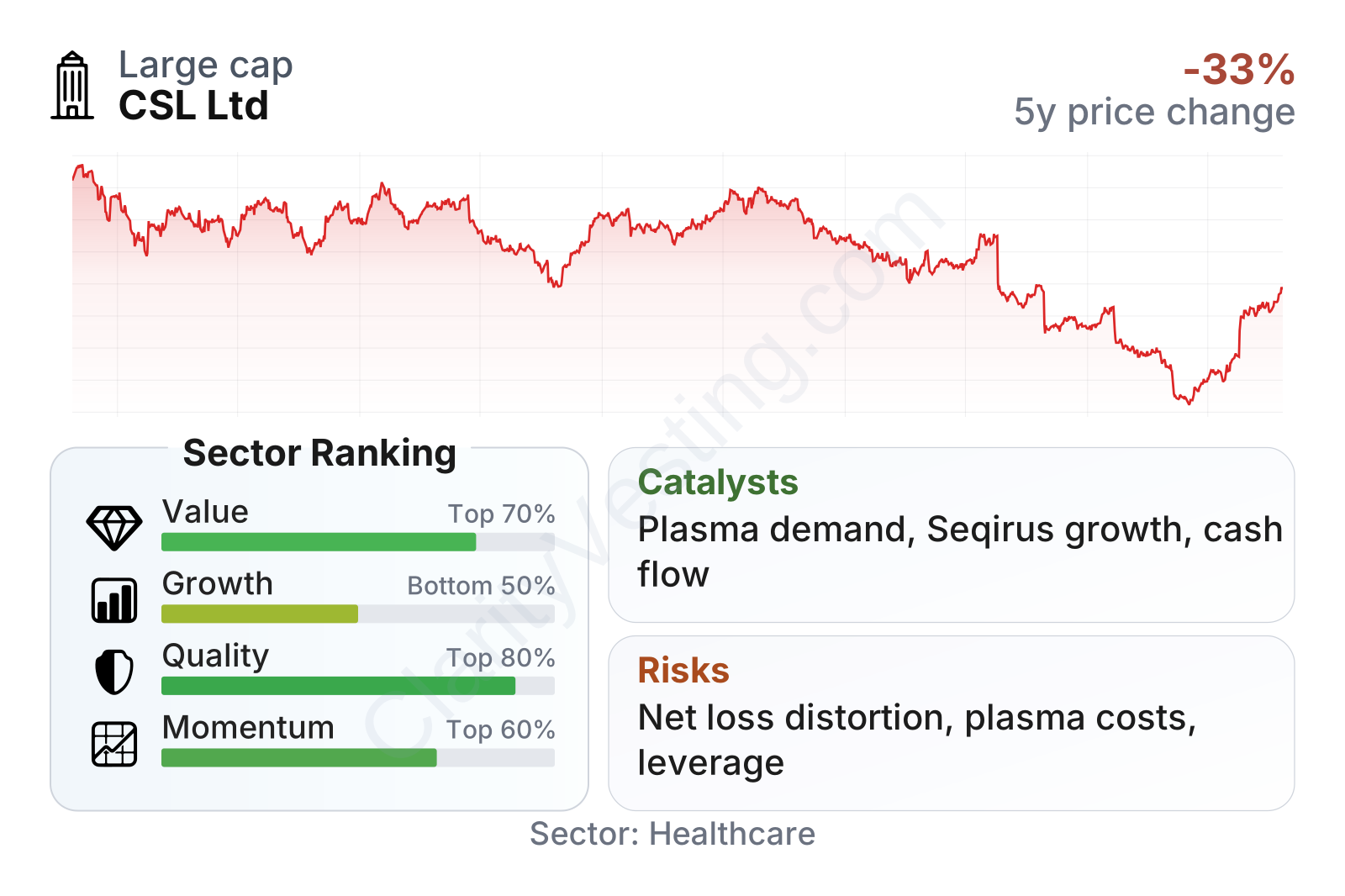
CSL stands out as a large healthcare company with unusually low share-price volatility, which is consistent with its exposure to essential therapies rather than highly speculative drug development. The overall profile is mixed in an interesting way: quality measures are strong relative to much of the healthcare sector, value metrics look favorable on cash flow and operating earnings, and momentum has been weak over longer periods despite a more recent rebound. Growth is more balanced than spectacular, with revenue and cash flow advancing over time, while margin trends have softened from earlier highs.
The stock’s multi-year chart shows that the market has substantially reduced the valuation it once gave CSL. That derating is a major part of the current investment debate: the business has continued to expand, but the share price has moved in the opposite direction over several years.
Growth
CSL operates in parts of healthcare that benefit from durable long-term demand. Plasma-derived medicines are used in chronic immune deficiencies, neurology, hematology, and critical care, where demand tends to be tied more to patient need than to the economic cycle. Influenza vaccines also remain a recurring public health requirement, especially in aging populations. Iron deficiency and kidney-related treatments add another long-duration healthcare demand stream.
The strongest structural growth driver is plasma. Building a plasma network requires donor centers, logistics, fractionation capacity, regulatory compliance, and specialist manufacturing know-how. That creates a barrier to entry and supports industry growth as more patients gain access to immunoglobulin therapies worldwide. CSL has spent years building that infrastructure, which supports future volume growth and can improve economics as utilization rises.
Near-term sales growth appears moderate rather than explosive, but the longer trend is more important. Over five years, revenue per share has grown much faster than the sector median, indicating that CSL has been able to expand its business on a per-share basis even through a difficult operating period for plasma collection after the pandemic.
Cash generation is another positive point. Free cash flow has risen meaningfully in the most recent periods and sits at a strong absolute level, giving the company room to fund research, capacity, debt servicing, and shareholder distributions. That is especially relevant in biotechnology and specialty pharma, where accounting earnings can sometimes be distorted by acquisition accounting, restructuring, or tax effects.
CSL’s strategy for future growth is broadly coherent. It combines expansion in core plasma therapies, support for Seqirus in differentiated flu vaccines, and selective pipeline development in specialty diseases. The Vifor acquisition broadened the company beyond plasma and vaccines, and management has also continued investing in manufacturing and collection capacity. Recent company updates have also pointed to demand resilience for immunoglobulins and continued interest in differentiated vaccine products, which supports the case for steady medium-term expansion rather than one-off growth spikes.
Risks
This article is for informational purposes only and does not constitute financial advice. Some content is AI-generated. See Disclaimer


