Stock Analysis · Carlisle Companies Incorporated (CSL)
Overview
Carlisle Companies Incorporated is a U.S. industrial manufacturer with a strong focus on building products. Over the last several years, the company has simplified its portfolio and concentrated more heavily on commercial roofing and related building-envelope products. In practical terms, Carlisle sells materials that help seal, insulate, protect, and maintain roofs and other parts of commercial buildings. That makes the company closely tied to construction, renovation, repair, and energy-efficiency spending.
The business is now far more concentrated than it used to be. Based on the company’s recent reporting structure, the main sources of revenue are:
- Carlisle Construction Materials (roughly 85% to 90% of revenue) — commercial roofing systems, insulation, underlayments, waterproofing products, metal components, coatings, sealants, and related accessories used in low-slope commercial roofs and building envelopes.
- Carlisle Weatherproofing Technologies (roughly 10% to 15% of revenue) — architectural metals, wall and waterproofing systems, spray foam, and other products aimed at protecting buildings from water, air, and weather intrusion.
This concentration matters because it gives Carlisle a clearer identity than a typical diversified industrial company. Instead of depending on many unrelated markets, it is increasingly a specialized building-products platform with scale in roofing and weatherproofing, where product performance, distribution reach, and contractor relationships are important.
The long-term financial profile also shows a business that has been able to convert a solid share of sales into profit and cash flow. Revenue moved from about $3.8 billion in 2021 to about $5.0 billion in 2025, although the path was not smooth. Profitability improved sharply after 2021, which suggests that pricing, mix, operational discipline, and portfolio changes have had a meaningful impact.
The overall flow of revenue to profit points to a business that has become more efficient than it was a few years ago. Even with some year-to-year volatility, gross profit and operating income remain well above 2021 levels, showing that Carlisle’s reshaped portfolio is structurally more profitable than before.
Key Figures
| Metric | Value | Sector ⓘ |
|---|---|---|
| Date | Oct 24, 2026 | |
| Context | ||
| Sector | Industrials | |
| Industry | Building Products & Equipment | |
| Market Cap ⓘ | $13.49B | |
| Beta ⓘ | 0.83 | |
Value (Cheapness) | ||
| P/E Ratio ⓘ | 18.78 | 22.29 |
| P/B Ratio ⓘ | 8.58 | 1.98 |
| FCF Yield ⓘ | 6.42% | 6.26% |
| Dividend Yield ⓘ | 1.33% | 1.92% |
| EBIT / EV ⓘ | 6.97% | 4.83% |
| PEG ⓘ | 0.90 | |
Growth (Business expansion) | ||
| Revenue Growth ⓘ | 8.30% | 9.30% |
| RPS Growth (5Y CAGR) ⓘ | 12.67% | 7.76% |
| EPS Growth (5Y CAGR) ⓘ | -15.44% | -13.17% |
| BVPS Growth (5Y CAGR) ⓘ | -4.24% | 6.13% |
| Margin Growth (5Y Trend) ⓘ | 5.61% | 0.74% |
| FCF Growth (5Y CAGR) ⓘ | 35.62% | 10.79% |
| DPS Growth (5Y CAGR) ⓘ | 18.66% | 9.41% |
Quality (Business durability) | ||
| ROIC (Latest) ⓘ | 17.51% | 10.75% |
| ROA (Latest) ⓘ | 11.42% | 5.41% |
| ROIC (5Y Median) ⓘ | 16.54% | 9.37% |
| ROA (5Y Median) ⓘ | 12.26% | 4.95% |
| Net Debt / EBIT (Latest) ⓘ | 2.11 | 2.04 |
| Net Debt / EBIT (5Y Median) ⓘ | 1.74 | 2.27 |
| Net Debt / EBITDA (Latest) ⓘ | 1.78 | 1.39 |
| Net Debt / Assets ⓘ | 35.60% | 19.27% |
| EBITDA / Interest ⓘ | 11.93 | 9.58 |
| Operating Margin (Latest) ⓘ | 20.64% | 10.49% |
| Operating Margin (5Y Median) ⓘ | 21.93% | 10.30% |
| Debt to Equity (Latest) ⓘ | 178.39% | 64.82% |
| Profit Margin (Latest) ⓘ | 14.21% | 6.67% |
| Free Cash Flow (Latest) ⓘ | $866.60M | |
Momentum (Price trend) | ||
| 3Y Return ⓘ | +42.86% | +67.77% |
| 12M Return (excl. last month) ⓘ | -4.73% | +12.05% |
| 6M Return ⓘ | -4.24% | 0.00% |
| Price vs. 200-Day MA ⓘ | -2.95% | +0.67% |
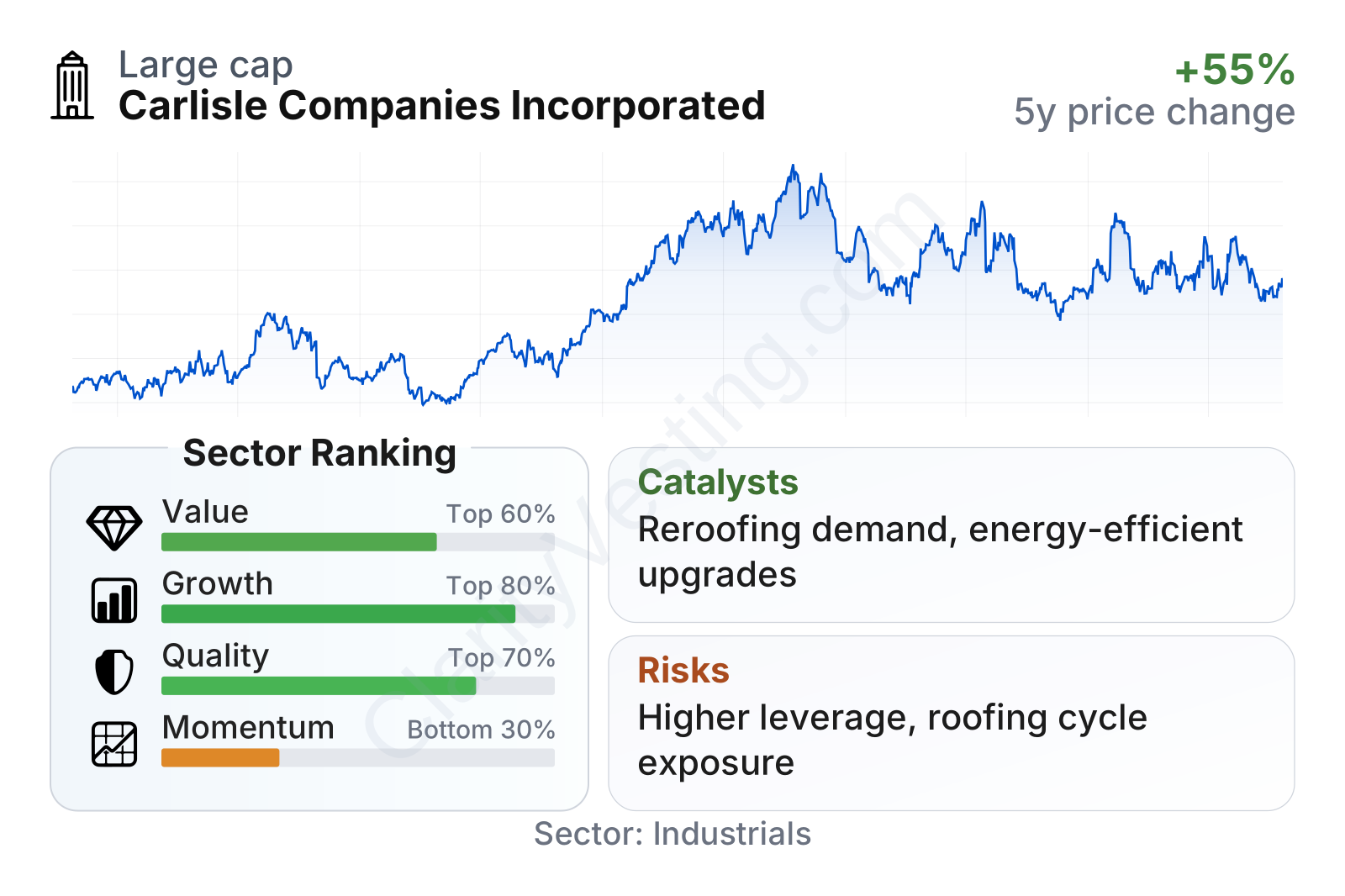
Carlisle stands out more for business quality and cash generation than for recent stock momentum. Profitability metrics are well above the industry median, with operating margin around 21% and profit margin around 14%, both materially stronger than many industrial peers. Returns on capital and assets are also high, which usually points to a business with pricing power, disciplined operations, or both. Growth metrics are mixed in the short term, but the longer view remains stronger, especially in revenue per share and free cash flow. The weaker area is leverage, which has risen noticeably and now sits above sector norms, and the stock’s recent market performance has lagged much of the broader industrial group.
Growth
Carlisle operates in a sector with durable long-term demand drivers. Commercial roofs need recurring repair and replacement, and buildings increasingly require better insulation, waterproofing, and energy performance. Those trends are supported by stricter building standards, rising energy-efficiency expectations, and the simple fact that roofs wear out over time. This makes roofing less dependent on new construction alone than many other building-product categories.
The company’s strategy also appears coherent. Management has spent years reshaping Carlisle into a more focused building-products company, emphasizing higher-margin categories and operational improvement. A narrower portfolio can reduce complexity and allow more investment in the businesses where Carlisle has stronger scale and customer relationships. That focus is especially relevant in commercial roofing, where specification-driven products and contractor familiarity can support repeat demand.
Growth has been uneven from quarter to quarter, which is normal for a company exposed to construction cycles, pricing swings, and weather patterns. The picture shows a surge in 2022, a correction in 2023, then a return to modest growth. More recently, the year-over-year trend has stabilized rather than accelerated sharply, which suggests Carlisle is currently in a more mature phase of expansion rather than a breakout period.
Cash generation remains one of the strongest parts of the case. Free cash flow has stayed at a high level even after coming down from its peak, with the trailing figure still near $0.9 billion. That level of cash creation gives Carlisle room to invest in operations, pursue acquisitions, reduce debt over time, and continue returning capital to shareholders through dividends and repurchases.
A meaningful catalyst is the company’s exposure to reroofing and energy-efficient building upgrades. Commercial roof replacement tends to be more resilient than discretionary construction categories because many projects cannot be postponed indefinitely. Another positive factor is Carlisle’s ability to attach complementary products around the roof and building envelope, which can raise revenue per project and deepen customer dependence on its product suite.
Recent company updates have also continued to emphasize portfolio optimization and operational initiatives. The broader message is that Carlisle is trying to compound growth not only through end-market demand, but also through mix improvement and execution. That tends to be a healthier source of long-term expansion than relying only on construction volume.
Risks
This article is for informational purposes only and does not constitute financial advice. Some content is AI-generated. See Disclaimer