Stock Analysis · Capstone Copper Corp (CSCCF)
Overview
Capstone Copper Corp is a copper mining company focused on producing copper concentrate and copper cathodes, with additional revenue from by-products such as gold, silver, molybdenum, sulfuric acid, and iron concentrate. Its operating base spans the Americas, with key assets in Chile, the United States, and Mexico, and its long-term strategy is centered on increasing copper output from existing mines while advancing a major development project in Chile.
For a simple way to think about the business, Capstone earns most of its money by extracting ore, processing it, and selling copper-bearing products to industrial customers. Copper is the core driver, while by-products help offset costs and support margins when metal prices are favorable.
Based on the company’s recent annual reporting, revenue is heavily concentrated in copper, with by-products playing a smaller but still meaningful role.
- Copper products: approximately 85% to 90% of revenue. This includes copper concentrate and copper cathodes sold from operating mines.
- Gold: approximately 5% to 8% of revenue. Gold is mainly recovered as a by-product from certain copper operations.
- Silver: approximately 1% to 3% of revenue. Like gold, silver is generally a by-product contribution.
- Molybdenum, sulfuric acid, iron concentrate, and other: approximately 3% to 7% of revenue combined, depending on production mix and commodity prices.
The business has become much larger over the past few years. Revenue rose from under $1 billion in 2021 to about $2.4 billion in 2025, but that expansion did not happen in a straight line. Costs increased sharply in 2022 and 2023, profitability weakened, and then results improved materially in 2025 as production and pricing became more supportive.
The operating picture shows a cyclical but improving business. Revenue has expanded strongly over the period, cost of revenue remains the dominant outflow as expected for a miner, and earnings recovered sharply in 2025 after a weak 2023 and only modest profitability in 2024. That pattern suggests the company’s value depends heavily on execution and commodity conditions rather than on steady, predictable margins.
Key Figures
| Metric | Value | Sector ⓘ |
|---|---|---|
| Date | Oct 10, 2026 | |
| Context | ||
| Sector | Basic Materials | |
| Industry | Copper | |
| Market Cap ⓘ | $7.71B | |
| Beta ⓘ | 2.22 | |
Value (Cheapness) | ||
| P/E Ratio ⓘ | 16.54 | 17.36 |
| P/B Ratio ⓘ | 2.40 | 1.73 |
| FCF Yield ⓘ | 3.83% | 5.81% |
| Dividend Yield ⓘ | N/A | 1.98% |
| EBIT / EV ⓘ | N/A | 6.34% |
| PEG ⓘ | N/A | |
Growth (Business expansion) | ||
| Revenue Growth ⓘ | 36.20% | 11.15% |
| RPS Growth (5Y CAGR) ⓘ | 12.60% | 4.49% |
| EPS Growth (5Y CAGR) ⓘ | N/A | -12.80% |
| BVPS Growth (5Y CAGR) ⓘ | 15.92% | 5.49% |
| Margin Growth (5Y Trend) ⓘ | -19.22% | -1.54% |
| FCF Growth (5Y CAGR) ⓘ | -20.69% | 0.20% |
| DPS Growth (5Y CAGR) ⓘ | N/A | 5.91% |
Quality (Business durability) | ||
| ROIC (Latest) ⓘ | N/A | 9.26% |
| ROA (Latest) ⓘ | N/A | 4.92% |
| ROIC (5Y Median) ⓘ | 5.33% | 7.82% |
| ROA (5Y Median) ⓘ | 3.44% | 3.88% |
| Net Debt / EBIT (Latest) ⓘ | N/A | 1.37 |
| Net Debt / EBIT (5Y Median) ⓘ | 1.91 | 1.70 |
| Net Debt / EBITDA (Latest) ⓘ | N/A | 0.92 |
| Net Debt / Assets ⓘ | 9.39% | 13.56% |
| EBITDA / Interest ⓘ | N/A | 12.28 |
| Operating Margin (Latest) ⓘ | N/A | 13.20% |
| Operating Margin (5Y Median) ⓘ | 17.31% | 11.82% |
| Debt to Equity (Latest) ⓘ | N/A | 39.91% |
| Profit Margin (Latest) ⓘ | 17.77% | 6.43% |
| Free Cash Flow (Latest) ⓘ | $295.23M | |
Momentum (Price trend) | ||
| 3Y Return ⓘ | +143.25% | +68.93% |
| 12M Return (excl. last month) ⓘ | +52.71% | +36.53% |
| 6M Return ⓘ | +21.78% | 0.00% |
| Price vs. 200-Day MA ⓘ | -0.87% | -0.18% |
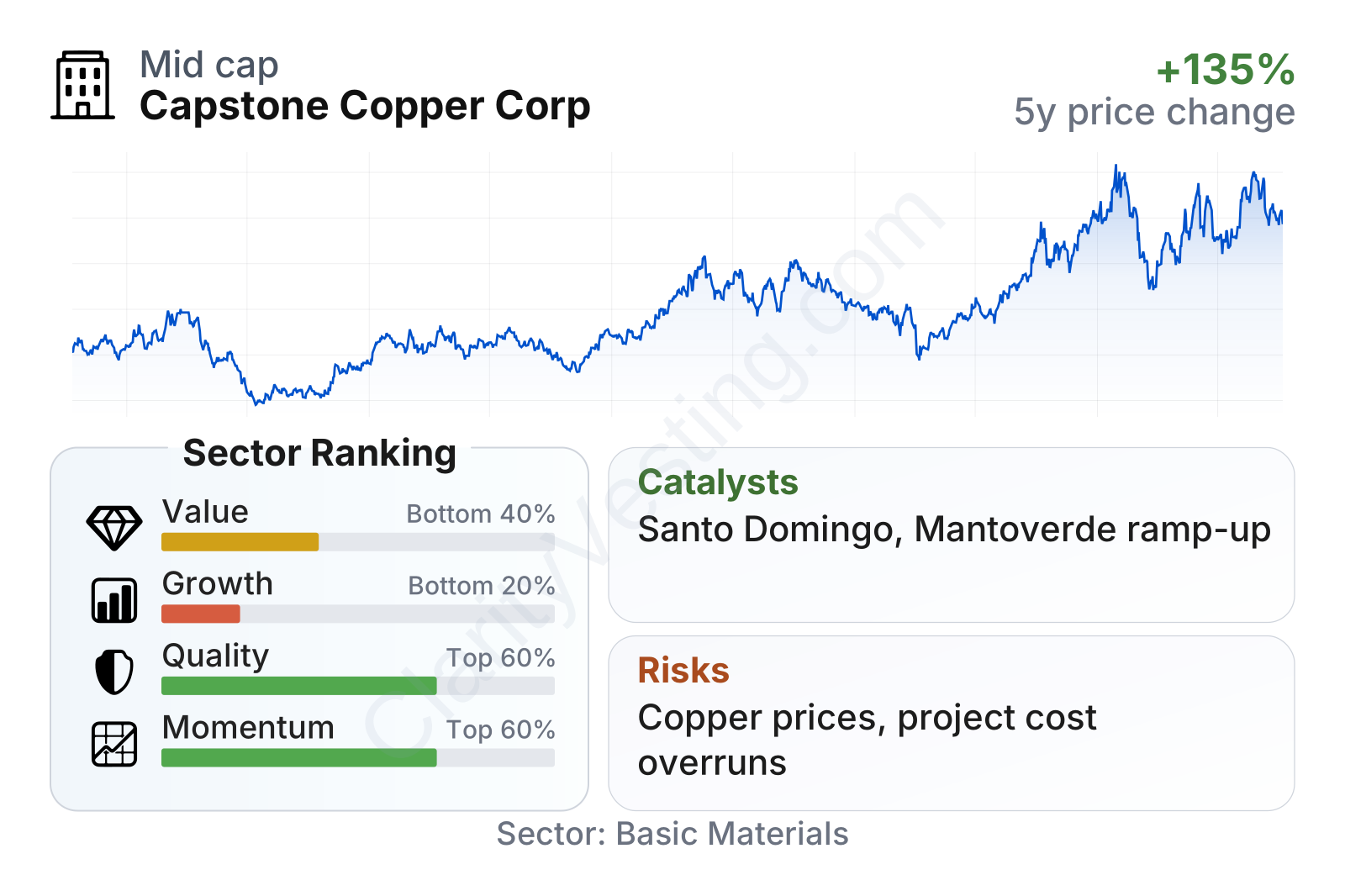
Capstone Copper is now a mid-to-large copper producer by market value, but its stock has behaved like a higher-volatility mining name rather than a defensive materials company. The shares have risen strongly over the last three years, yet the path has been uneven, reflecting copper price swings, project spending, and changing views on future production growth.
On valuation, the stock does not look stretched on earnings alone, with a price-to-earnings ratio slightly below the sector median. However, other measures are less forgiving: the price-to-book ratio sits above the sector median and free cash flow yield is below the sector median, which means the market is giving credit to future growth and better cash generation rather than paying only for current asset value or current cash returns.
The factor profile is mixed in a useful way. Quality sits around the middle of the sector, helped by a solid balance sheet structure and a trailing profit margin that is currently above the sector median. Growth metrics look contradictory at first glance: recent revenue growth has been strong, but longer-term margin and free cash flow trends have been weaker because expansion spending and operational variability have weighed on consistency. Momentum remains favorable relative to many peers, though the stock’s beta above 2 shows that large swings should be expected.
Growth
Copper is widely viewed as a structurally important material for electrification. Power grids, renewable energy, electric vehicles, charging infrastructure, and data center buildouts all require large amounts of copper. That does not guarantee smooth demand every year, but it does support the case that the sector is positioned for long-term relevance rather than decline.
Capstone’s strategy broadly fits that theme. The company is not trying to build a completely new identity; it is doing something easier to understand: increase exposure to copper through mine optimization, brownfield expansions, and the large Santo Domingo project in Chile. Brownfield growth can be attractive because it often uses existing infrastructure and operating knowledge, which can lower risk compared with starting from zero.
Recent top-line growth has been strong. Revenue growth moved back into clearly positive territory through 2024 and 2025, with several quarters showing gains well above the sector median. That improvement suggests the company is already benefiting from a larger operating base and better commercial conditions, not just talking about growth far in the future.
Cash generation has also improved, but this area deserves nuance. Free cash flow was deeply negative during part of the recent investment cycle, then turned positive again. That is common in mining when companies spend heavily to expand production. The key question for long-term analysis is whether today’s spending is building a larger, lower-cost future business. In Capstone’s case, the answer appears directionally positive, especially if new production comes online near management’s targeted timelines and cost ranges.
A major catalyst is the development pipeline in Chile, especially Santo Domingo and the broader Mantoverde-Santo Domingo district approach. Management has described these assets as a platform for materially higher copper production over time, with added exposure to iron and cobalt at Santo Domingo. If the company executes well, the resulting production mix could give Capstone more scale and improve its competitive standing among mid-tier copper producers.
Another favorable point is geographic positioning. Chile remains one of the world’s most important copper jurisdictions. While permitting and infrastructure always matter, operating in an established copper region can be an advantage because labor pools, suppliers, and export channels are already developed. Recent company updates have also highlighted progress in ramping up expansion projects and integrating district-level planning, which supports the view that growth is becoming more tangible.
Risks
This article is for informational purposes only and does not constitute financial advice. Some content is AI-generated. See Disclaimer