Stock Analysis · Crispr Therapeutics AG (CRSP)
Overview
CRISPR Therapeutics AG is a biotechnology company focused on gene editing medicines. Its core technology uses CRISPR/Cas9, a tool designed to edit DNA with the goal of treating diseases at their source rather than only managing symptoms. The company’s pipeline is centered on serious conditions such as sickle cell disease, beta thalassemia, cancer, autoimmune disorders, and certain regenerative medicine applications.
The company is still in the early commercial stage, which means its business model is not yet built on broad, recurring product sales like a mature pharmaceutical company. Revenue has been uneven from year to year because it has depended heavily on collaboration payments, milestone payments, and the early launch phase of its first approved therapy.
Based on recent company reporting, the main revenue sources can be summarized as follows:
- Collaboration and license revenue: approximately 80% to 95% in recent periods. This includes payments from partners tied to research, development work, milestones, and licensing arrangements.
- Product-related revenue and commercial sharing: approximately 5% to 20% in recent periods. This mainly reflects the early commercialization of CASGEVY, the gene-edited therapy developed with Vertex for eligible patients with sickle cell disease and transfusion-dependent beta thalassemia.
- Other revenue: limited. This may include smaller items that are not a major part of the business at this stage.
The main point for long-term readers is that CRISPR Therapeutics is transitioning from a research-driven biotech into a company trying to prove it can turn scientific leadership into durable commercial revenue. That shift is promising, but it is not complete yet, so the income profile remains volatile.
The long-term pattern has been highly irregular. Revenue surged when large collaboration payments were recognized, then dropped sharply when those payments were absent. At the same time, research spending has remained substantial, which is typical for a company still building multiple programs rather than harvesting profits from a large product base.
Key Figures
| Metric | Value | Sector ⓘ |
|---|---|---|
| Date | Oct 24, 2026 | |
| Context | ||
| Sector | Healthcare | |
| Industry | Biotechnology | |
| Market Cap ⓘ | $4.88B | |
| Beta ⓘ | 1.76 | |
Value (Cheapness) | ||
| P/E Ratio ⓘ | N/A | 25.42 |
| P/B Ratio ⓘ | 2.76 | 3.08 |
| FCF Yield ⓘ | -7.66% | 3.12% |
| Dividend Yield ⓘ | N/A | 1.85% |
| EBIT / EV ⓘ | -12.40% | 0.56% |
| PEG ⓘ | -0.21 | |
Growth (Business expansion) | ||
| Revenue Growth ⓘ | 1041.40% | 7.50% |
| RPS Growth (5Y CAGR) ⓘ | -75.79% | 8.60% |
| EPS Growth (5Y CAGR) ⓘ | -29.82% | -17.73% |
| BVPS Growth (5Y CAGR) ⓘ | -8.01% | 3.72% |
| Margin Growth (5Y Trend) ⓘ | N/A | -0.57% |
| FCF Growth (5Y CAGR) ⓘ | N/A | 0.96% |
| DPS Growth (5Y CAGR) ⓘ | N/A | 6.69% |
Quality (Business durability) | ||
| ROIC (Latest) ⓘ | -17.21% | 3.17% |
| ROA (Latest) ⓘ | -18.43% | 2.98% |
| ROIC (5Y Median) ⓘ | -14.83% | 4.56% |
| ROA (5Y Median) ⓘ | -16.38% | 1.87% |
| Net Debt / EBIT (Latest) ⓘ | N/A | 1.34 |
| Net Debt / EBIT (5Y Median) ⓘ | N/A | 1.86 |
| Net Debt / EBITDA (Latest) ⓘ | N/A | 1.00 |
| Net Debt / Assets ⓘ | 18.58% | 5.06% |
| EBITDA / Interest ⓘ | N/A | 9.55 |
| Operating Margin (Latest) ⓘ | -3529.79% | 9.25% |
| Operating Margin (5Y Median) ⓘ | -1036.19% | 7.33% |
| Debt to Equity (Latest) ⓘ | 44.87% | 26.68% |
| Profit Margin (Latest) ⓘ | N/A | 3.34% |
| Free Cash Flow (Latest) ⓘ | -$373.80M | |
Momentum (Price trend) | ||
| 3Y Return ⓘ | +24.66% | +51.61% |
| 12M Return (excl. last month) ⓘ | -4.94% | +19.90% |
| 6M Return ⓘ | -11.40% | +10.10% |
| Price vs. 200-Day MA ⓘ | -5.71% | +6.44% |
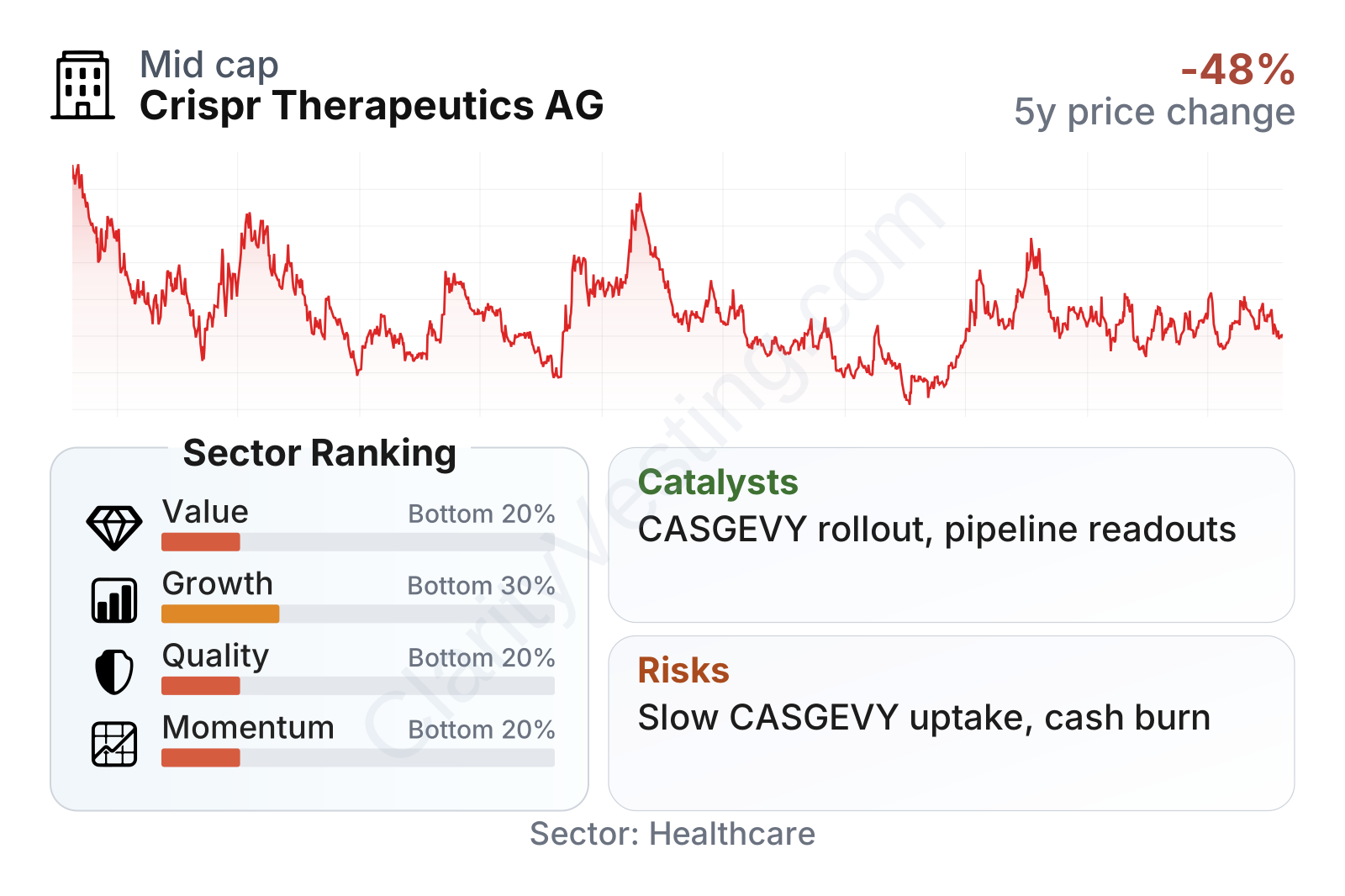
The broad picture is mixed. The company sits in the lower end of the sector on value, growth, and quality measures, largely because profitability remains negative and cash outflows are still meaningful. Momentum is stronger than those fundamentals, suggesting the market has been responding more to pipeline expectations and commercial milestones than to current earnings strength.
CRISPR Therapeutics is a mid-sized biotech by market value, with a stock that has shown high volatility over the past several years. That volatility is not unusual for a gene-editing company, but it matters because market sentiment can move quickly when clinical, regulatory, or launch news changes.
Growth
Gene editing remains one of the most important areas in biotechnology. The sector is attractive because it aims to address diseases at the genetic level, potentially creating one-time or infrequent treatments with large medical value. If that model works at scale, it can be transformative for both patients and the companies involved. CRISPR Therapeutics is directly exposed to that trend.
The company’s strategy is logical for future growth. First, it now has an approved product, CASGEVY, which is a major milestone because very few gene-editing companies have reached commercialization. Second, it continues to invest in a broader pipeline, including oncology and autoimmune programs, which gives it more than one path to long-term expansion. Third, partnerships help spread development costs and can validate the science.
Revenue growth has been dramatic on paper in some periods, but the pattern needs careful interpretation. The swings are mostly the result of milestone timing and low comparison bases rather than steady operating expansion. For a long-term assessment, the more important question is whether commercial adoption of CASGEVY becomes meaningful enough to reduce reliance on collaboration accounting.
Cash generation remains a weak point. Free cash flow has stayed deeply negative, which is common for clinical-stage and early commercial biotech companies, but it shows the company is still consuming capital rather than producing it. The long-term growth case therefore depends on turning scientific progress into actual patient treatment volume and eventually more predictable cash inflows.
The clearest catalyst is the rollout of CASGEVY. This matters not only because it creates a revenue opportunity, but also because it validates the underlying platform in the real world. Beyond that, progress in immuno-oncology, autoimmune disease, and next-generation edited cell therapies could expand the company’s addressable market materially if clinical results remain encouraging.
Recent company updates have continued to emphasize treatment center activation, patient identification, and broader market access efforts for CASGEVY, alongside pipeline advancement. For a company at this stage, those operational steps are just as important as scientific headlines because they determine whether regulatory success can become commercial traction.
Risks
This article is for informational purposes only and does not constitute financial advice. Some content is AI-generated. See Disclaimer


