Stock Analysis · Carpenter Technology Corporation (CRS)
Overview
Carpenter Technology Corporation is a U.S. producer of specialty metals and performance alloys. In simple terms, it makes advanced steel, titanium, nickel, cobalt, and other engineered materials designed for demanding uses where standard metals are not good enough. Its products are used in aircraft engines, fasteners, medical implants, energy equipment, industrial tools, transportation components, and defense applications.
The company’s business is built around materials that must handle high heat, pressure, corrosion, fatigue, or strict purity requirements. That pushes Carpenter away from commodity metals and toward higher-value applications where technical know-how, certification history, and long customer qualification cycles matter a great deal.
Based on the latest annual filing, revenue is concentrated in two operating segments, with a much larger contribution from the specialty alloys business.
- Specialty Alloys Operations: about 88% of fiscal 2026 net sales. This segment includes premium specialty alloys, stainless steels, titanium products, powder metals, and process solutions sold mainly into aerospace and defense, medical, energy, transportation, and industrial markets.
- Performance Engineered Products: about 12% of fiscal 2026 net sales. This business mainly produces high-performance engineered metal products such as precision components, including products used in medical and industrial applications.
End-market exposure is also important because Carpenter’s results are closely tied to where demand is strongest. Aerospace and defense has become the company’s main engine, with medical and broader industrial demand adding diversification. The recent financial progression also shows a notable change in mix: sales have grown, but profitability has improved even faster, suggesting the company is selling more high-value products rather than merely shipping higher volumes.
Over the last several years, the business has shifted from thin or negative profitability to much stronger earnings power. Revenue has risen steadily, but the more striking change is the expansion in gross profit and operating income, while interest expense has fallen. That combination points to better pricing, richer product mix, and a healthier balance sheet.
Key Figures
| Metric | Value | Sector ⓘ |
|---|---|---|
| Date | Oct 24, 2026 | |
| Context | ||
| Sector | Industrials | |
| Industry | Metal Fabrication | |
| Market Cap ⓘ | $18.46B | |
| Beta ⓘ | 1.29 | |
Value (Cheapness) | ||
| P/E Ratio ⓘ | 35.99 | 22.29 |
| P/B Ratio ⓘ | 8.33 | 1.98 |
| FCF Yield ⓘ | 1.96% | 6.26% |
| Dividend Yield ⓘ | 0.21% | 1.92% |
| EBIT / EV ⓘ | 3.49% | 4.83% |
| PEG ⓘ | 1.59 | |
Growth (Business expansion) | ||
| Revenue Growth ⓘ | 12.60% | 9.30% |
| RPS Growth (5Y CAGR) ⓘ | 13.12% | 7.76% |
| EPS Growth (5Y CAGR) ⓘ | N/A | -13.17% |
| BVPS Growth (5Y CAGR) ⓘ | 12.66% | 6.13% |
| Margin Growth (5Y Trend) ⓘ | 23.20% | 0.74% |
| FCF Growth (5Y CAGR) ⓘ | N/A | 10.79% |
| DPS Growth (5Y CAGR) ⓘ | -0.27% | 9.41% |
Quality (Business durability) | ||
| ROIC (Latest) ⓘ | 20.46% | 10.75% |
| ROA (Latest) ⓘ | 14.63% | 5.41% |
| ROIC (5Y Median) ⓘ | 11.07% | 9.37% |
| ROA (5Y Median) ⓘ | 5.88% | 4.95% |
| Net Debt / EBIT (Latest) ⓘ | 0.43 | 2.04 |
| Net Debt / EBIT (5Y Median) ⓘ | 1.38 | 2.27 |
| Net Debt / EBITDA (Latest) ⓘ | 0.35 | 1.39 |
| Net Debt / Assets ⓘ | 7.75% | 19.27% |
| EBITDA / Interest ⓘ | 22.25 | 9.58 |
| Operating Margin (Latest) ⓘ | 22.21% | 10.49% |
| Operating Margin (5Y Median) ⓘ | 10.04% | 10.30% |
| Debt to Equity (Latest) ⓘ | 31.01% | 64.82% |
| Profit Margin (Latest) ⓘ | 16.96% | 6.67% |
| Free Cash Flow (Latest) ⓘ | $362.30M | |
Momentum (Price trend) | ||
| 3Y Return ⓘ | +514.10% | +67.77% |
| 12M Return (excl. last month) ⓘ | +68.38% | +12.05% |
| 6M Return ⓘ | -15.99% | 0.00% |
| Price vs. 200-Day MA ⓘ | -17.17% | +0.67% |
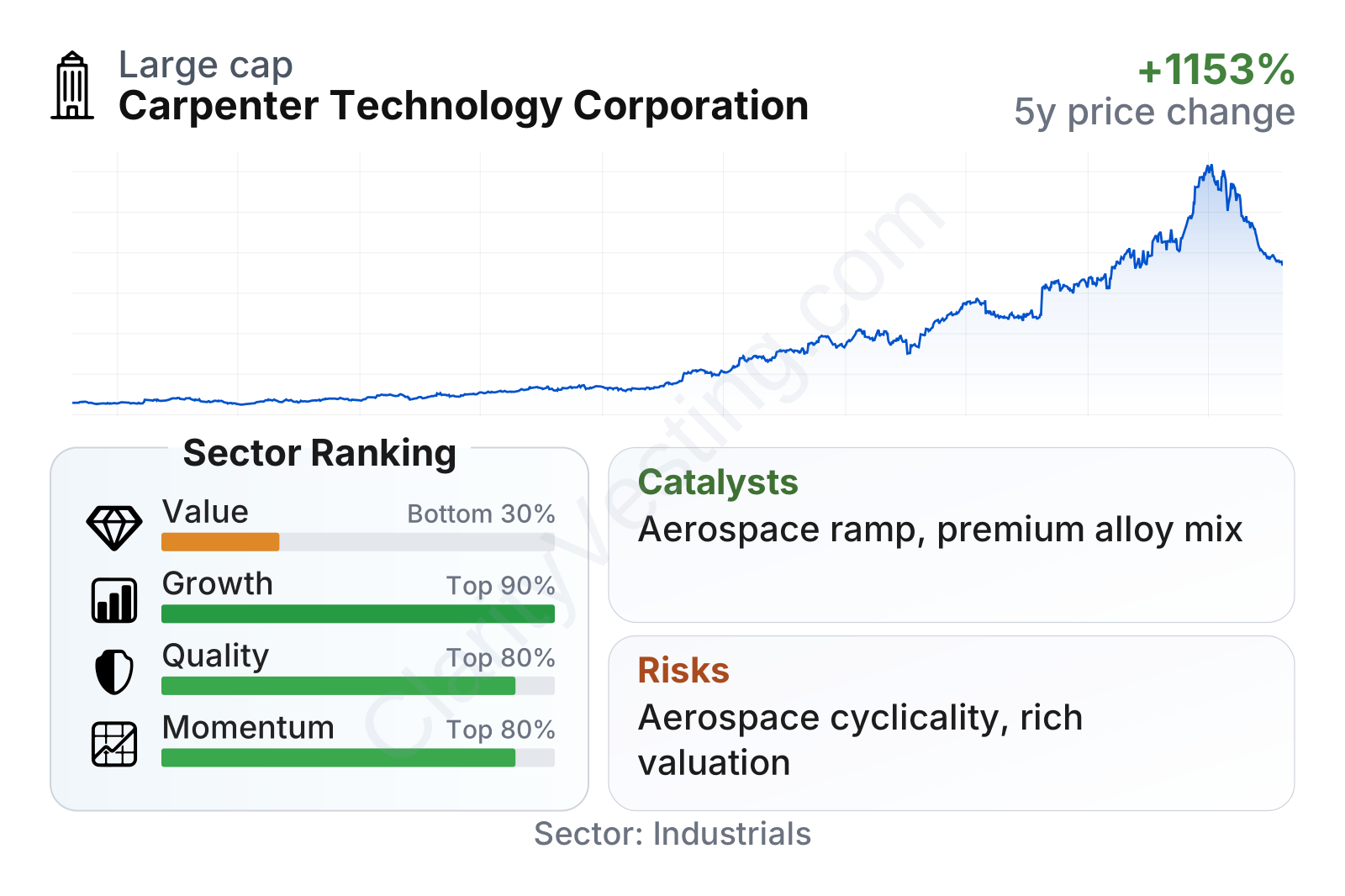
Carpenter now sits in the larger range of industrial companies by market value, but the stock’s movements have been much more intense than the average industrial name. The metrics table shows a business that currently ranks well on growth, quality, and market performance, while screening weaker on classic value measures. In plain language, the market is paying a premium for stronger margins, improving returns on capital, and a major earnings turnaround.
The stock price has climbed sharply over the last three years, far outpacing the broader industrial median in the underlying comparison. At the same time, leverage looks moderate and interest coverage is strong, which helps explain why the company’s quality profile has improved so much. The trade-off is that valuation multiples now stand above sector norms, leaving less room for disappointment.
Growth
Carpenter operates in a part of the materials sector that benefits from long-term demand for lighter, stronger, and more heat-resistant metals. That is a favorable place to be. Aerospace remains one of the clearest structural growth markets for specialty alloys because engine makers and airframe suppliers need certified materials that can perform under extreme conditions, and production increases often flow through the supply chain over multiple years.
The company’s strategy appears coherent with that backdrop. Management has spent several years pushing the portfolio toward premium alloys and powder products, especially those tied to aerospace, defense, and medical uses. Those markets typically offer better margins than standard industrial metal products because customers care more about performance, traceability, and qualification history than about the lowest possible input cost.
Revenue growth has cooled from the exceptional rebound rates seen earlier in the cycle, but it remains positive and still sits above the sector median on the latest reading. More importantly, margin improvement has continued even when sales growth was less dramatic. That usually indicates a healthier business model rather than a short-lived volume spike.
Cash generation has improved materially as well. Free cash flow was negative a few years ago and has since turned strongly positive, reflecting better profitability and stronger operating execution. For a metals producer, that matters because these businesses can consume a lot of cash when demand weakens or working capital expands too quickly. Carpenter’s recent trajectory shows the opposite direction.
A key catalyst is the continued aerospace production ramp, especially in engine-related materials and components where Carpenter has technical capabilities and entrenched customer relationships. Defense demand also adds support, particularly as governments continue to prioritize supply-chain resilience and domestic industrial capacity for strategic materials.
Another meaningful opportunity is in additive manufacturing and powder metals. Carpenter has invested in premium metal powders and high-performance materials that fit advanced manufacturing applications. This is still not the largest part of the business, but it aligns well with industries that require complex parts, low waste, and exact material properties.
Recent company communications have also highlighted strong demand in aerospace and defense, continued operational gains, and progress in converting that demand into higher earnings. The latest annual results reinforce the idea that Carpenter is not only benefiting from a favorable market, but also executing well inside that market.
Risks
This article is for informational purposes only and does not constitute financial advice. Some content is AI-generated. See Disclaimer


