Stock Analysis · Cronos Group Inc (CRON)
Overview
Cronos Group Inc is a cannabis company focused on developing, producing, marketing, and selling cannabinoid products. Its business spans adult-use cannabis, medical cannabis, and cannabinoid-derived consumer products. Geographically, the company is most exposed to Canada and Israel, while also pursuing broader international opportunities through distribution, brand development, and technology aimed at differentiated cannabis products.
Cronos operates with a brand-led strategy. Its portfolio includes dried flower, pre-rolls, vapes, edibles, oils, and other derivative products in recreational cannabis, while medical sales rely on regulated patient channels. The company has also invested in cannabinoid research and product development to improve consistency, formats, and margins over time.
Based on recent annual reporting, Cronos’ revenue is concentrated in a few main sources:
- Adult-use cannabis sales in Canada: approximately 70% to 80% of revenue. This includes branded recreational products such as flower, pre-rolls, vapes, and edibles sold through provincial distributors and retailers.
- International cannabis sales, mainly Israel: approximately 15% to 25% of revenue. This primarily reflects sales of cannabis products into medical and other regulated international channels.
- Other revenue, including cannabis flower, extracts, and smaller ancillary streams: typically a low single-digit to low double-digit share depending on the period.
The broad trend is more important than exact mix shifts: Cronos remains a relatively small cannabis operator, but one that has been improving revenue scale while tightening costs. Revenue rose from about $65 million in 2021 to about $149 million in 2025, and the business moved from deeply negative gross profit several years ago to much healthier gross profit more recently. That shift suggests the company is becoming more disciplined operationally, even if earnings are still uneven.
The multi-year picture shows a meaningful improvement in the income structure. Revenue has expanded, gross profit has turned clearly positive, and selling expenses have come down from earlier peaks. Even so, operating income remained negative in 2025, which means Cronos is still in the transition from restructuring to consistently profitable operations.
Key Figures
| Metric | Value | Sector ⓘ |
|---|---|---|
| Date | Oct 17, 2026 | |
| Context | ||
| Sector | Healthcare | |
| Industry | Drug Manufacturers - Specialty & Generic | |
| Market Cap ⓘ | $1.16B | |
| Beta ⓘ | 1.20 | |
Value (Cheapness) | ||
| P/E Ratio ⓘ | 16.63 | 24.79 |
| P/B Ratio ⓘ | 1.21 | 3.08 |
| FCF Yield ⓘ | 4.27% | 3.15% |
| Dividend Yield ⓘ | N/A | 1.94% |
| EBIT / EV ⓘ | -0.62% | 0.57% |
| PEG ⓘ | N/A | |
Growth (Business expansion) | ||
| Revenue Growth ⓘ | 58.40% | 7.45% |
| RPS Growth (5Y CAGR) ⓘ | 22.08% | 8.61% |
| EPS Growth (5Y CAGR) ⓘ | N/A | -17.81% |
| BVPS Growth (5Y CAGR) ⓘ | -6.96% | 3.72% |
| Margin Growth (5Y Trend) ⓘ | N/A | -0.62% |
| FCF Growth (5Y CAGR) ⓘ | N/A | 1.04% |
| DPS Growth (5Y CAGR) ⓘ | N/A | 6.77% |
Quality (Business durability) | ||
| ROIC (Latest) ⓘ | 0.61% | 3.24% |
| ROA (Latest) ⓘ | 5.92% | 3.01% |
| ROIC (5Y Median) ⓘ | -6.02% | 4.60% |
| ROA (5Y Median) ⓘ | -6.29% | 1.89% |
| Net Debt / EBIT (Latest) ⓘ | -18.46 | 1.34 |
| Net Debt / EBIT (5Y Median) ⓘ | N/A | 1.84 |
| Net Debt / EBITDA (Latest) ⓘ | -40.99 | 1.00 |
| Net Debt / Assets ⓘ | -39.47% | 5.45% |
| EBITDA / Interest ⓘ | N/A | 9.64 |
| Operating Margin (Latest) ⓘ | -1.28% | 9.27% |
| Operating Margin (5Y Median) ⓘ | -91.60% | 7.38% |
| Debt to Equity (Latest) ⓘ | 0.12% | 28.58% |
| Profit Margin (Latest) ⓘ | 39.08% | 3.59% |
| Free Cash Flow (Latest) ⓘ | $49.72M | |
Momentum (Price trend) | ||
| 3Y Return ⓘ | +70.21% | +42.80% |
| 12M Return (excl. last month) ⓘ | +25.49% | +18.50% |
| 6M Return ⓘ | +17.65% | +7.57% |
| Price vs. 200-Day MA ⓘ | +13.59% | +5.12% |
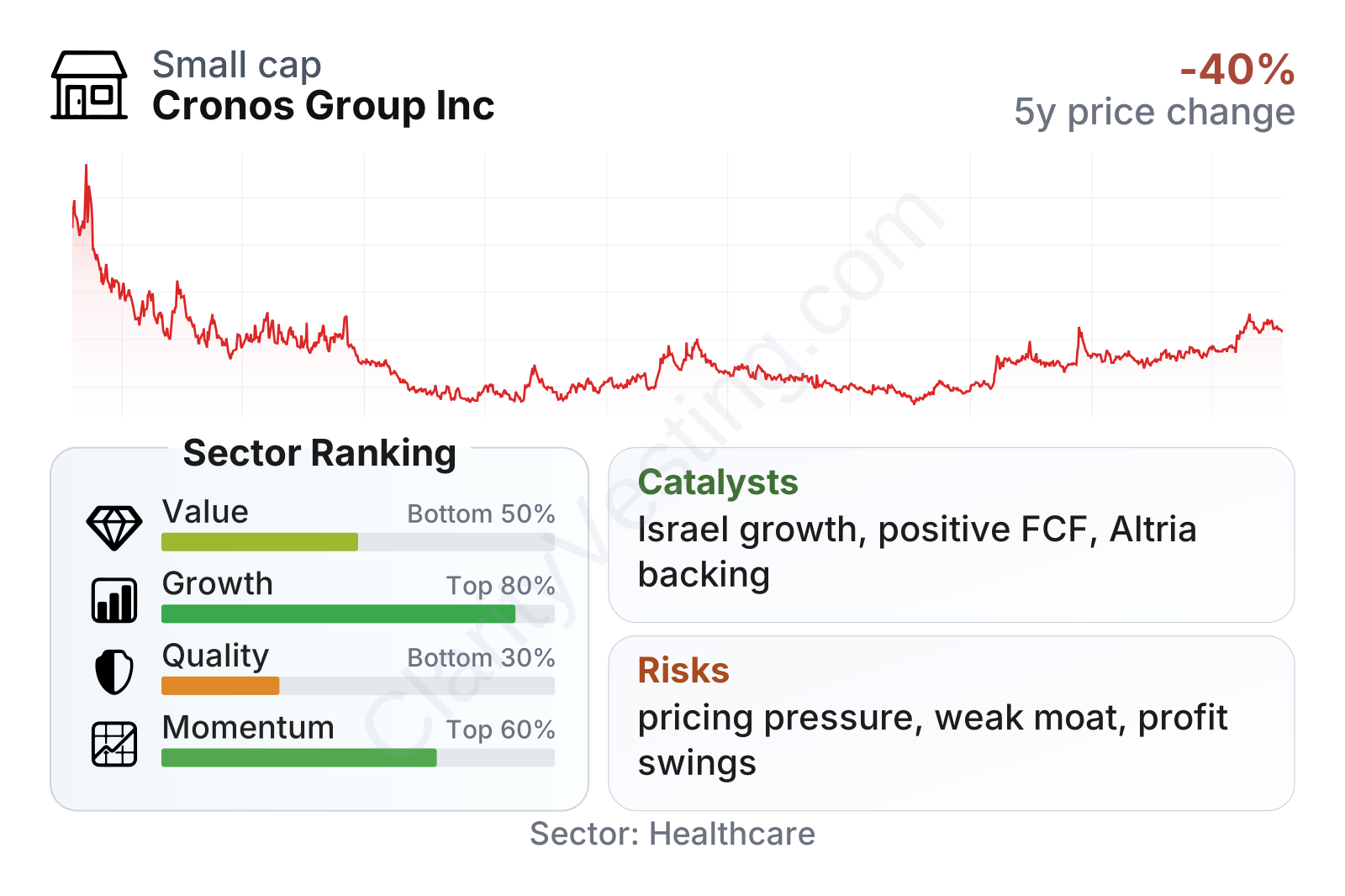
Cronos looks unusual at first glance: growth and recent market performance rank well versus much of the healthcare sector, while business quality is still mixed because the long-term record includes several years of weak profitability. The balance sheet stands out positively. Debt is close to negligible, cash generation has turned positive, and valuation multiples sit below sector medians on earnings and book value. That combination gives the company more flexibility than many cannabis peers, but it does not fully remove execution risk.
The stock history also reflects that tension. Shares fell sharply from 2021 into 2023, then stabilized and recovered part of the decline. That pattern usually signals a business that has moved past its worst operating phase but has not yet convinced the market that steady profitability is firmly established.
Growth
The cannabis industry is still a growth market in the long run, but it is not a simple one. Demand expansion is supported by gradual legalization, product innovation, and the shift from illicit to regulated channels. At the same time, many cannabis companies have struggled with oversupply, price pressure, and changing regulation. For Cronos, the relevant question is not whether cannabis demand can grow, but whether the company can grow while protecting margins better than it did in the past.
Cronos’ recent operating direction is encouraging. Revenue growth has reaccelerated strongly after a softer 2023 period, and the latest year-over-year figures show growth well above the broader healthcare median. The company’s five-year revenue-per-share trend is also strong, which suggests the business has expanded its commercial footprint rather than merely benefiting from one temporary spike.
A notable point is that growth has become stronger as the company’s cost structure has improved. In 2025, annual revenue moved to roughly $149 million, well above the prior year, and quarterly growth in 2026 remained elevated. That suggests demand for Cronos’ products is improving, especially in its core recreational lineup and international channels.
Free cash flow is another sign of progress. After extended periods of cash burn, the trailing figure turned positive, which matters because cannabis companies often depend on external capital when operations do not fund themselves.
The positive swing in cash generation is important strategically. It gives Cronos more room to invest in brands, innovation, and international distribution without relying heavily on debt or repeated equity financing. In a sector where many peers remain financially constrained, that is a real operating advantage.
One additional catalyst is industry structure. Cronos has kept a cleaner balance sheet than many cannabis rivals and has the support of a major strategic shareholder, Altria. That does not guarantee a breakthrough, but it improves access to commercial expertise, regulatory know-how, and long-term optionality if the cannabis market opens further in the United States or other large jurisdictions. More immediately, continued expansion in Canada’s derivative categories and international medical markets could support further growth if execution remains disciplined.
Risks
This article is for informational purposes only and does not constitute financial advice. Some content is AI-generated. See Disclaimer


