Stock Analysis · Charles River Laboratories (CRL)
Overview
Charles River Laboratories is a specialized services company that supports drug research and development. Its customers are mainly pharmaceutical companies, biotechnology firms, and academic or government research groups. In simple terms, Charles River helps customers move potential medicines from very early discovery work into preclinical testing, manufacturing support, and certain clinical-stage activities. The company is deeply embedded in the outsourced research ecosystem, which makes it an important partner for customers that want to avoid building every capability in-house.
The business is organized into three main segments. Based on the company’s latest annual filing for 2025, revenue is spread across these activities in roughly the following order:
- Discovery and Safety Assessment: about 61% of revenue. This is the largest business and includes discovery support, toxicology, safety testing, pharmacology, and other preclinical services used before human trials.
- Research Models and Services: about 22% of revenue. This segment includes research models, related services, and products used in laboratory research environments.
- Manufacturing Solutions: about 17% of revenue. This business includes microbial solutions, biologics testing, cell and gene therapy support, and other products and services used in pharmaceutical manufacturing and quality control.
That mix matters because it shows Charles River is not just a laboratory animal supplier, which is how some people still think of the company. Most of its revenue now comes from higher-value outsourced research and testing work. Over the last several years, acquisitions broadened the platform, but they also increased complexity and debt. More recently, the company has been dealing with weaker biotech funding, customer cost controls, and softer demand in some early-stage research areas.
Looking at the income flow over the last five years, revenue climbed from roughly $3.5 billion in 2021 to just above $4.0 billion in 2025, but profitability compressed sharply. Gross profit and operating income were much stronger in 2022 and 2023 than in 2024 and 2025, showing that the recent issue has not been scale alone, but margin pressure.
Key Figures
| Metric | Value | Sector ⓘ |
|---|---|---|
| Date | Oct 03, 2026 | |
| Context | ||
| Sector | Healthcare | |
| Industry | Diagnostics & Research | |
| Market Cap ⓘ | $14.21B | |
| Beta ⓘ | 1.41 | |
Value (Cheapness) | ||
| P/E Ratio ⓘ | N/A | 24.06 |
| P/B Ratio ⓘ | 4.98 | 3.08 |
| FCF Yield ⓘ | 2.61% | 3.07% |
| Dividend Yield ⓘ | N/A | 2.05% |
| EBIT / EV ⓘ | -0.48% | 0.63% |
| PEG ⓘ | 0.12 | |
Growth (Business expansion) | ||
| Revenue Growth ⓘ | -2.70% | 7.50% |
| RPS Growth (5Y CAGR) ⓘ | 4.15% | 8.70% |
| EPS Growth (5Y CAGR) ⓘ | -18.88% | -18.20% |
| BVPS Growth (5Y CAGR) ⓘ | 6.33% | 3.95% |
| Margin Growth (5Y Trend) ⓘ | -15.48% | -0.58% |
| FCF Growth (5Y CAGR) ⓘ | -0.64% | 0.88% |
| DPS Growth (5Y CAGR) ⓘ | N/A | 6.80% |
Quality (Business durability) | ||
| ROIC (Latest) ⓘ | -2.60% | 3.29% |
| ROA (Latest) ⓘ | -3.17% | 3.02% |
| ROIC (5Y Median) ⓘ | 9.94% | 4.75% |
| ROA (5Y Median) ⓘ | 6.01% | 1.93% |
| Net Debt / EBIT (Latest) ⓘ | N/A | 1.33 |
| Net Debt / EBIT (5Y Median) ⓘ | 5.34 | 1.83 |
| Net Debt / EBITDA (Latest) ⓘ | 12.86 | 0.99 |
| Net Debt / Assets ⓘ | 37.65% | 5.33% |
| EBITDA / Interest ⓘ | 2.07 | 9.63 |
| Operating Margin (Latest) ⓘ | -1.94% | 9.25% |
| Operating Margin (5Y Median) ⓘ | 15.67% | 7.80% |
| Debt to Equity (Latest) ⓘ | 106.62% | 28.99% |
| Profit Margin (Latest) ⓘ | -5.96% | 3.60% |
| Free Cash Flow (Latest) ⓘ | $370.61M | |
Momentum (Price trend) | ||
| 3Y Return ⓘ | +48.32% | +37.48% |
| 12M Return (excl. last month) ⓘ | +72.89% | +20.85% |
| 6M Return ⓘ | +64.00% | +9.73% |
| Price vs. 200-Day MA ⓘ | +36.91% | +4.69% |
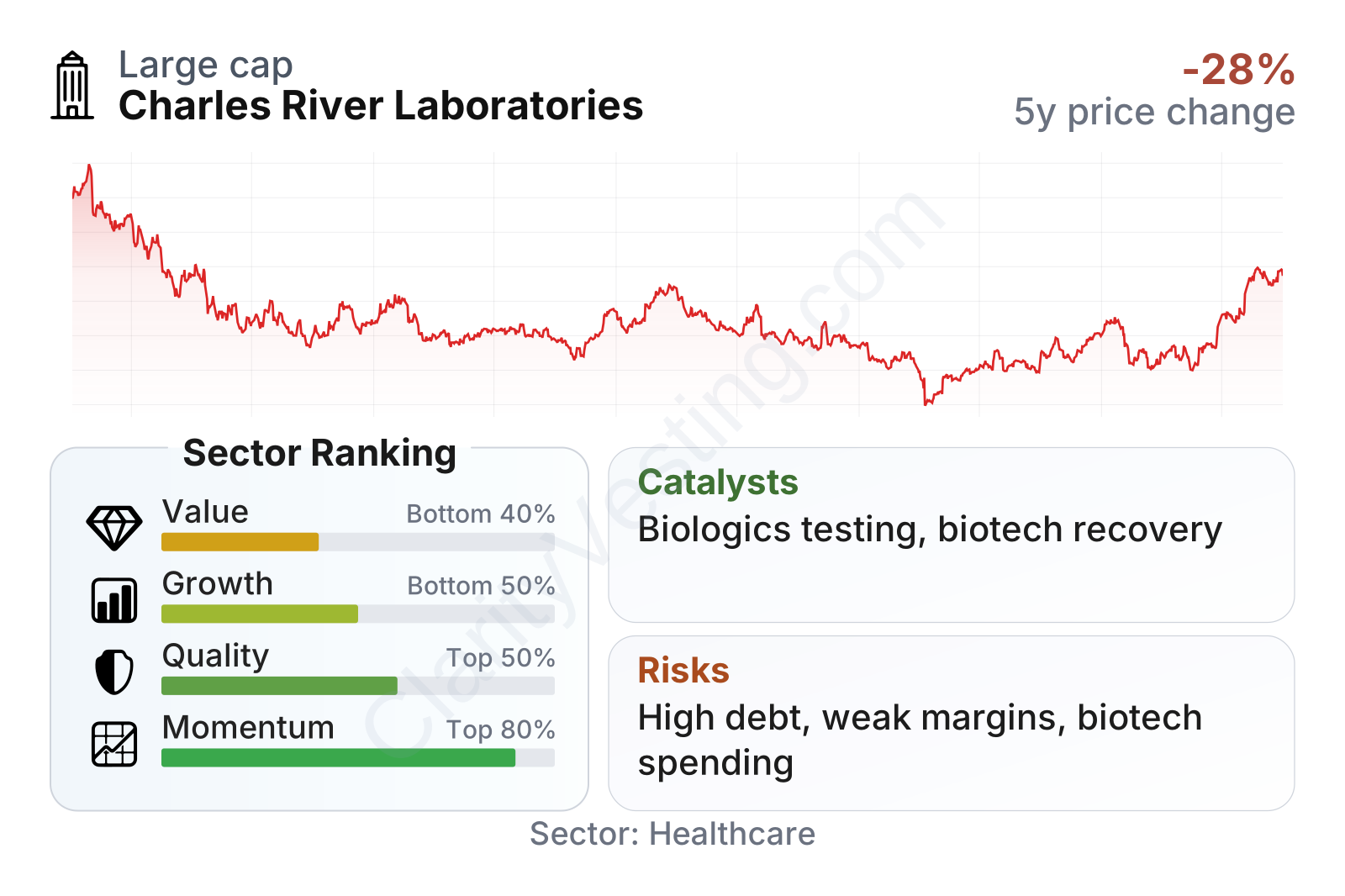
Charles River is a large mid-cap healthcare services company with a stock that has been much more volatile than the average defensive healthcare name. The recent share-price recovery has been strong, but the operating picture remains mixed. On the factor table, momentum stands out as a clear strength, while value and growth look weaker relative to the broader healthcare sector.
The quality profile also needs nuance. Historically, the company generated solid returns on capital and stronger-than-sector operating margins, which points to a business that was once structurally attractive. But the latest trailing figures are much weaker, including negative operating profitability and weak recent returns. In other words, the company’s long-term economics have looked better than its current snapshot.
Growth
Charles River operates in a sector with durable long-term demand drivers. Drug development continues to expand as large pharmaceutical companies replenish pipelines, biologic drugs become more complex, and smaller biotech companies increasingly outsource specialized work. These trends generally support contract research organizations and testing providers. The broad sector logic is still intact: developing medicines is expensive, technically demanding, and heavily regulated, so external partners remain important.
Where things become less straightforward is timing. Charles River has been growing in an attractive industry, but near-term growth has slowed meaningfully. Revenue growth was strong in 2021 through 2023, then turned negative across much of 2024 and 2025, with only limited signs of stabilization more recently. That pattern suggests the company is navigating a cyclical slowdown rather than participating in a clean growth acceleration today.
The company’s strategy still makes sense on paper. It has built an end-to-end platform across discovery, safety, and manufacturing support, which can make it more useful to customers that prefer fewer vendors. It also has meaningful exposure to biologics and cell and gene therapy tools, both of which remain attractive niches over the long run. If biotech funding and preclinical activity recover, Charles River is positioned to participate because it already has the infrastructure and customer relationships in place.
Cash generation provides a more stable signal than earnings right now. Free cash flow remains positive even after the earnings downturn, which suggests the underlying business still has resilience despite weak margins. Free cash flow has come down from peak levels but has not collapsed, an important distinction for a company currently working through a reset.
A notable recent opportunity is the company’s effort to refocus operations, reduce costs, and emphasize segments with better long-term demand such as biologics testing and manufacturing-related services. Management has also highlighted booking trends and customer engagement as areas to watch. If order activity improves, the operating model could show meaningful upside because fixed-cost businesses often recover margins quickly once volume returns.
Risks
This article is for informational purposes only and does not constitute financial advice. Some content is AI-generated. See Disclaimer