Stock Analysis · Comstock Resources Inc (CRK)
Overview
Comstock Resources is a U.S. natural gas producer focused mainly on the Haynesville shale in North Louisiana and East Texas. In simple terms, the company drills wells, produces natural gas, and sells that gas into the market. It also produces smaller amounts of crude oil and natural gas liquids, but gas is clearly the center of the business.
Its revenue is tied mostly to commodity sales, so results can change a lot depending on natural gas prices, production volumes, and hedging activity. Based on recent annual filings, the business mix is heavily concentrated in natural gas production.
- Natural gas sales: approximately 85% to 95% of revenue in recent periods. This is the company’s main product and includes gas produced primarily from the Haynesville area.
- Oil and natural gas liquids sales: approximately 5% to 15% of revenue. These are byproducts of production and are much less important than gas.
- Other operating revenue: typically minimal. This can include items linked to marketing or miscellaneous oil and gas operations when reported.
Comstock’s asset base is relatively concentrated compared with larger diversified energy companies. That can be a strength when the Haynesville region is attractive, but it also means company performance depends heavily on one basin and one main commodity.
The business has gone through sharp swings over the last several years. Revenue surged when gas prices were unusually strong, then weakened as prices fell, and later recovered. The overall pattern shows a company with meaningful operating leverage: when pricing improves, earnings can rebound quickly; when pricing weakens, pressure can show up just as fast.
The long-term pattern is highly cyclical rather than steadily linear. Revenue and operating income expanded dramatically in the 2022 gas-price spike, fell hard in 2023 and 2024, and improved again in 2025. That helps explain why Comstock can look very profitable in one phase of the cycle and strained in another.
Key Figures
| Metric | Value | Sector ⓘ |
|---|---|---|
| Date | Oct 17, 2026 | |
| Context | ||
| Sector | Energy | |
| Industry | Oil & Gas E&P | |
| Market Cap ⓘ | $4.17B | |
| Beta ⓘ | 0.51 | |
Value (Cheapness) | ||
| P/E Ratio ⓘ | 7.51 | 15.44 |
| P/B Ratio ⓘ | 2.00 | 1.73 |
| FCF Yield ⓘ | -17.65% | 8.20% |
| Dividend Yield ⓘ | N/A | 3.59% |
| EBIT / EV ⓘ | 12.05% | 7.46% |
| PEG ⓘ | 4.64 | |
Growth (Business expansion) | ||
| Revenue Growth ⓘ | -25.20% | 26.90% |
| RPS Growth (5Y CAGR) ⓘ | -4.82% | 6.90% |
| EPS Growth (5Y CAGR) ⓘ | -55.49% | -15.73% |
| BVPS Growth (5Y CAGR) ⓘ | 11.49% | 6.07% |
| Margin Growth (5Y Trend) ⓘ | 38.58% | 0.58% |
| FCF Growth (5Y CAGR) ⓘ | N/A | 1.86% |
| DPS Growth (5Y CAGR) ⓘ | N/A | 16.79% |
Quality (Business durability) | ||
| ROIC (Latest) ⓘ | 13.30% | 11.40% |
| ROA (Latest) ⓘ | 7.42% | 6.06% |
| ROIC (5Y Median) ⓘ | 7.57% | 10.30% |
| ROA (5Y Median) ⓘ | 3.55% | 5.42% |
| Net Debt / EBIT (Latest) ⓘ | 3.66 | 1.64 |
| Net Debt / EBIT (5Y Median) ⓘ | 4.00 | 1.83 |
| Net Debt / EBITDA (Latest) ⓘ | 2.12 | 1.08 |
| Net Debt / Assets ⓘ | 41.53% | 17.29% |
| EBITDA / Interest ⓘ | 6.68 | 9.64 |
| Operating Margin (Latest) ⓘ | 45.30% | 16.27% |
| Operating Margin (5Y Median) ⓘ | 26.58% | 20.39% |
| Debt to Equity (Latest) ⓘ | 122.91% | 54.76% |
| Profit Margin (Latest) ⓘ | 27.00% | 8.82% |
| Free Cash Flow (Latest) ⓘ | -$735.22M | |
Momentum (Price trend) | ||
| 3Y Return ⓘ | +9.58% | +67.38% |
| 12M Return (excl. last month) ⓘ | -10.34% | +49.19% |
| 6M Return ⓘ | -15.69% | +7.07% |
| Price vs. 200-Day MA ⓘ | -17.79% | +9.56% |
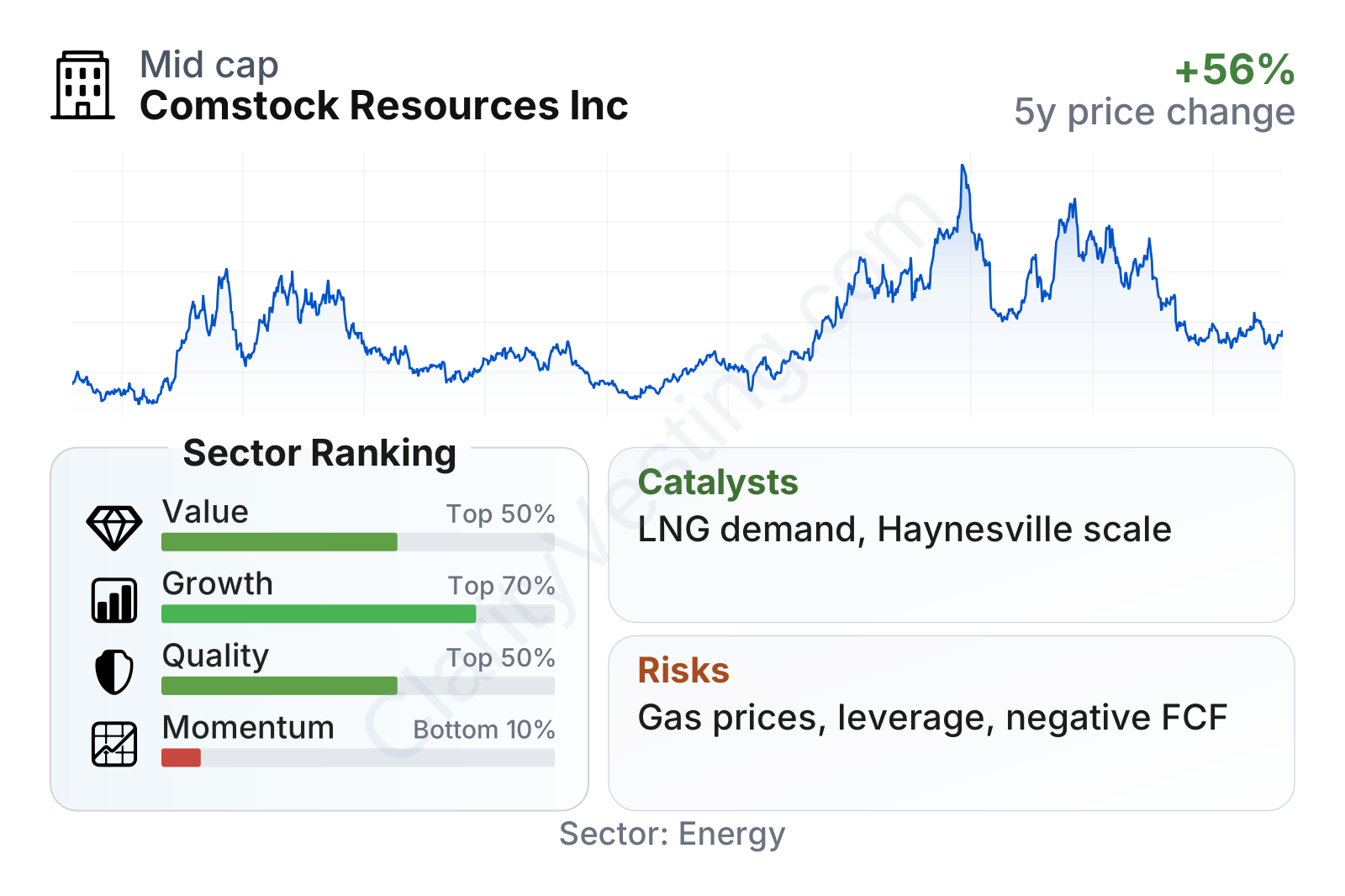
Comstock is a mid-sized exploration and production company in the energy sector. The current factor profile looks mixed. On valuation, the shares screen cheaper than much of the sector on earnings and operating-value measures, but that comes with weaker recent cash generation. On quality, profitability is currently strong, with returns on capital and margins above sector medians, yet leverage remains clearly elevated. Growth metrics are uneven because the recent comparison period has been volatile, and market momentum is weak after a sharp decline from earlier highs.
The stock-price history also reflects the commodity cycle. The shares climbed strongly during favorable gas markets, then gave back much of that move as natural gas prices softened and the market reassessed the company’s leverage and cash flow profile.
Growth
Comstock operates in a sector that should remain important for years, even if it stays cyclical. Natural gas remains a major fuel for electricity generation, industrial use, exports through LNG facilities, and balancing intermittent renewable power. For a producer focused on the Haynesville, the biggest structural theme is its proximity to the U.S. Gulf Coast, where LNG export demand has been expanding. That location matters because gas closer to export and industrial hubs can become more valuable when regional demand rises.
The company’s strategy is straightforward: build scale in Haynesville, keep drilling inventory deep enough to support production, and position output to benefit from stronger Gulf Coast gas demand. That strategy is logical because Haynesville is one of the most important U.S. dry-gas basins and is closely connected to pipeline and LNG infrastructure.
Growth has not been smooth. Revenue growth moved from very strong expansion to deep contraction and then partial recovery before softening again most recently. That does not necessarily signal a broken business model; it mostly shows how exposed Comstock is to natural gas pricing. For long-term analysis, the key point is that production businesses like this can post large year-to-year swings even when the underlying acreage remains valuable.
Free cash flow is the more cautionary growth signal. It turned meaningfully negative after a period of strong cash generation, which suggests that capital spending and weaker pricing have recently outweighed operating cash inflows. For a producer, future growth is more compelling when rising output also converts into durable free cash flow. Until that improves, the growth case depends more on a favorable gas-price environment and future demand growth than on near-term self-funded expansion.
A notable catalyst in recent years has been the company’s combination with larger Haynesville-focused assets through prior acquisitions, which increased scale and drilling inventory. More recently, the broad opportunity is tied to new LNG export capacity along the Gulf Coast. If those projects continue ramping, Haynesville producers such as Comstock could see a stronger demand backdrop than they had during the recent low-price period.
Risks
This article is for informational purposes only and does not constitute financial advice. Some content is AI-generated. See Disclaimer


