Stock Analysis · CRH PLC (CRH)
Overview
CRH plc is one of the world’s largest building materials companies. It supplies the basic products used to build and repair roads, bridges, data centers, warehouses, commercial buildings, and homes. Its activities span aggregates such as crushed stone, asphalt, ready-mixed concrete, cement, paving and construction services, and a broad set of outdoor living and infrastructure products. After shifting its primary listing to the United States, the group is increasingly positioned around North American construction markets, especially public infrastructure and non-residential building.
CRH’s revenue base is diversified by both product and end market. Based on the company’s recent annual reporting structure, the largest sources of revenue are approximately:
- Americas Materials Solutions: about 62% of revenue. This includes aggregates, asphalt, ready-mixed concrete, paving, and road construction services, largely tied to transportation infrastructure and local construction activity in the U.S. and Canada.
- Americas Building Solutions: about 30% of revenue. This covers architectural products, precast, masonry, fencing, outdoor living, and utility-related products used in non-residential, residential, and infrastructure projects.
- International Solutions: about 8% of revenue. This includes operations outside the Americas, with products and services in building materials and construction solutions.
The business mix matters because CRH is not just selling commodities. A meaningful part of the group is tied to value-added downstream products and services, which can support pricing, customer relationships, and recurring project work. Over the last several years, the company has also reshaped its portfolio through acquisitions and divestitures to concentrate on markets with stronger scale and better margins, especially in North America.
Its financial flow also shows a useful pattern: revenue has climbed steadily from 2021 through 2025, while operating profit has expanded faster than sales, suggesting better mix and pricing discipline. Interest expense has also risen, which reflects a more acquisition-driven balance sheet and makes debt management an important part of the investment case.
Key Figures
| Metric | Value | Sector ⓘ |
|---|---|---|
| Date | Oct 17, 2026 | |
| Context | ||
| Sector | Basic Materials | |
| Industry | Building Materials | |
| Market Cap ⓘ | $53.32B | |
| Beta ⓘ | 1.19 | |
Value (Cheapness) | ||
| P/E Ratio ⓘ | 14.16 | 16.90 |
| P/B Ratio ⓘ | 2.35 | 1.65 |
| FCF Yield ⓘ | 5.19% | 5.76% |
| Dividend Yield ⓘ | 1.95% | 2.13% |
| EBIT / EV ⓘ | 8.15% | 6.30% |
| PEG ⓘ | 1.53 | |
Growth (Business expansion) | ||
| Revenue Growth ⓘ | 5.60% | 11.10% |
| RPS Growth (5Y CAGR) ⓘ | 14.01% | 4.49% |
| EPS Growth (5Y CAGR) ⓘ | -20.36% | -13.47% |
| BVPS Growth (5Y CAGR) ⓘ | 10.06% | 5.51% |
| Margin Growth (5Y Trend) ⓘ | 3.20% | -1.54% |
| FCF Growth (5Y CAGR) ⓘ | 2.33% | 0.37% |
| DPS Growth (5Y CAGR) ⓘ | 6.32% | 6.08% |
Quality (Business durability) | ||
| ROIC (Latest) ⓘ | 10.76% | 9.26% |
| ROA (Latest) ⓘ | 6.56% | 4.91% |
| ROIC (5Y Median) ⓘ | 9.60% | 7.70% |
| ROA (5Y Median) ⓘ | 7.40% | 3.86% |
| Net Debt / EBIT (Latest) ⓘ | 2.80 | 1.40 |
| Net Debt / EBIT (5Y Median) ⓘ | 1.85 | 1.70 |
| Net Debt / EBITDA (Latest) ⓘ | 2.04 | 0.95 |
| Net Debt / Assets ⓘ | 28.67% | 13.69% |
| EBITDA / Interest ⓘ | 9.68 | 12.34 |
| Operating Margin (Latest) ⓘ | 15.49% | 13.20% |
| Operating Margin (5Y Median) ⓘ | 12.56% | 11.80% |
| Debt to Equity (Latest) ⓘ | 82.43% | 40.56% |
| Profit Margin (Latest) ⓘ | 9.94% | 6.43% |
| Free Cash Flow (Latest) ⓘ | $2.77B | |
Momentum (Price trend) | ||
| 3Y Return ⓘ | +46.54% | +68.89% |
| 12M Return (excl. last month) ⓘ | -20.38% | +30.21% |
| 6M Return ⓘ | -32.03% | -4.16% |
| Price vs. 200-Day MA ⓘ | -25.21% | -1.27% |
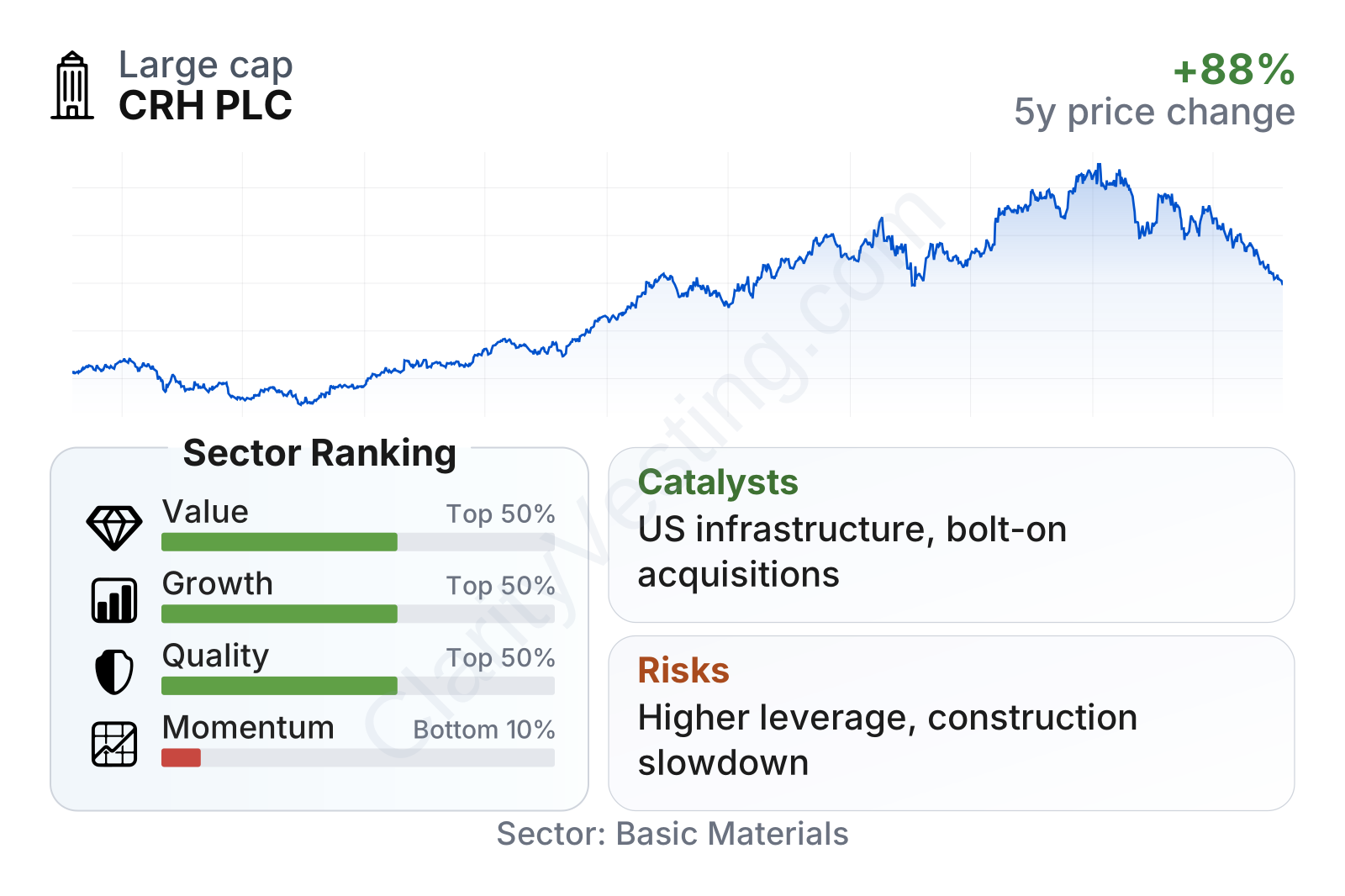
CRH is a large-cap building materials company with market sensitivity a little above the broader market, as shown by a beta near 1.2. On valuation, the shares trade at an earnings multiple below the sector median, while the EBIT-to-enterprise-value measure stands above the sector median, which points to stronger operating earnings relative to total business value. Quality metrics are solid: returns on invested capital and assets are clearly above typical sector levels, and operating profitability is also ahead of the median. Growth is more mixed in the short term, with recent revenue growth below the sector midpoint, but the longer-term record in revenue per share, free cash flow, and book value per share is materially stronger. The weakest area is recent stock momentum, with the share price having pulled back over the last year and sitting below its longer-term trend.
Growth
CRH operates in a sector with durable long-term demand, even if yearly results can be cyclical. Roads, bridges, utility networks, logistics facilities, and data center construction all require large volumes of aggregates, asphalt, concrete, and related products. In the United States, these markets benefit from public infrastructure programs, state transportation budgets, reshoring-related industrial projects, and ongoing maintenance demand. That backdrop supports steady demand over a multi-year horizon, even when private construction categories soften.
CRH’s strategy is built around scale, local density, and portfolio improvement. In building materials, scale matters because transportation costs are high and customers often source locally. A company with dense networks of quarries, asphalt plants, ready-mix sites, and distribution assets can serve projects more efficiently and protect margins better than smaller rivals. CRH has spent years adding bolt-on acquisitions in attractive regions and recycling capital out of less strategic assets. That logic is straightforward and generally well aligned with how this industry creates value.
Recent revenue growth has not been smooth quarter to quarter, which is common in a business exposed to weather, project timing, acquisitions, and divestitures. Even so, the broader direction remains positive. Over five years, revenue per share has compounded at roughly 14%, far above the sector median, and margins have trended upward rather than downward. That combination suggests growth has not come only from buying assets, but also from improving the profitability of the overall portfolio.
Cash generation is another important support. Free cash flow has remained in the multi-billion-dollar range and has recovered after a softer period, with five-year free cash flow growth ahead of the sector median. That matters because this is a capital-intensive business: sustained cash generation gives CRH room to fund acquisitions, modernize plants, invest in capacity, and continue shareholder distributions without depending entirely on new borrowing.
A notable catalyst for future growth is the company’s exposure to infrastructure-heavy categories in North America, where public funding visibility is stronger than in many private construction segments. Another is CRH’s positioning in value-added building solutions, which can benefit from non-residential activity such as data centers, advanced manufacturing, and utility upgrades. Recent company updates have also emphasized ongoing acquisition activity and disciplined capital allocation, reinforcing the view that management is still actively shaping the portfolio rather than simply riding end-market demand.
Risks
This article is for informational purposes only and does not constitute financial advice. Some content is AI-generated. See Disclaimer


