Stock Analysis · China Resources Gas Group Limited (CRGGF)
Overview
China Resources Gas Group Limited is a large city gas utility focused on mainland China. The company distributes natural gas to residential, commercial, and industrial users, and it also operates related services around urban energy infrastructure. In simple terms, it earns money by bringing gas to homes and businesses, charging connection fees when new customers are added, and selling related products and services.
Its business model is built around local gas concessions in Chinese cities. These concessions can create recurring demand because households and businesses need a steady energy supply, while local networks are difficult and expensive to replicate. The company is part of the broader China Resources group, which adds scale, financing access, and relationships that matter in regulated infrastructure.
Based on the company’s recent annual reporting structure, revenue is mainly driven by gas sales, with smaller contributions from connection activity and integrated energy or value-added services.
- Gas sales: approximately 80% to 90% of revenue. This includes the sale and distribution of natural gas to residential, industrial, and commercial customers.
- Gas connection: approximately 5% to 15% of revenue. This comes from construction and installation fees for connecting new users and projects to the company’s network.
- Integrated services and other businesses: approximately 5% to 10% of revenue. This generally includes engineering, gas appliances, distributed energy, and other related utility services.
The broad pattern in recent years has been rising revenue, but with a much heavier cost base. Revenue moved from about HK$79.6 billion in 2021 to about HK$97.7 billion in 2025, while net income fell from about HK$6.4 billion to about HK$3.5 billion over the same period. That combination suggests the business kept expanding in size, but profitability became more pressured.
The business mix highlights why margins matter so much here: most revenue comes from gas sales, which tend to be high-volume but lower-margin, while connection income and service activities can provide stronger profitability. Over the last few years, operating profit and net income have trended down faster than revenue, showing that cost control and pricing pass-through have become more important than simple top-line expansion.
Key Figures
| Metric | Value | Sector ⓘ |
|---|---|---|
| Date | Oct 17, 2026 | |
| Context | ||
| Sector | Utilities | |
| Industry | Utilities - Regulated Gas | |
| Market Cap ⓘ | $4.51B | |
| Beta ⓘ | 0.70 | |
Value (Cheapness) | ||
| P/E Ratio ⓘ | 10.00 | 17.28 |
| P/B Ratio ⓘ | 0.10 | 1.51 |
| FCF Yield ⓘ | 97.59% | 0.65% |
| Dividend Yield ⓘ | 47.50% | 3.77% |
| EBIT / EV ⓘ | N/A | 5.01% |
| PEG ⓘ | 3.27 | |
Growth (Business expansion) | ||
| Revenue Growth ⓘ | 5.20% | 6.10% |
| RPS Growth (5Y CAGR) ⓘ | 5.00% | 3.87% |
| EPS Growth (5Y CAGR) ⓘ | -24.51% | -11.30% |
| BVPS Growth (5Y CAGR) ⓘ | -16.42% | 4.23% |
| Margin Growth (5Y Trend) ⓘ | -8.61% | 3.57% |
| FCF Growth (5Y CAGR) ⓘ | 5.80% | -8.84% |
| DPS Growth (5Y CAGR) ⓘ | 1.70% | 4.84% |
Quality (Business durability) | ||
| ROIC (Latest) ⓘ | N/A | 6.53% |
| ROA (Latest) ⓘ | 4.72% | 3.20% |
| ROIC (5Y Median) ⓘ | 12.82% | 5.95% |
| ROA (5Y Median) ⓘ | 4.18% | 2.75% |
| Net Debt / EBIT (Latest) ⓘ | 1.44 | 7.13 |
| Net Debt / EBIT (5Y Median) ⓘ | 1.34 | 7.23 |
| Net Debt / EBITDA (Latest) ⓘ | 0.91 | 4.31 |
| Net Debt / Assets ⓘ | 12.87% | 38.42% |
| EBITDA / Interest ⓘ | 18.07 | 4.58 |
| Operating Margin (Latest) ⓘ | 6.56% | 20.83% |
| Operating Margin (5Y Median) ⓘ | 9.72% | 20.08% |
| Debt to Equity (Latest) ⓘ | 60.52% | 137.69% |
| Profit Margin (Latest) ⓘ | 3.56% | 11.37% |
| Free Cash Flow (Latest) ⓘ | $4.40B | |
Momentum (Price trend) | ||
| 3Y Return ⓘ | -17.77% | +52.37% |
| 12M Return (excl. last month) ⓘ | -14.73% | +8.84% |
| 6M Return ⓘ | -26.27% | -3.95% |
| Price vs. 200-Day MA ⓘ | -31.21% | -0.79% |
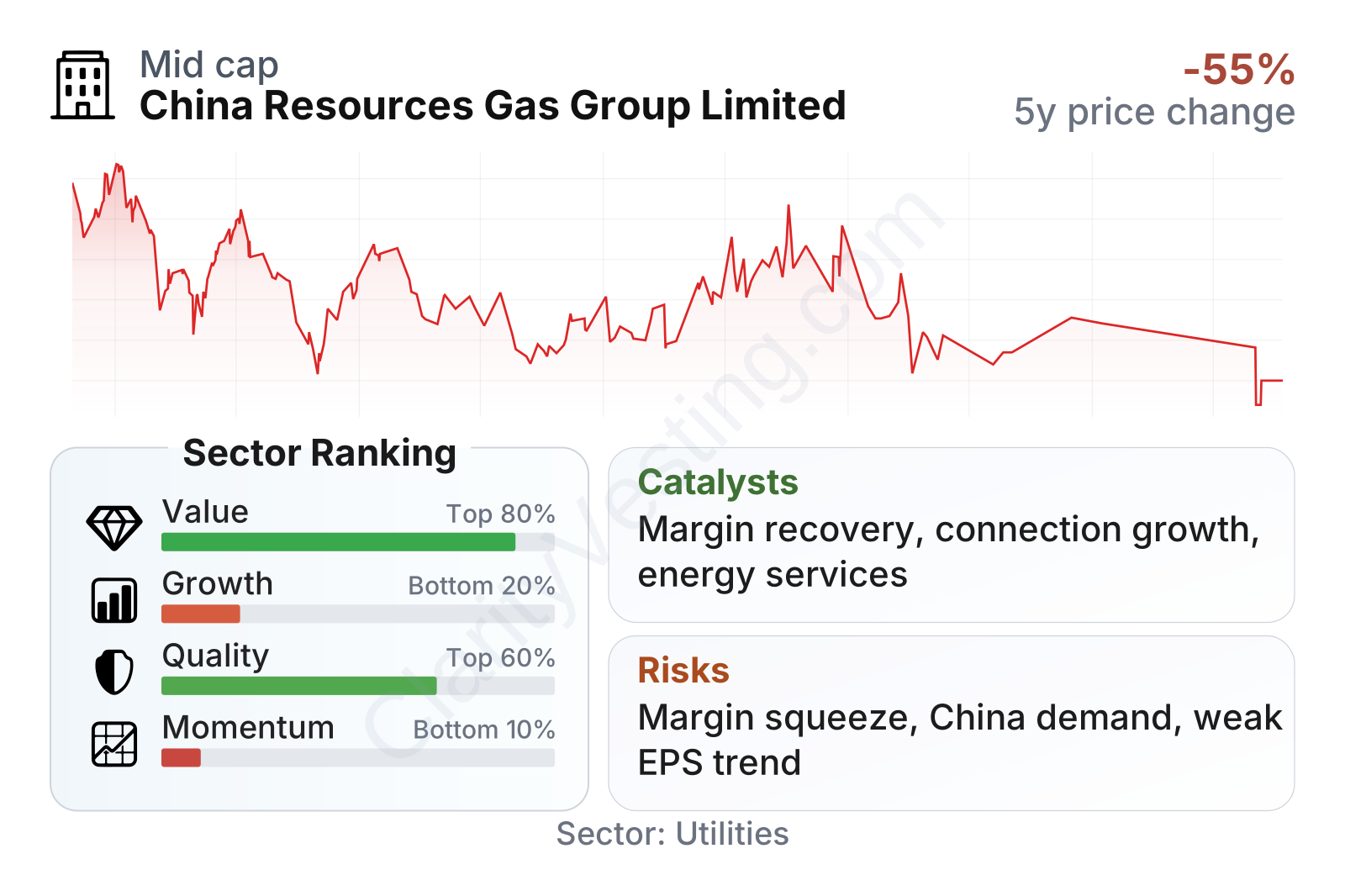
China Resources Gas is a mid-sized listed utility by market value, and its share price behavior has been relatively less volatile than the broader market, reflected in a beta below 1. The table points to a mixed profile. Valuation multiples appear low compared with the sector, while balance-sheet leverage looks conservative for a regulated utility. Profitability quality is respectable in asset returns and debt coverage, but operating and net margins are clearly below the sector median. Growth metrics are weaker, especially on earnings and margin trends, and share-price momentum has been soft over multi-year and recent periods.
The stock price history also shows that the market has become more cautious over time. The shares were materially higher in 2021 and 2022 than in the more recent observations, which lines up with the drop in earnings and the weaker margin profile.
Growth
China’s natural gas market still has structural growth drivers, even if the pace is no longer as straightforward as it was several years ago. Natural gas remains part of the country’s energy transition because it can replace more polluting fuels in households, industry, and urban heating. That gives city gas distributors a long runway in regions where gas penetration, industrial switching, and urban development continue.
For China Resources Gas, the strategy still makes industrial sense. A city gas operator can grow by adding connected households, expanding industrial and commercial volumes, building integrated energy solutions, and deepening its presence in the cities where it already holds concessions. The value of the network often comes from density: once pipes are installed, more users on the same system can improve economics over time.
The company’s revenue per share trend has generally moved upward across the last five years, although the latest year pulled back from the peak. That suggests the business has continued to grow in scale, but recent pressure on earnings shows that additional revenue has not translated into stronger profit at the same rate.
A practical catalyst is any improvement in the spread between gas procurement costs and customer pricing. Since this is a high-volume utility, even modest normalization in gross margin can have a meaningful effect on profit. Another important catalyst is growth in higher-margin activities such as gas connection and integrated energy services, which can complement the lower-margin core gas sales business.
The company has also been active in broader urban energy services beyond simple gas distribution, which matters for future growth. If that segment gains more weight over time, it could reduce dependence on plain commodity distribution and support a more stable earnings mix. In addition, state-linked utilities in China can sometimes benefit from project access and consolidation opportunities that smaller private rivals may not match.
Risks
This article is for informational purposes only and does not constitute financial advice. Some content is AI-generated. See Disclaimer


