Stock Analysis · Concordia Financial Group Ltd (CRDIY)
Overview
Concordia Financial Group Ltd is a Japan-based financial group centered on retail banking. Through its main banking subsidiaries, the company provides everyday banking services such as deposits, lending, payments, and foreign exchange, while also earning fees from trust, securities, and other financial products. For U.S. readers looking at the ADR, CRDIY represents an interest in a business that is primarily tied to the Japanese domestic banking market.
The group is built around three main banks: Resona Bank, Saitama Resona Bank, and Kansai Mirai Bank, plus Minato Bank within the Kansai area network. Its positioning is not that of a global money-center bank. Instead, it is more focused on households, small and mid-sized businesses, and regional corporate customers. That makes the company easier to understand than many large diversified financial institutions: its results are driven mainly by lending volumes, deposit gathering, fee income, credit quality, and interest rate conditions in Japan.
Based on the company’s segment disclosures, revenue is dominated by banking operations in Japan. A simplified breakdown is as follows:
- Banking income: about 85% to 90% — net interest income from loans and securities, plus fees from settlement, asset management, and customer services at the main banking subsidiaries.
- Trust and related services: about 5% to 10% — trust-related products, pension and asset administration, real estate-related trust functions, and other fiduciary services.
- Other financial activities: about 5% — leasing, credit-related services, guarantees, and other group functions.
That mix shows a company with a very traditional banking profile. It is less dependent on volatile investment banking or trading revenue than many larger peers, but more exposed to domestic interest margins and the health of Japan’s consumers and businesses.
The business flow over the last five fiscal years points to a favorable earnings trend: total revenue has moved steadily higher, net income has expanded materially, and operating costs have risen more slowly than revenue overall. One important offset is funding cost pressure, with interest expense climbing sharply as rates normalized, so a key question is whether loan yields and fee income can keep outrunning that headwind.
Key Figures
| Metric | Value | Sector ⓘ |
|---|---|---|
| Date | Nov 21, 2026 | |
| Context | ||
| Sector | Financial Services | |
| Industry | Banks - Regional | |
| Market Cap ⓘ | $11.11B | |
| Beta ⓘ | 0.22 | |
Value (Cheapness) | ||
| P/E Ratio ⓘ | 14.08 | 12.01 |
| P/B Ratio ⓘ | N/A | 1.48 |
| FCF Yield ⓘ | N/A | 8.77% |
| Dividend Yield ⓘ | 1.30% | 3.01% |
| EBIT / EV ⓘ | N/A | 8.31% |
| PEG ⓘ | N/A | |
Growth (Business expansion) | ||
| Revenue Growth ⓘ | 17.00% | 6.70% |
| RPS Growth (5Y CAGR) ⓘ | 11.23% | 12.35% |
| EPS Growth (5Y CAGR) ⓘ | -34.43% | -0.27% |
| BVPS Growth (5Y CAGR) ⓘ | 6.53% | 4.83% |
| Margin Growth (5Y Trend) ⓘ | N/A | -4.16% |
| FCF Growth (5Y CAGR) ⓘ | N/A | 4.69% |
| DPS Growth (5Y CAGR) ⓘ | 18.59% | 8.82% |
Quality (Business durability) | ||
| ROIC (Latest) ⓘ | N/A | 9.49% |
| ROE (Latest) ⓘ | 8.93% | 14.02% |
| ROA (Latest) ⓘ | 0.50% | 1.53% |
| ROIC (5Y Median) ⓘ | N/A | 7.80% |
| ROE (5Y Median) ⓘ | 5.53% | 12.09% |
| ROA (5Y Median) ⓘ | 0.27% | 1.28% |
| Net Debt / EBIT (Latest) ⓘ | N/A | 0.88 |
| Net Debt / EBIT (5Y Median) ⓘ | N/A | 0.73 |
| Net Debt / EBITDA (Latest) ⓘ | N/A | 0.71 |
| Operating Margin (Latest) ⓘ | N/A | 23.37% |
| Operating Margin (5Y Median) ⓘ | N/A | 24.29% |
| Debt to Equity (Latest) ⓘ | N/A | 59.34% |
| Profit Margin (Latest) ⓘ | 30.35% | 26.65% |
| Free Cash Flow (Latest) ⓘ | N/A | |
Momentum (Price trend) | ||
| 3Y Return ⓘ | +147.07% | +73.29% |
| 12M Return (excl. last month) ⓘ | +48.94% | +18.35% |
| 6M Return ⓘ | -4.94% | +3.24% |
| Price vs. 200-Day MA ⓘ | -5.75% | +2.17% |
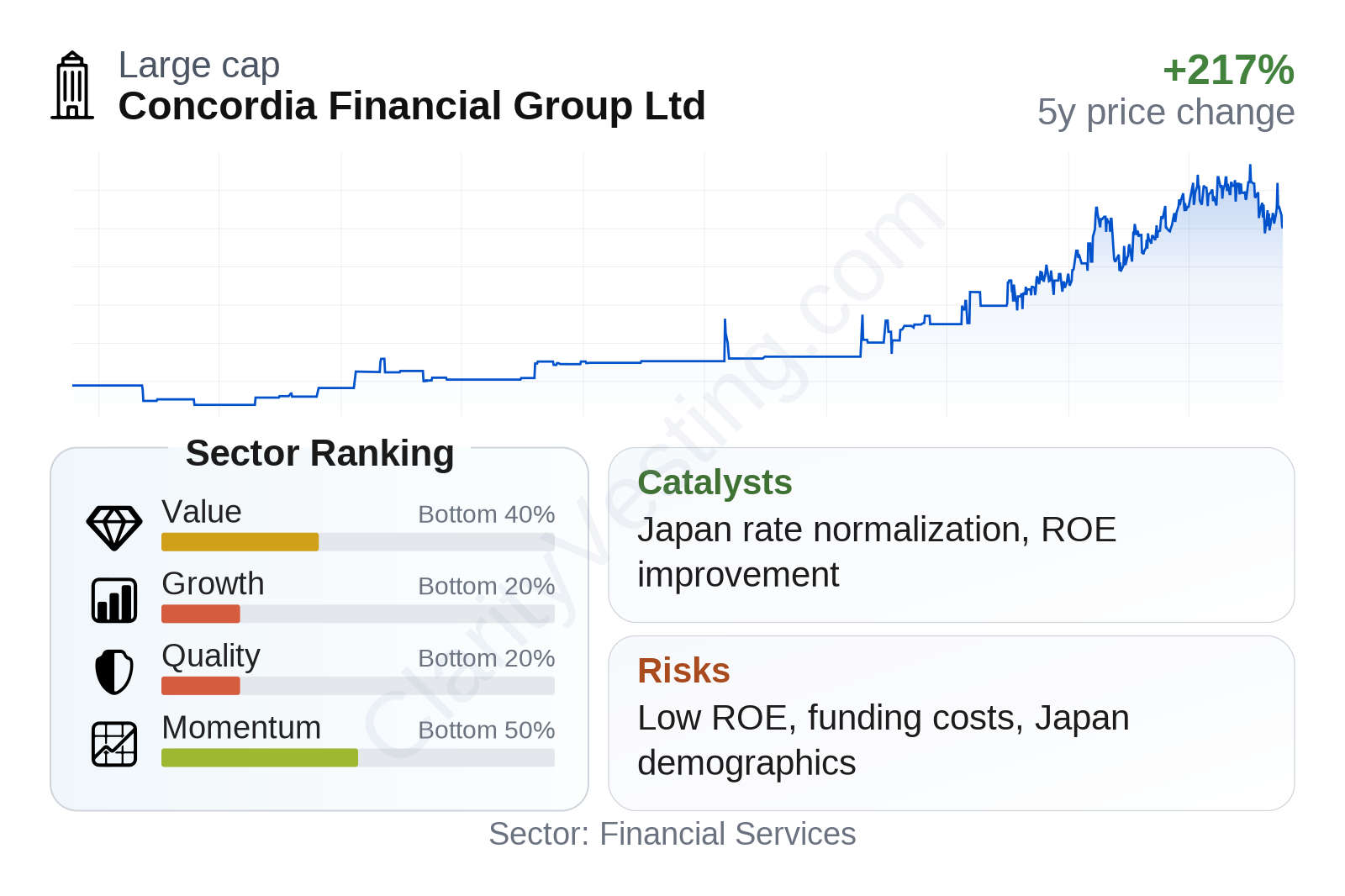
Concordia is a large regional banking group by market value, but it trades with unusually low share-price volatility, as shown by a beta well below 1. The recent stock move has been strong over one year and three years, placing momentum around the middle-to-better part of the banking sector. By contrast, the underlying factor profile is less impressive: value sits in the bottom 30% of the sector, while growth and quality both rank in the bottom 20%.
That combination is important. The market has rewarded the shares, but the traditional profitability measures remain below many peers. Return on equity is around 8% versus a sector median near 14%, and return on assets is also well below the sector norm. On the positive side, profit margin is somewhat above the sector median, recent year-over-year revenue growth is clearly stronger than the median, and book value per share growth over five years has outpaced the sector median. Dividend growth has also been strong, even though the current dividend yield remains below the sector median.
Growth
Concordia operates in a sector that is not structurally high-growth, but it has recently benefited from a major change in Japan’s banking environment: the end of ultra-low interest rate conditions. For many years, Japanese banks struggled with thin lending spreads. A more normal interest rate backdrop can improve loan pricing, deposit economics, and recurring banking earnings, especially for domestically focused lenders like Concordia.
The company’s strategy appears centered on deepening relationships with retail and small-business customers, strengthening regional banking networks, and expanding fee-based income in trust and solutions businesses. That strategy is sensible for a mature banking market because it does not rely only on balance-sheet growth. It also aims to raise earnings quality by combining lending, settlement services, inheritance and asset succession support, and other client services that can produce steadier fee income.
Recent financial progression supports the case that operating conditions have become more favorable. Revenue has grown from roughly ¥166 billion equivalent in the 2022 fiscal snapshot provided to about ¥235 billion in the latest one, while net income has nearly doubled over that span. The balance sheet also shows gradual capital accumulation rather than flat value creation.
Book value per share has trended upward consistently over the last five years, which matters for a bank because book value is one of the clearest signals of whether management is adding underlying franchise value over time. The pace is not explosive, but it is steady, and it aligns with the company’s stronger dividend growth and better recent earnings.
A further catalyst is corporate reform in Japan. Across the market, banks and other financial groups have faced increasing pressure to improve capital efficiency, simplify cross-shareholdings, and focus more clearly on shareholder returns. Concordia has already participated in that broader trend through capital management and payout actions. If management continues to improve returns on equity from current levels, the market may continue to treat the company less like a low-growth regional bank and more like a recovering financial franchise.
Risks
This article is for informational purposes only and does not constitute financial advice. Some content is AI-generated. See Disclaimer