Stock Analysis · Circle Internet Group Inc (CRCL)
Overview
Circle Internet Group Inc is a financial technology company centered on digital dollars. Its core product is USDC, a U.S. dollar-backed stablecoin designed to maintain a 1-to-1 value with the dollar and move across blockchain networks. In simple terms, Circle provides infrastructure that helps businesses, financial institutions, developers, and users send, store, settle, and convert digital money more quickly than traditional payment rails. The company also operates related services for payments, treasury, and blockchain-based financial applications.
For long-term analysis, the most important point is that Circle is not a broadly diversified financial company today. Its economics are still heavily tied to the scale and usage of USDC, and especially to the income earned from the reserves backing that stablecoin. Public filings show that reserve-related income is by far the dominant engine of the business, while transaction, service, and product revenue remain much smaller.
The main revenue sources can be summarized this way:
- Reserve income on USDC backing assets: approximately 95% to 99%. This comes primarily from interest earned on cash and short-duration U.S. Treasury-related assets held to support USDC in circulation. This is the key driver of profitability.
- Transaction and service revenue: approximately 1% to 5%. This includes fees tied to infrastructure, payments, treasury services, and other platform activity, but it is still minor relative to reserve income.
- Other revenue: limited. Any additional lines appear small and not material compared with reserve income.
That revenue mix creates a business with strong operating leverage when stablecoin balances are high and short-term interest rates are attractive, but it also means Circle remains exposed to crypto market sentiment, USDC adoption levels, and the interest-rate environment.
The broader financial flow over recent years shows a company that scaled revenue very quickly, moved from deep losses into profitability in 2023 and 2024, and then saw margins compress again in 2025 as expenses and revenue-sharing costs increased faster than profits. Revenue growth has remained strong in absolute terms, but earnings quality is more volatile than the top line suggests.
Key Figures
| Metric | Value | Sector ⓘ |
|---|---|---|
| Date | Oct 03, 2026 | |
| Context | ||
| Sector | Financial Services | |
| Industry | Capital Markets | |
| Market Cap ⓘ | $22.40B | |
| Beta ⓘ | N/A | |
Value (Cheapness) | ||
| P/E Ratio ⓘ | 16.77 | 12.60 |
| P/B Ratio ⓘ | 6.35 | 1.23 |
| FCF Yield ⓘ | 3.47% | 10.16% |
| Dividend Yield ⓘ | N/A | 2.96% |
| EBIT / EV ⓘ | 1.81% | 7.77% |
| PEG ⓘ | 6.86 | |
Growth (Business expansion) | ||
| Revenue Growth ⓘ | 6.60% | 9.50% |
| RPS Growth (5Y CAGR) ⓘ | 56.00% | 12.10% |
| EPS Growth (5Y CAGR) ⓘ | N/A | -9.45% |
| BVPS Growth (5Y CAGR) ⓘ | N/A | 5.01% |
| Margin Growth (5Y Trend) ⓘ | N/A | -4.07% |
| FCF Growth (5Y CAGR) ⓘ | N/A | 4.96% |
| DPS Growth (5Y CAGR) ⓘ | N/A | 8.79% |
Quality (Business durability) | ||
| ROIC (Latest) ⓘ | 13.19% | 9.60% |
| ROE (Latest) ⓘ | 13.82% | 13.84% |
| ROA (Latest) ⓘ | 0.59% | 1.53% |
| ROIC (5Y Median) ⓘ | N/A | 7.86% |
| ROE (5Y Median) ⓘ | 15.32% | 12.20% |
| ROA (5Y Median) ⓘ | -0.11% | 1.29% |
| Net Debt / EBIT (Latest) ⓘ | -4.38 | 0.91 |
| Net Debt / EBIT (5Y Median) ⓘ | N/A | 0.74 |
| Net Debt / EBITDA (Latest) ⓘ | -3.46 | 0.97 |
| Operating Margin (Latest) ⓘ | 13.59% | 22.12% |
| Operating Margin (5Y Median) ⓘ | -3.70% | 24.39% |
| Debt to Equity (Latest) ⓘ | 0.45% | 60.37% |
| Profit Margin (Latest) ⓘ | 15.53% | 26.62% |
| Free Cash Flow (Latest) ⓘ | $776.92M | |
Momentum (Price trend) | ||
| 3Y Return ⓘ | N/A | +89.23% |
| 12M Return (excl. last month) ⓘ | -32.20% | +17.35% |
| 6M Return ⓘ | -8.63% | +10.00% |
| Price vs. 200-Day MA ⓘ | -3.61% | +3.73% |
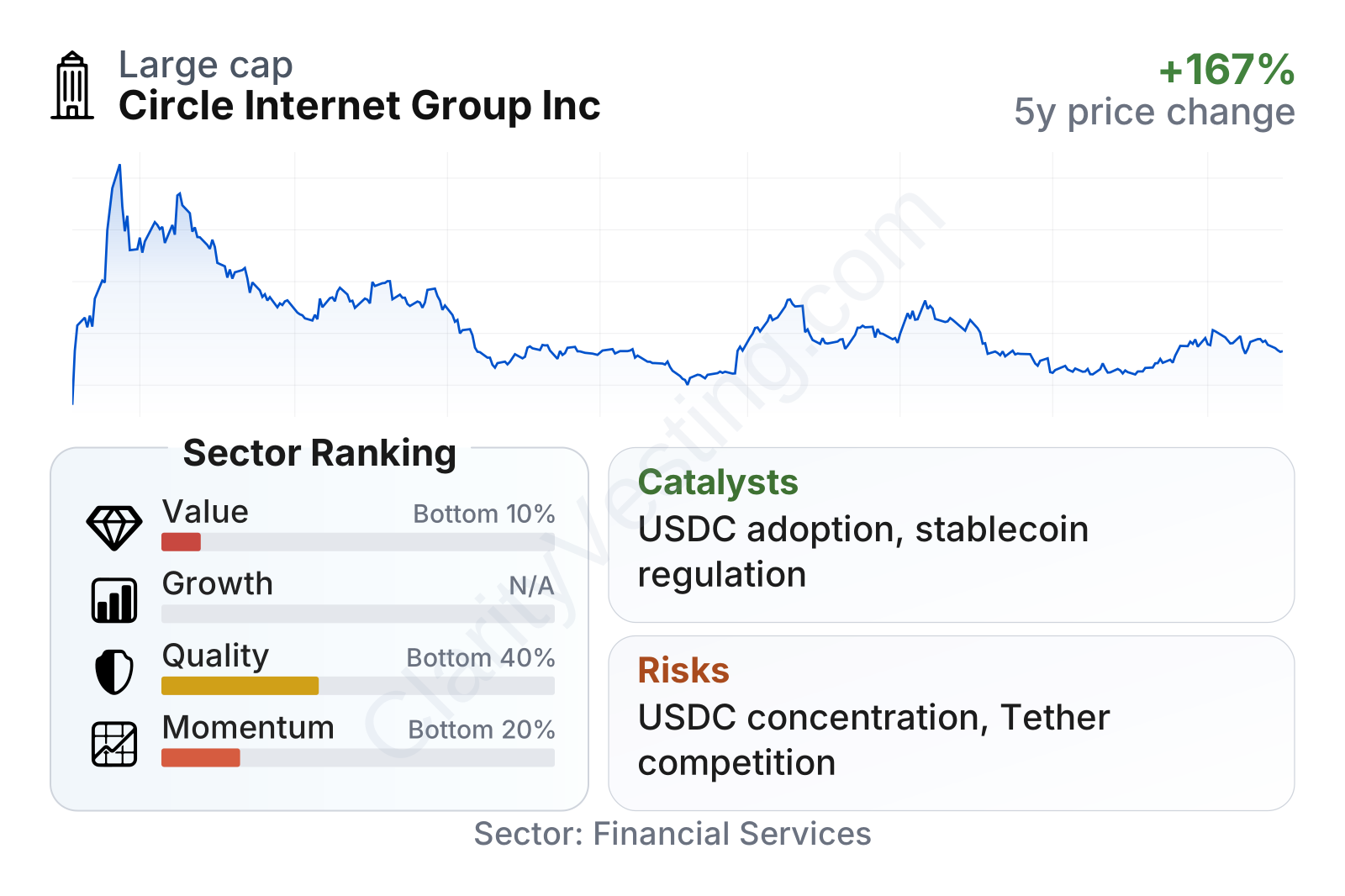
Circle is now a large public company by market value, but its factor profile is mixed. On valuation, it screens as expensive versus much of the financial sector, with both earnings and book-based multiples above sector medians and a relatively modest free-cash-flow yield. On quality, returns on invested capital and return on equity are respectable, and the balance sheet is very lightly levered, but asset returns remain weaker than many peers. Growth indicators are harder to classify because Circle’s business model changed rapidly over the past few years, yet the longer-term revenue expansion has been unusually strong. Market performance has been volatile since listing, which fits a company still being priced around future adoption rather than steady mature financial results.
Growth
Circle operates in a sector with meaningful long-term potential. Stablecoins sit at the intersection of payments, dollar settlement, crypto markets, and tokenized finance. If digital dollars become more widely used for cross-border transfers, exchange settlement, merchant payments, treasury operations, and on-chain capital markets, Circle has a clear position in a market that could keep expanding for years. This is one of the main reasons the company attracts attention beyond its current earnings base.
Its strategy is logical for that backdrop. Circle is trying to make USDC useful across many blockchains and distribution partners rather than relying on a single app or exchange. That matters because utility and network reach are critical in payments. The more wallets, institutions, developers, exchanges, and payment providers that support USDC, the more likely it is to remain relevant as digital-dollar infrastructure matures.
Another growth support is regulatory positioning. Circle has generally emphasized compliance, reserve transparency, and integration with the traditional financial system. If regulation becomes clearer and favors issuers that already operate with tighter controls and stronger disclosure, Circle could be in a better position than less regulated competitors. For a business linked to trust, that is a meaningful strategic asset.
At the same time, near-term growth is not perfectly linear. Revenue rose quickly over the last several years, but recent year-over-year revenue growth is more moderate than its five-year pace. This suggests the company is entering a phase where expansion still exists, but it may depend more on broader adoption catalysts than on simple early-stage scaling alone.
The earnings path reflects that uneven pattern. Circle has shown it can produce substantial profits when reserve income is favorable, but earnings can also shift quickly when operating costs, partner economics, or reserve dynamics move in the opposite direction. For long-term readers, this means the business has real earnings power, but not yet the smooth consistency usually seen in mature financial infrastructure companies.
Book value per share has recovered strongly from earlier volatility, which is consistent with the company moving from a more fragile balance-sheet phase toward a more established financial profile. That said, because Circle’s market valuation stands well above book value, future market performance is likely to depend more on scaling USDC usage and building durable profitability than on balance-sheet expansion alone.
A major catalyst is the possibility that stablecoins become more embedded in mainstream finance. Areas such as international transfers, tokenized securities settlement, institutional cash management, and digital payment rails could all enlarge Circle’s addressable market. Another important catalyst is any new partnership with major exchanges, banks, payment firms, or blockchain ecosystems that increases circulation and transaction volume for USDC.
Risks
This article is for informational purposes only and does not constitute financial advice. Some content is AI-generated. See Disclaimer