Stock Analysis · California Resources Corp (CRC)
Overview
California Resources Corp is an independent energy company focused mainly on California. Its core business is producing oil, natural gas, and natural gas liquids from fields located close to the state’s large fuel and power markets. In recent years, the company has also expanded into carbon management through carbon capture and storage projects, a move that could make it more than a traditional oil and gas producer over time.
CRC’s revenue still comes overwhelmingly from hydrocarbon production and related sales. Based on the company’s recent reporting structure and California-focused upstream operations, the mix is best understood as follows:
- Oil sales: approximately 65% to 75% of revenue. This is the largest source and includes crude oil produced from the company’s California fields.
- Natural gas sales: approximately 15% to 25% of revenue. This includes gas sold into California’s energy market.
- Natural gas liquids and other energy-related sales: approximately 5% to 10% of revenue. This generally includes products extracted alongside gas production and certain other field-related revenue streams.
- Carbon management and other emerging low-carbon activities: currently a small share of revenue, but strategically important because it may become a future growth platform if projects move from development into commercial operation.
The business model is relatively simple to understand: CRC develops and operates energy-producing properties, sells those commodities, and uses cash flow to fund operations, manage debt, return some cash to shareholders, and invest in newer carbon storage opportunities. One helpful feature of its footprint is that California is both the company’s production base and a very large end market, which can support local infrastructure advantages.
Over the last several years, revenue has fluctuated with commodity prices, while operating costs and interest expense have taken a larger share of the economics than they did at the 2022 peak. Revenue recovered strongly in 2025, but net income did not follow at the same pace, showing how sensitive earnings remain to costs, financing, and pricing conditions.
Key Figures
| Metric | Value | Sector ⓘ |
|---|---|---|
| Date | Oct 17, 2026 | |
| Context | ||
| Sector | Energy | |
| Industry | Oil & Gas E&P | |
| Market Cap ⓘ | $4.82B | |
| Beta ⓘ | 1.02 | |
Value (Cheapness) | ||
| P/E Ratio ⓘ | N/A | 15.44 |
| P/B Ratio ⓘ | 1.42 | 1.73 |
| FCF Yield ⓘ | 8.20% | 8.20% |
| Dividend Yield ⓘ | 3.00% | 3.59% |
| EBIT / EV ⓘ | -1.56% | 7.46% |
| PEG ⓘ | 0.44 | |
Growth (Business expansion) | ||
| Revenue Growth ⓘ | 33.00% | 26.90% |
| RPS Growth (5Y CAGR) ⓘ | 7.48% | 6.90% |
| EPS Growth (5Y CAGR) ⓘ | -22.87% | -15.73% |
| BVPS Growth (5Y CAGR) ⓘ | 19.90% | 6.07% |
| Margin Growth (5Y Trend) ⓘ | 5.84% | 0.58% |
| FCF Growth (5Y CAGR) ⓘ | -4.76% | 1.86% |
| DPS Growth (5Y CAGR) ⓘ | 74.28% | 16.79% |
Quality (Business durability) | ||
| ROIC (Latest) ⓘ | 2.06% | 11.40% |
| ROA (Latest) ⓘ | -1.75% | 6.06% |
| ROIC (5Y Median) ⓘ | 23.25% | 10.30% |
| ROA (5Y Median) ⓘ | 13.41% | 5.42% |
| Net Debt / EBIT (Latest) ⓘ | N/A | 1.64 |
| Net Debt / EBIT (5Y Median) ⓘ | 1.17 | 1.83 |
| Net Debt / EBITDA (Latest) ⓘ | 2.50 | 1.08 |
| Net Debt / Assets ⓘ | 18.18% | 17.29% |
| EBITDA / Interest ⓘ | 4.65 | 9.64 |
| Operating Margin (Latest) ⓘ | -2.32% | 16.27% |
| Operating Margin (5Y Median) ⓘ | 20.39% | 20.39% |
| Debt to Equity (Latest) ⓘ | 39.59% | 54.76% |
| Profit Margin (Latest) ⓘ | -3.24% | 8.82% |
| Free Cash Flow (Latest) ⓘ | $395.00M | |
Momentum (Price trend) | ||
| 3Y Return ⓘ | +8.01% | +67.38% |
| 12M Return (excl. last month) ⓘ | +8.38% | +49.19% |
| 6M Return ⓘ | -13.96% | +7.07% |
| Price vs. 200-Day MA ⓘ | -3.42% | +9.56% |
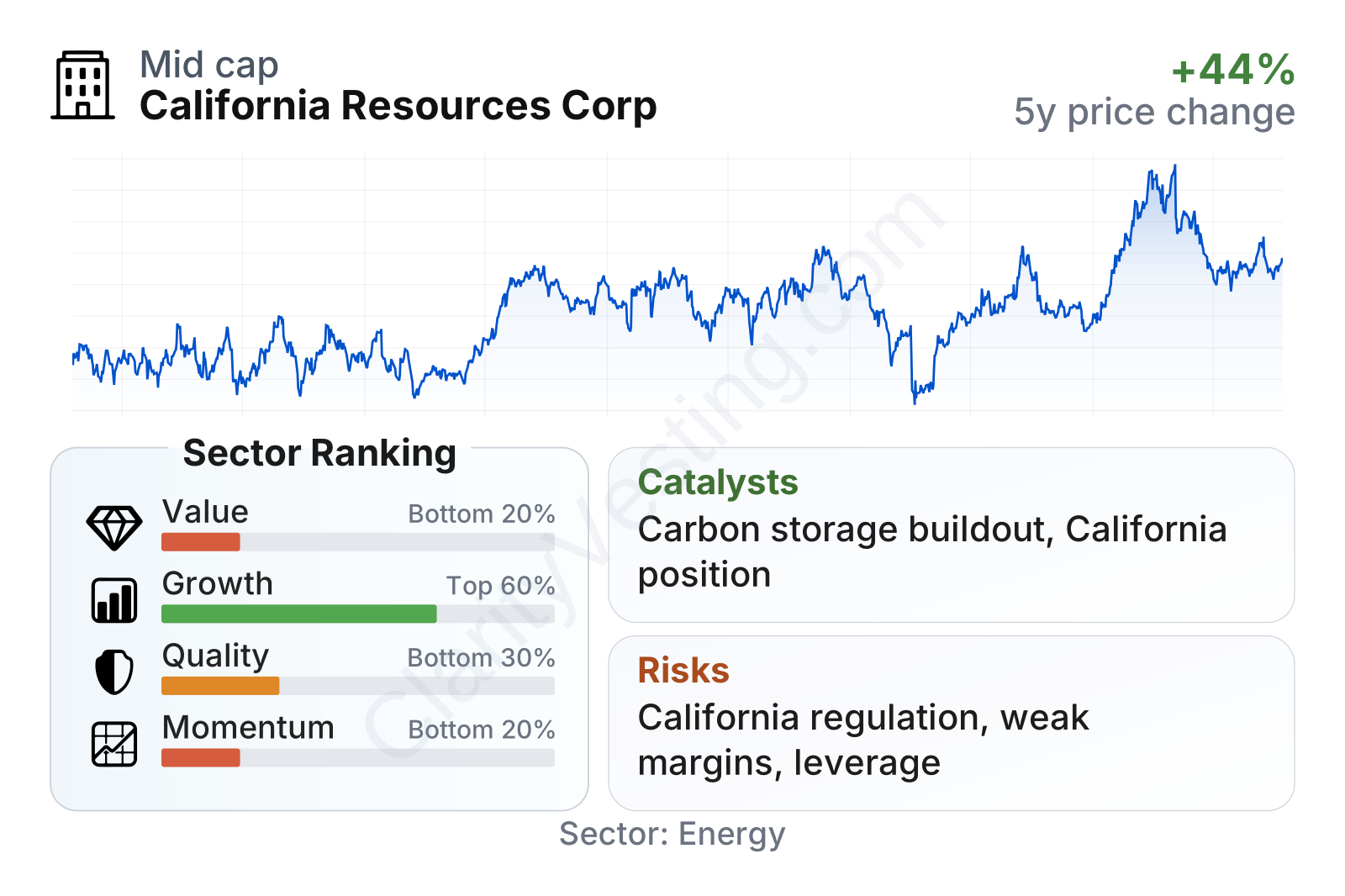
CRC is a mid-sized energy producer with a stock that has been volatile rather than steadily trending upward. The broader profile is mixed: growth metrics sit around the middle of the sector, but quality, value, and momentum rank weaker. Free cash flow yield is slightly better than the sector median, and debt-to-equity is lower than the median, which helps. However, current profitability measures are weak, and recent share price performance has lagged much of the energy group.
Growth
CRC operates in a sector that can still generate meaningful cash flow, but it is not a conventional high-growth industry. Long-term growth in oil and gas depends less on rapid demand expansion and more on supply discipline, commodity prices, reserve quality, operating efficiency, and access to infrastructure. In CRC’s case, the more interesting growth angle is the combination of a mature hydrocarbon base with a developing carbon capture and storage platform.
The company’s strategy has a logical industrial fit. CRC already controls land, subsurface expertise, permitting experience, and infrastructure in California. Those assets can be useful not only for producing oil and gas, but also for storing captured carbon dioxide. California’s policy environment is stricter than that of many other states, but it also tends to support decarbonization projects more aggressively. If CRC can convert that position into contracted carbon storage volumes, it could create a second business line with different economics than pure commodity production.
Revenue growth has been uneven, which is normal for a producer tied to energy prices. The recent pattern shows sharp swings from negative to strongly positive growth rather than a smooth trend. The latest year-over-year reading is well above the sector median, suggesting a recent rebound, but the historical pattern also shows that this business can move quickly in both directions.
Free cash flow remains one of the more important strengths to watch. Even though it has moved up and down over time, CRC has continued to generate positive trailing free cash flow in the hundreds of millions of dollars. That matters because cash generation gives the company flexibility to fund capital spending, support shareholder returns, and continue building its carbon management platform without relying entirely on external financing.
A major catalyst is CRC’s carbon management effort, including its CTV I carbon capture and storage venture and related permitting progress. Another notable opportunity is California’s structural need for in-state energy and emissions solutions. That combination gives CRC exposure to both traditional energy cash flow and a policy-supported decarbonization theme, which is unusual among smaller and mid-sized exploration and production companies.
Risks
This article is for informational purposes only and does not constitute financial advice. Some content is AI-generated. See Disclaimer


