Stock Analysis · CRA International Inc (CRAI)
Overview
CRA International is a consulting firm that helps corporations, law firms, and government bodies analyze complex business problems. Its work is centered on economics, finance, litigation support, regulatory matters, and management consulting. In simple terms, clients usually hire CRA when they need expert advice for high-stakes decisions such as mergers, antitrust reviews, damages claims, investigations, strategy projects, or disputes that may end up in court.
The company organizes its business in two main segments. The larger segment is Litigation, Regulatory and Financial Consulting, which has historically represented the clear majority of revenue. Based on the company’s recent annual reporting, this segment accounts for roughly 75% to 80% of total revenue. It includes antitrust and competition work, forensic services, intellectual property, labor and employment matters, transfer pricing, energy and finance consulting, and expert witness support.
The second segment is Management Consulting, which contributes about 20% to 25% of revenue. This area includes strategic advice, performance improvement, and sector-focused consulting, especially in industries where CRA has specialized expertise such as life sciences, energy, and communications.
Within those segments, revenue is mainly generated from professional fees billed for consultant time and expertise. That means the business depends more on staff utilization, pricing, reputation, and client demand than on factories, inventory, or physical assets. This makes CRA an asset-light company, but also one whose success is closely tied to retaining senior talent and sustaining a strong pipeline of assignments.
The financial profile over the last several years shows a business that has been expanding steadily. Revenue rose from about $566 million in 2021 to about $752 million in 2025, while net income also moved higher over that period. Costs have increased too, but profit dollars have generally grown alongside sales, showing that CRA has been able to scale its consulting platform despite normal fluctuations in utilization and hiring.
The multi-year trend points to consistent top-line growth with improving operating income in dollar terms. Gross profit has expanded meaningfully since 2021, although compensation and administrative costs remain substantial, which is normal for a people-based consulting business.
Key Figures
| Metric | Value | Sector ⓘ |
|---|---|---|
| Date | Oct 31, 2026 | |
| Context | ||
| Sector | Industrials | |
| Industry | Consulting Services | |
| Market Cap ⓘ | $1.21B | |
| Beta ⓘ | 0.69 | |
Value (Cheapness) | ||
| P/E Ratio ⓘ | 25.71 | 21.91 |
| P/B Ratio ⓘ | 6.76 | 1.97 |
| FCF Yield ⓘ | -2.29% | 6.34% |
| Dividend Yield ⓘ | 1.13% | 1.88% |
| EBIT / EV ⓘ | 5.15% | 4.83% |
| PEG ⓘ | 1.27 | |
Growth (Business expansion) | ||
| Revenue Growth ⓘ | 12.80% | 9.50% |
| RPS Growth (5Y CAGR) ⓘ | 10.81% | 7.67% |
| EPS Growth (5Y CAGR) ⓘ | -9.12% | -11.63% |
| BVPS Growth (5Y CAGR) ⓘ | 4.18% | 6.14% |
| Margin Growth (5Y Trend) ⓘ | 1.14% | 0.71% |
| FCF Growth (5Y CAGR) ⓘ | -29.01% | 11.01% |
| DPS Growth (5Y CAGR) ⓘ | 17.31% | 9.31% |
Quality (Business durability) | ||
| ROIC (Latest) ⓘ | 15.83% | 10.70% |
| ROA (Latest) ⓘ | 7.62% | 5.45% |
| ROIC (5Y Median) ⓘ | 21.57% | 9.33% |
| ROA (5Y Median) ⓘ | 7.89% | 4.94% |
| Net Debt / EBIT (Latest) ⓘ | 2.27 | 2.03 |
| Net Debt / EBIT (5Y Median) ⓘ | 1.32 | 2.28 |
| Net Debt / EBITDA (Latest) ⓘ | 1.66 | 1.37 |
| Net Debt / Assets ⓘ | 26.45% | 19.16% |
| EBITDA / Interest ⓘ | 14.98 | 9.73 |
| Operating Margin (Latest) ⓘ | 9.74% | 10.49% |
| Operating Margin (5Y Median) ⓘ | 10.26% | 10.30% |
| Debt to Equity (Latest) ⓘ | 106.28% | 65.91% |
| Profit Margin (Latest) ⓘ | 6.20% | 6.61% |
| Free Cash Flow (Latest) ⓘ | -$27.75M | |
Momentum (Price trend) | ||
| 3Y Return ⓘ | +110.96% | +69.18% |
| 12M Return (excl. last month) ⓘ | -18.36% | +12.04% |
| 6M Return ⓘ | +25.50% | +0.22% |
| Price vs. 200-Day MA ⓘ | +16.63% | +0.19% |
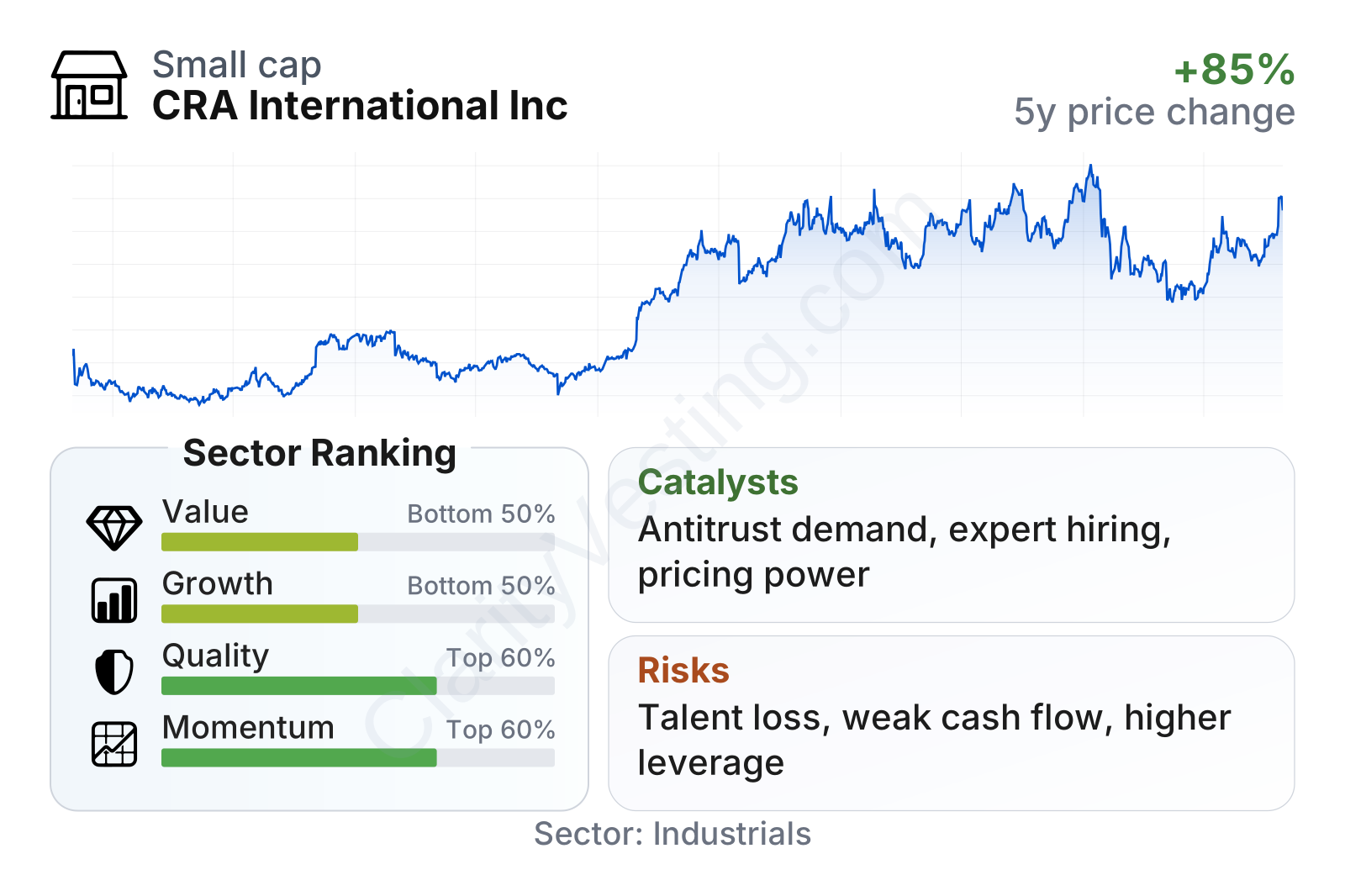
CRA is a small public company by market value, with lower share-price volatility than many stocks in the broader market. The overall profile is mixed: business quality looks solid, with returns on capital above sector norms, while valuation appears somewhat richer than the industry median. Growth has been better than the sector in revenue terms, but weaker cash conversion pulls down the overall growth ranking. Recent share performance has also been uneven, with strong longer-term appreciation but a softer stretch over the last year before a partial recovery.
The company also pays a modest dividend, though income is not the main attraction here. The more important takeaway is that CRA looks like a profitable niche advisory firm with respectable operating performance, but not one that currently stands out as cheap on standard valuation measures.
Growth
CRA operates in a part of consulting that benefits from structural demand rather than one-time trends alone. Regulatory complexity, antitrust enforcement, litigation activity, transfer pricing disputes, and demand for specialized economic analysis all create recurring need for outside experts. These are areas where corporations and law firms often prefer recognized specialists because the cost of a weak analysis can be very high.
The company’s strategy also makes sense for long-term expansion. CRA has continued to invest in senior talent and practice development, which is critical in consulting because prominent professionals often bring both client relationships and pricing power. Growth in this industry often comes from adding well-known experts, deepening capabilities in attractive verticals, and expanding in fields where regulation is increasing.
Recent revenue growth has been healthy. The latest year-over-year pace is around 13%, ahead of the sector median near 10%, and the broader pattern since 2024 has generally stayed positive. That suggests demand has remained solid across the firm’s advisory practices even though quarterly growth can naturally vary based on the timing of large matters.
One caution in the growth profile is cash generation. Free cash flow has been volatile and recently turned negative on a trailing basis. For a consulting firm, this can happen when bonus payments, hiring, working capital movements, or collections temporarily absorb cash. It does not automatically mean the underlying business is deteriorating, but it does matter because sustained earnings growth is more convincing when cash flow follows it.
As for catalysts, CRA’s biggest opportunities likely come from continued demand in antitrust, damages, investigations, and regulatory work, especially when governments take a more active role in competition policy and corporate oversight. Complex litigation and cross-border tax or transfer pricing matters can also support demand for highly specialized advisors. In addition, the company has shown that it can grow through selective expansion of expert teams, which can open new client relationships without requiring heavy capital investment.
Recent company communications have also pointed to ongoing investment in talent and capabilities. In this kind of business, adding recognized experts is more than a staffing decision; it can create a pipeline for future assignments, strengthen reputation in court-related work, and deepen relationships with major law firms and corporate clients.
Risks
This article is for informational purposes only and does not constitute financial advice. Some content is AI-generated. See Disclaimer


