Stock Analysis · Cheniere Energy Partners LP (CQP)
Overview
Cheniere Energy Partners LP is an LNG infrastructure company. In simple terms, it takes natural gas, turns it into liquefied natural gas so it can be shipped overseas, and earns money from the use of its export facilities. Its main asset is the Sabine Pass LNG terminal in Louisiana, one of the largest LNG export sites in the United States. The partnership also owns related pipelines and storage assets that support gas deliveries to the terminal.
The business model is more stable than that of a typical oil and gas producer because a large share of earnings comes from long-term contracts. Customers reserve liquefaction capacity and usually pay fixed fees whether they fully use that capacity or not, with additional revenue tied to LNG volumes and market conditions. That structure helps reduce direct exposure to daily commodity price swings, although it does not eliminate it completely.
Based on the partnership’s recent annual reporting, revenue is mainly generated from LNG and regasification activities, with a much smaller contribution from pipeline transportation.
- LNG and regasification services: approximately 97% to 99% of revenue. This includes fixed liquefaction fees under long-term agreements, LNG sales, and related terminal services at Sabine Pass.
- Pipeline transportation: approximately 1% to 3% of revenue. This comes from fees linked to the Creole Trail Pipeline and associated gas transportation services.
The profit structure has also shown that Cheniere Energy Partners can keep a large portion of revenue after operating costs. Over the last several years, revenue has moved up and down with LNG pricing and cargo mix, but operating income and net income have remained substantial, showing the importance of the contract base and the scale of the asset.
The broad trend is a business with volatile top-line sales but consistently strong profitability. Revenue peaked during the global gas price spike, then normalized, while operating profit stayed robust and interest expense remained a meaningful but fairly stable cost because of the partnership’s debt-heavy structure.
Key Figures
| Metric | Value | Sector ⓘ |
|---|---|---|
| Date | Oct 24, 2026 | |
| Context | ||
| Sector | Energy | |
| Industry | Oil & Gas Midstream | |
| Market Cap ⓘ | $31.29B | |
| Beta ⓘ | 0.33 | |
Value (Cheapness) | ||
| P/E Ratio ⓘ | 11.73 | 15.40 |
| P/B Ratio ⓘ | 8.36 | 1.71 |
| FCF Yield ⓘ | 10.41% | 8.24% |
| Dividend Yield ⓘ | 5.14% | 3.52% |
| EBIT / EV ⓘ | 7.79% | 7.45% |
| PEG ⓘ | 5.05 | |
Growth (Business expansion) | ||
| Revenue Growth ⓘ | 5.20% | 26.85% |
| RPS Growth (5Y CAGR) ⓘ | 3.34% | 6.78% |
| EPS Growth (5Y CAGR) ⓘ | -22.57% | -14.41% |
| BVPS Growth (5Y CAGR) ⓘ | 32.50% | 6.08% |
| Margin Growth (5Y Trend) ⓘ | 8.68% | 0.55% |
| FCF Growth (5Y CAGR) ⓘ | 11.82% | 2.75% |
| DPS Growth (5Y CAGR) ⓘ | 9.21% | 16.79% |
Quality (Business durability) | ||
| ROIC (Latest) ⓘ | 18.67% | 11.30% |
| ROA (Latest) ⓘ | 18.14% | 6.00% |
| ROIC (5Y Median) ⓘ | 17.37% | 10.35% |
| ROA (5Y Median) ⓘ | 14.12% | 5.46% |
| Net Debt / EBIT (Latest) ⓘ | 3.98 | 1.64 |
| Net Debt / EBIT (5Y Median) ⓘ | 4.50 | 1.82 |
| Net Debt / EBITDA (Latest) ⓘ | 3.32 | 1.08 |
| Net Debt / Assets ⓘ | 79.20% | 17.29% |
| EBITDA / Interest ⓘ | 5.70 | 9.53 |
| Operating Margin (Latest) ⓘ | 30.59% | 16.21% |
| Operating Margin (5Y Median) ⓘ | 34.76% | 20.55% |
| Debt to Equity (Latest) ⓘ | 391.22% | 52.27% |
| Profit Margin (Latest) ⓘ | 27.31% | 8.79% |
| Free Cash Flow (Latest) ⓘ | $3.26B | |
Momentum (Price trend) | ||
| 3Y Return ⓘ | +38.70% | +68.93% |
| 12M Return (excl. last month) ⓘ | +33.25% | +42.90% |
| 6M Return ⓘ | +4.79% | +9.18% |
| Price vs. 200-Day MA ⓘ | +2.84% | +9.87% |
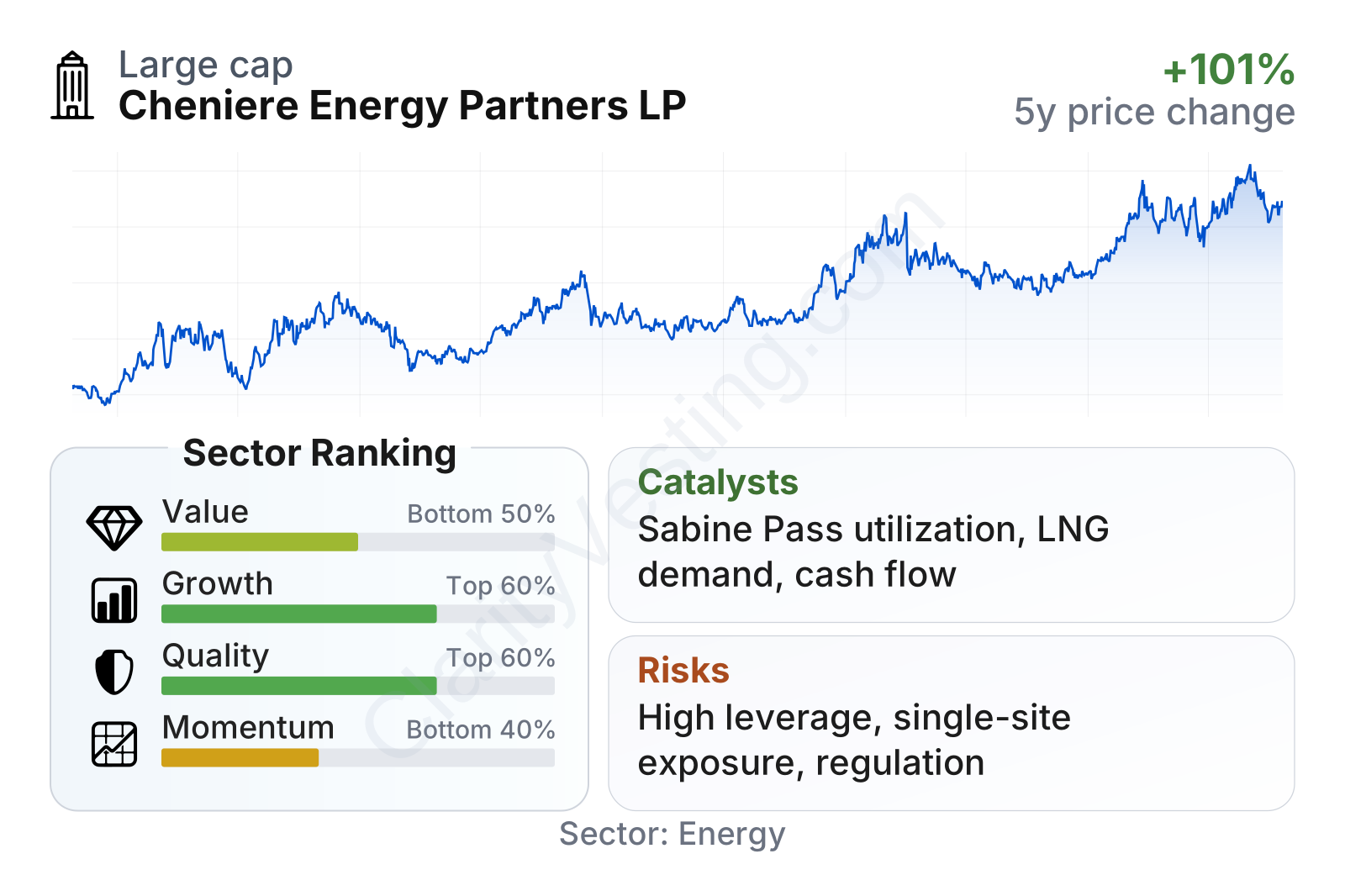
Cheniere Energy Partners is a large midstream energy company with relatively low share-price volatility, reflected by a beta well below 1. On valuation, it screens around the middle of the sector overall, with an earnings multiple below the sector median and a free cash flow yield above it. Quality is supported by strong returns on assets and invested capital, as well as margins that are clearly above most peers. Growth is more mixed: free cash flow expansion has been solid over time, but revenue growth has been uneven and slower than the broader energy sector recently. Market momentum has been weaker than many sector peers even after a strong multi-year stock move.
Growth
Cheniere Energy Partners operates in a sector with durable long-term support. Global LNG demand has been rising as countries look for energy security, cleaner-burning alternatives to coal, and flexible gas supply that can move across oceans. The United States has become a major LNG exporter, and large export terminals with existing permits, operating history, and customer contracts are difficult and expensive to replicate. That makes established LNG infrastructure an attractive position in a market where new supply takes years to build.
The partnership’s strategy is straightforward: maximize the value of the Sabine Pass platform, keep long-term capacity contracted, and convert that scale into distributable cash flow. This approach makes sense for long-term growth because it relies less on finding new commodity reserves and more on operating a scarce infrastructure asset. The parent company, Cheniere Energy, has also continued to advance expansion projects across its broader LNG system, which matters because it reinforces commercial relationships, procurement scale, and operating expertise around the partnership’s core asset.
Revenue growth has not been smooth. After extraordinary growth during the 2021-2022 energy shock, sales declined in 2023 and 2024 as LNG prices normalized, then returned to positive growth in 2025 and remained positive into 2026, though at a slower pace. That pattern is important: it shows that headline revenue can swing sharply with the market environment, even while the underlying infrastructure franchise remains intact.
Free cash flow has been much steadier than revenue. It has stayed in the multi-billion-dollar range and has generally trended upward over the last several years. That is one of the most important features of the company for a long-term view, because cash generation supports distributions, debt service, and financial flexibility even when commodity-linked revenue is less favorable.
A meaningful recent catalyst is the continued strength of U.S. LNG as a strategic export industry. New long-term supply contracting across the LNG market, supportive policy momentum for U.S. gas exports after periods of regulatory uncertainty, and Europe and Asia’s ongoing need for reliable gas imports all reinforce the value of operating export capacity. For Cheniere Energy Partners specifically, the key opportunity is less about a sudden transformation and more about sustained high utilization, steady contract-backed cash flow, and the possibility of improved economics if global LNG trade remains tight.
Risks
This article is for informational purposes only and does not constitute financial advice. Some content is AI-generated. See Disclaimer


