Stock Analysis · China Power International Development Limited (CPWIF)
Overview
China Power International Development Limited is a Chinese power producer and energy operator focused on electricity generation, power sales, and related services. The company is listed in Hong Kong and is part of the State Power Investment Corporation system, one of China’s large state-owned power groups. For long-term analysis, the most important point is that this is not a pure coal utility anymore. It has been shifting its portfolio toward cleaner power sources such as hydropower, wind, solar, and natural gas while still operating traditional thermal power assets.
Its revenue mainly comes from selling electricity and heat, with additional contributions from new energy development and related services. Based on the company’s recent annual disclosures, the business mix is still dominated by power generation, while the production mix has become much more diversified by energy source than in the past.
The main sources of revenue can be summarized as follows:
- Electricity sales: approximately 85% to 95% of revenue. This includes power sold from coal-fired plants, hydropower stations, wind farms, photovoltaic projects, and gas-fired facilities.
- Heat supply: approximately 3% to 10% of revenue. This mainly comes from cogeneration plants that sell steam or heat alongside electricity.
- Other operating income: approximately 2% to 7% of revenue. This can include energy-related services, tariff-related items, and other ancillary utility activities.
From an operating perspective, the company’s strategic emphasis is increasingly on clean energy installed capacity rather than only on current accounting revenue split. That matters because wind, solar, and hydropower are becoming more important drivers of future earnings quality, policy support, and asset value.
The profit flow over recent years shows a clear operational improvement through 2024, with revenue and operating income rising strongly from 2021 levels. One visible pressure point is financing cost: interest expense remains large, which limits how much of the operating progress reaches net profit.
Key Figures
| Metric | Value | Sector ⓘ |
|---|---|---|
| Date | Oct 03, 2026 | |
| Context | ||
| Sector | Utilities | |
| Industry | Utilities - Regulated Electric | |
| Market Cap ⓘ | $4.33B | |
| Beta ⓘ | 0.41 | |
Value (Cheapness) | ||
| P/E Ratio ⓘ | 17.50 | 16.80 |
| P/B Ratio ⓘ | 0.08 | 1.48 |
| FCF Yield ⓘ | -321.22% | 0.64% |
| Dividend Yield ⓘ | 49.71% | 3.91% |
| EBIT / EV ⓘ | N/A | 5.01% |
| PEG ⓘ | N/A | |
Growth (Business expansion) | ||
| Revenue Growth ⓘ | 2.50% | 6.00% |
| RPS Growth (5Y CAGR) ⓘ | 2.15% | 4.14% |
| EPS Growth (5Y CAGR) ⓘ | -10.56% | -11.39% |
| BVPS Growth (5Y CAGR) ⓘ | 6.74% | 4.29% |
| Margin Growth (5Y Trend) ⓘ | 12.89% | 3.55% |
| FCF Growth (5Y CAGR) ⓘ | -40.18% | -9.10% |
| DPS Growth (5Y CAGR) ⓘ | 9.40% | 4.51% |
Quality (Business durability) | ||
| ROIC (Latest) ⓘ | N/A | 6.53% |
| ROA (Latest) ⓘ | 1.67% | 3.19% |
| ROIC (5Y Median) ⓘ | 3.81% | 6.12% |
| ROA (5Y Median) ⓘ | 1.19% | 2.76% |
| Net Debt / EBIT (Latest) ⓘ | 10.42 | 7.15 |
| Net Debt / EBIT (5Y Median) ⓘ | 16.85 | 7.24 |
| Net Debt / EBITDA (Latest) ⓘ | 4.15 | 4.40 |
| Net Debt / Assets ⓘ | 56.05% | 39.16% |
| EBITDA / Interest ⓘ | 5.15 | 4.41 |
| Operating Margin (Latest) ⓘ | 20.03% | 20.93% |
| Operating Margin (5Y Median) ⓘ | 20.96% | 20.18% |
| Debt to Equity (Latest) ⓘ | 387.93% | 140.88% |
| Profit Margin (Latest) ⓘ | 3.92% | 11.32% |
| Free Cash Flow (Latest) ⓘ | -$13.91B | |
Momentum (Price trend) | ||
| 3Y Return ⓘ | +7.26% | +48.75% |
| 12M Return (excl. last month) ⓘ | -20.45% | +11.24% |
| 6M Return ⓘ | -20.45% | -3.69% |
| Price vs. 200-Day MA ⓘ | -18.11% | -1.97% |
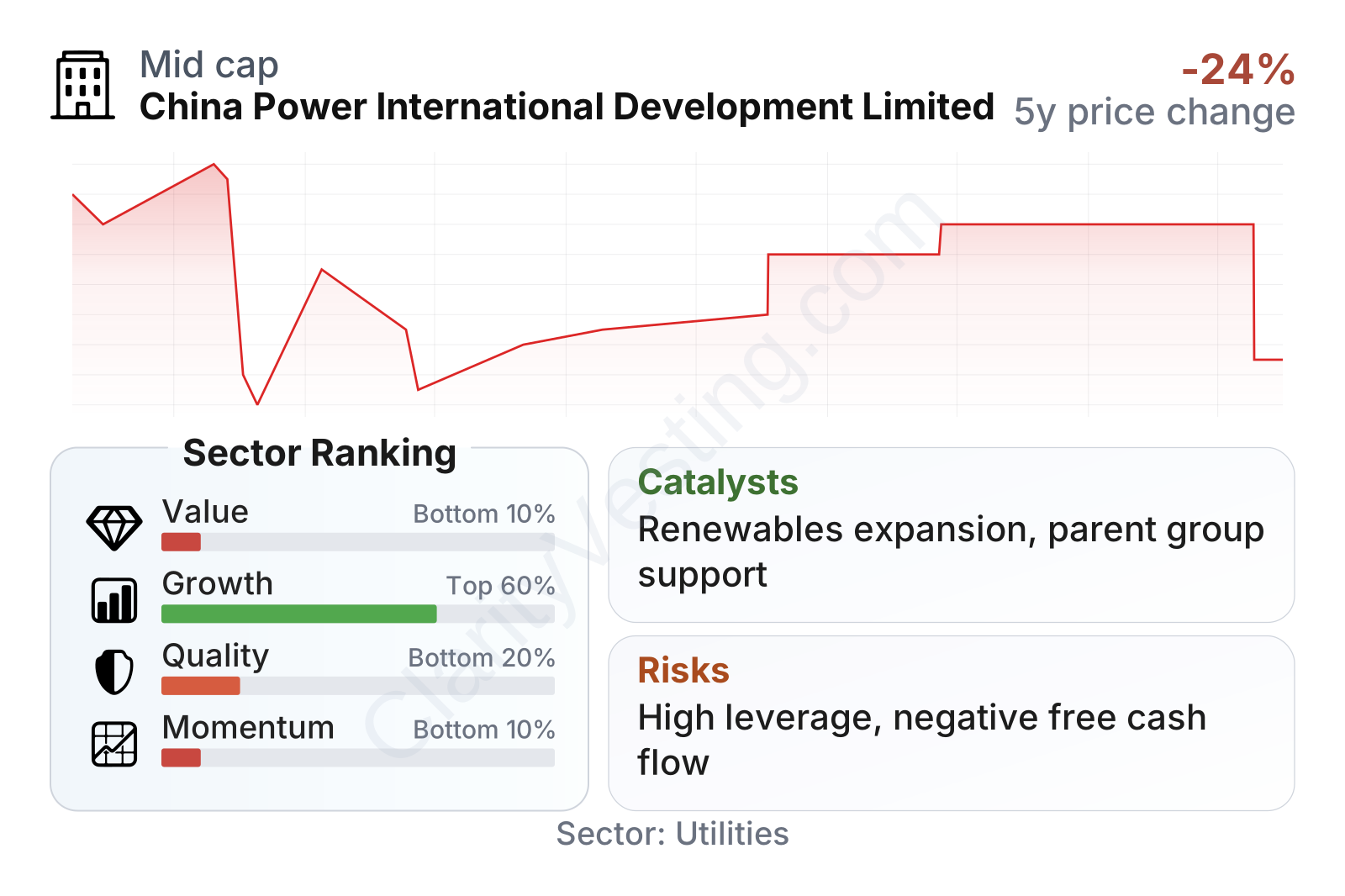
China Power International Development is a mid-sized listed utility by market value, and its share price behavior has been relatively low-volatility, with a beta well below 1. That lower sensitivity can be typical for regulated and asset-heavy utilities, but the recent market trend has been weak. On the operating side, growth indicators are mixed rather than poor: revenue growth is positive, book value per share has compounded at a healthy pace, and operating margins have improved over five years. The more difficult part is quality. Profitability is below many sector peers, leverage is high, and free cash flow is currently negative, which reduces financial flexibility even though interest coverage remains serviceable for now.
Growth
China’s power sector remains a growing and strategically important market, but the most attractive part of that market is not simply electricity demand growth. It is the transition toward lower-carbon generation. China Power International Development is positioned directly in that shift. The company has spent years increasing its exposure to hydropower, wind, solar, and other cleaner assets, which fits both national energy policy and long-term power system needs.
This strategy makes sense because clean energy projects can improve fuel-cost stability over time. Coal plants are exposed to fuel price swings and policy pressure, while hydro, wind, and solar assets usually have different economics: high upfront investment, but lower ongoing fuel costs. For a company with a large balance sheet and state-backed connections, scaling those assets can be a meaningful long-term growth path if financing remains manageable.
Revenue per share has been uneven rather than steadily rising, but the broader pattern over five years still points to moderate expansion. That matches the profile of a utility in transition: growth is present, but it is shaped by new project additions, tariff dynamics, weather conditions for hydro generation, and the timing of asset injections or construction cycles.
A major catalyst is China’s ongoing renewable buildout and electrification trend. Power demand growth from industry, transport electrification, and digital infrastructure supports the need for new generation capacity. Another important catalyst is the company’s access to its parent group ecosystem, which can help with project development, asset acquisitions, and funding channels. In practical terms, this can accelerate portfolio upgrading faster than for a smaller independent producer.
Recent company communications have continued to emphasize clean energy expansion, including renewable project development and installed capacity optimization. For a long-term reader, that is likely the most important opportunity: if the company can keep increasing the share of earnings coming from cleaner assets while controlling debt, its business mix could become structurally stronger than it was a few years ago.
Risks
This article is for informational purposes only and does not constitute financial advice. Some content is AI-generated. See Disclaimer