Stock Analysis · Ceres Power Holdings plc (CPWHF)
Overview
Ceres Power Holdings plc is a U.K.-based clean-energy technology company focused on solid oxide fuel cell and solid oxide electrolyzer technology. In simple terms, it develops electrochemical systems that can convert fuels such as hydrogen, natural gas, or other gases into electricity with high efficiency, and it is also developing systems that can use electricity to produce hydrogen. Rather than trying to become a large-scale manufacturer of end products on its own, Ceres mainly follows a licensing and partnership model: it creates the core technology, then works with industrial partners that can scale manufacturing and commercial deployment.
That business model matters because it makes Ceres look different from many industrial companies. Revenue can be uneven from year to year because it depends heavily on milestone payments, license fees, engineering services, and development work tied to large strategic partners. This can produce sharp swings in reported sales and profitability even when the long-term technology platform is progressing.
Based on recent annual reporting, Ceres generates revenue primarily from technology transfer and license-related activities rather than from mass product sales. The revenue mix can vary materially by year, but the main sources can be described as follows:
- License and milestone revenue: approximately the largest component in stronger years, often around 50% to 70% of revenue when major partner milestones are recognized. This includes upfront technology access, development milestones, and contractual payments linked to progress.
- Engineering services and development work: often around 20% to 40%. This covers technical support, joint development activity, stack and system integration assistance, and work performed for partners.
- Product and hardware-related revenue: generally the smallest share, often below 20%. This includes stacks, test equipment, or related deliverables used in development and validation rather than broad commercial volume shipments.
Ceres has built relationships with large industrial groups over time, including companies involved in power systems, manufacturing, and energy equipment. That partner-led structure is central to the investment case: if partners successfully launch commercial products using Ceres technology, the company could benefit from licensing, royalty, and service income without carrying the full burden of global manufacturing.
The longer-term appeal is tied less to current earnings and more to whether Ceres becomes an enabling technology supplier in hydrogen production and distributed power generation. For now, that remains a scaling and execution question rather than a fully proven commercial outcome.
The financial flow over the last several years shows why the company is still in transition. Revenue improved meaningfully in 2024 before falling back in 2025, while research and development spending stayed very high throughout. Gross profit has at times been strong relative to sales, but operating losses remain large because Ceres continues to fund technology development well ahead of broad commercial rollout.
Key Figures
| Metric | Value | Sector ⓘ |
|---|---|---|
| Date | Oct 17, 2026 | |
| Context | ||
| Sector | Industrials | |
| Industry | Electrical Equipment & Parts | |
| Market Cap ⓘ | $1.25B | |
| Beta ⓘ | 2.09 | |
Value (Cheapness) | ||
| P/E Ratio ⓘ | N/A | 22.10 |
| P/B Ratio ⓘ | 6.06 | 1.97 |
| FCF Yield ⓘ | -4.61% | 6.38% |
| Dividend Yield ⓘ | N/A | 1.94% |
| EBIT / EV ⓘ | N/A | 4.79% |
| PEG ⓘ | N/A | |
Growth (Business expansion) | ||
| Revenue Growth ⓘ | 7.90% | 9.30% |
| RPS Growth (5Y CAGR) ⓘ | 0.39% | 7.81% |
| EPS Growth (5Y CAGR) ⓘ | -17.02% | -13.06% |
| BVPS Growth (5Y CAGR) ⓘ | -22.15% | 6.14% |
| Margin Growth (5Y Trend) ⓘ | N/A | 0.88% |
| FCF Growth (5Y CAGR) ⓘ | -13.29% | 11.01% |
| DPS Growth (5Y CAGR) ⓘ | N/A | 9.48% |
Quality (Business durability) | ||
| ROIC (Latest) ⓘ | N/A | 10.84% |
| ROA (Latest) ⓘ | -40.75% | 5.41% |
| ROIC (5Y Median) ⓘ | -16.35% | 9.38% |
| ROA (5Y Median) ⓘ | -16.95% | 4.95% |
| Net Debt / EBIT (Latest) ⓘ | N/A | 2.08 |
| Net Debt / EBIT (5Y Median) ⓘ | N/A | 2.27 |
| Net Debt / EBITDA (Latest) ⓘ | N/A | 1.39 |
| Net Debt / Assets ⓘ | -70.03% | 19.28% |
| EBITDA / Interest ⓘ | N/A | 9.58 |
| Operating Margin (Latest) ⓘ | -91.44% | 10.50% |
| Operating Margin (5Y Median) ⓘ | -145.11% | 10.29% |
| Debt to Equity (Latest) ⓘ | 1.06% | 65.48% |
| Profit Margin (Latest) ⓘ | -130.56% | 6.67% |
| Free Cash Flow (Latest) ⓘ | -$57.73M | |
Momentum (Price trend) | ||
| 3Y Return ⓘ | +42.75% | +61.68% |
| 12M Return (excl. last month) ⓘ | +240.62% | +12.58% |
| 6M Return ⓘ | +38.63% | 0.00% |
| Price vs. 200-Day MA ⓘ | +3.90% | +0.02% |
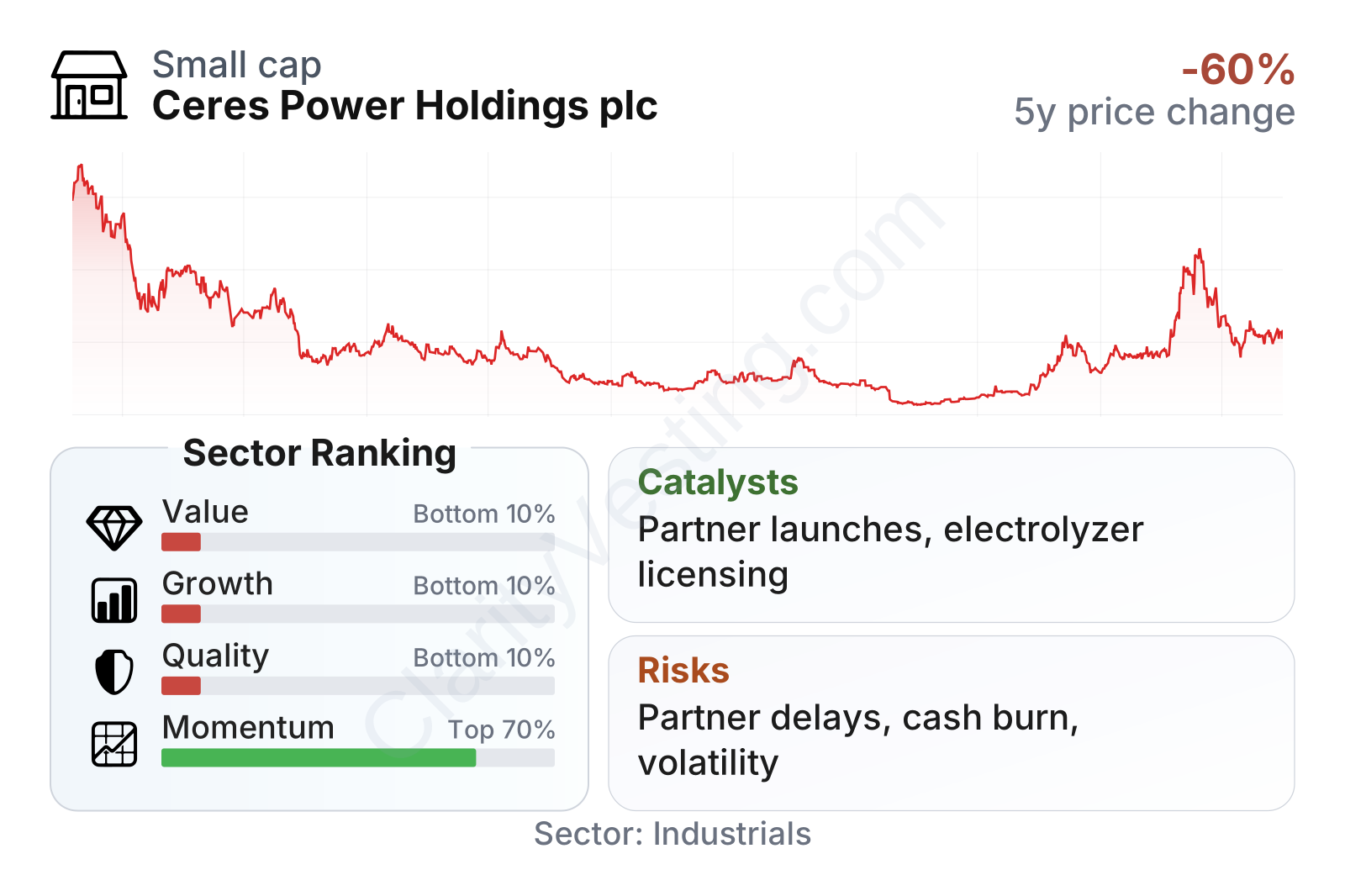
The market metrics point to a company that the market still values on future potential rather than current fundamentals. On value, growth, and quality, Ceres ranks near the bottom of its sector, which is consistent with a business that is not yet profitable and is still consuming cash. The balance sheet is a relative bright spot: debt is very low and net cash remains an important cushion. Momentum has been much stronger than the underlying operating profile, with a sharp rebound over the last year after a very deep decline from earlier highs. That combination usually signals a stock driven by changing expectations around commercialization rather than by stable earnings power.
Growth
Ceres operates in a sector with clear long-term tailwinds. Fuel cells and hydrogen-related equipment are linked to several structural themes: decarbonization, power efficiency, grid resilience, industrial electrification, and low-carbon hydrogen production. Solid oxide technology is especially interesting because it can operate at high efficiency and can potentially serve both power generation and hydrogen production. If those end markets expand as expected, a specialist technology owner like Ceres could have a meaningful role.
The company’s strategy is logically built for that opportunity. Licensing the core platform to larger industrial partners reduces the need for Ceres to build giant factories and compete head-on in capital-intensive manufacturing. If the model works, it can support higher returns on capital than a fully integrated equipment business. The challenge is timing: the value depends on partners moving from demonstrations and development programs into repeat commercial orders.
A notable positive point is that Ceres has continued to attract major counterparties and has been expanding the relevance of its technology beyond fuel cells into electrolyzers. That creates two possible growth paths instead of one. Fuel cells can address distributed and efficient power generation, while electrolyzers can address hydrogen production. Few smaller listed companies have credible exposure to both through the same core materials and stack expertise.
Recent corporate developments have also reinforced the idea that external validation matters here. New partnerships, manufacturing progress by licensees, and updates on commercial deployment plans are more important for Ceres than short-term quarterly sales swings. In practical terms, the strongest catalysts are likely to be additional licensing agreements, successful partner product launches, and evidence that royalty-like revenue can become recurring rather than project-based.
The industry backdrop is supportive, but investors should recognize the difference between a growing sector and a company already converting that sector growth into durable financial results. Ceres clearly has exposure to an attractive market; the open question is how quickly that opportunity becomes visible in sustained revenue and narrower losses.
Risks
This article is for informational purposes only and does not constitute financial advice. Some content is AI-generated. See Disclaimer


