Stock Analysis · Camden Property Trust (CPT)
Overview
Camden Property Trust is a residential real estate investment trust, or REIT. In simple terms, it owns, develops, acquires, and manages apartment communities, mainly in large U.S. metro areas with strong job markets and population growth. The company focuses on multifamily housing, which means rental apartment properties rather than offices, malls, or industrial buildings.
Its business is built around collecting rent from residents, keeping occupancy high, controlling property-level costs, and selectively building or buying new communities where demand appears attractive. Camden also earns smaller amounts from related property activities such as fees and other resident services, but the core of the business remains apartment operations.
Based on recent annual reporting, Camden’s revenue mix is heavily concentrated in property operations. The main sources are approximately:
- Rental and other property revenue: about 95% to 97% — monthly apartment rent, parking, utility reimbursements, pet-related charges, and other resident fees tied to owned communities.
- Property management and fee income: about 1% to 3% — management-related income and smaller operating fees where applicable.
- Other real estate activity: about 1% to 3% — items such as development-related or transactional real estate income, which can vary by year.
What stands out is the simplicity of the model: Camden is largely a pure-play apartment landlord. That makes the business easier to understand than diversified property owners, but it also means results depend heavily on apartment rent trends, occupancy, and the health of the Sun Belt and other target markets.
Over the last several years, total revenue has trended upward, while profitability has moved around more sharply because apartment REIT earnings can be affected by property sales, financing costs, and valuation-related items. Even so, the business continues to generate a large gross profit base and substantial cash flow from its portfolio.
Revenue has climbed from roughly $1.1 billion in 2021 to about $1.6 billion in 2025, showing portfolio expansion and rent growth over time. Profitability has been less smooth, with interest expense rising and net income moving more than revenue, which is typical for a capital-intensive REIT.
Key Figures
| Metric | Value | Sector ⓘ |
|---|---|---|
| Date | Oct 03, 2026 | |
| Context | ||
| Sector | Real Estate | |
| Industry | REIT - Residential | |
| Market Cap ⓘ | $9.73B | |
| Beta ⓘ | 0.78 | |
Value (Cheapness) | ||
| P/E Ratio ⓘ | 32.46 | 17.35 |
| P/B Ratio ⓘ | 2.60 | 0.86 |
| FCF Yield ⓘ | 6.85% | 7.47% |
| Dividend Yield ⓘ | 4.33% | 4.75% |
| EBIT / EV ⓘ | 3.03% | 3.81% |
| PEG ⓘ | 9.17 | |
Growth (Business expansion) | ||
| Revenue Growth ⓘ | -0.80% | 5.30% |
| RPS Growth (5Y CAGR) ⓘ | 6.88% | 5.96% |
| EPS Growth (5Y CAGR) ⓘ | 2.14% | -11.41% |
| BVPS Growth (5Y CAGR) ⓘ | -0.80% | 0.41% |
| Margin Growth (5Y Trend) ⓘ | -1.85% | 0.53% |
| FCF Growth (5Y CAGR) ⓘ | 26.94% | 5.40% |
| DPS Growth (5Y CAGR) ⓘ | 6.25% | 5.02% |
Quality (Business durability) | ||
| ROIC (Latest) ⓘ | N/A | 5.77% |
| ROE (Latest) ⓘ | 7.88% | 7.64% |
| ROA (Latest) ⓘ | 3.52% | 2.85% |
| ROIC (5Y Median) ⓘ | 5.85% | 4.20% |
| ROE (5Y Median) ⓘ | 8.20% | 6.03% |
| ROA (5Y Median) ⓘ | 4.30% | 2.45% |
| Net Debt / EBIT (Latest) ⓘ | 9.83 | 7.57 |
| Net Debt / EBIT (5Y Median) ⓘ | 7.22 | 8.41 |
| Net Debt / EBITDA (Latest) ⓘ | 4.35 | 5.12 |
| Net Debt / Assets ⓘ | 50.80% | 37.84% |
| EBITDA / Interest ⓘ | 7.48 | 4.11 |
| Operating Margin (Latest) ⓘ | 31.07% | 35.40% |
| Operating Margin (5Y Median) ⓘ | 34.14% | 36.59% |
| Debt to Equity (Latest) ⓘ | 127.52% | 89.06% |
| Profit Margin (Latest) ⓘ | 20.62% | 19.99% |
| Free Cash Flow (Latest) ⓘ | $665.85M | |
Momentum (Price trend) | ||
| 3Y Return ⓘ | +16.63% | +30.60% |
| 12M Return (excl. last month) ⓘ | -1.52% | +7.55% |
| 6M Return ⓘ | +0.30% | +0.69% |
| Price vs. 200-Day MA ⓘ | -7.77% | -2.30% |
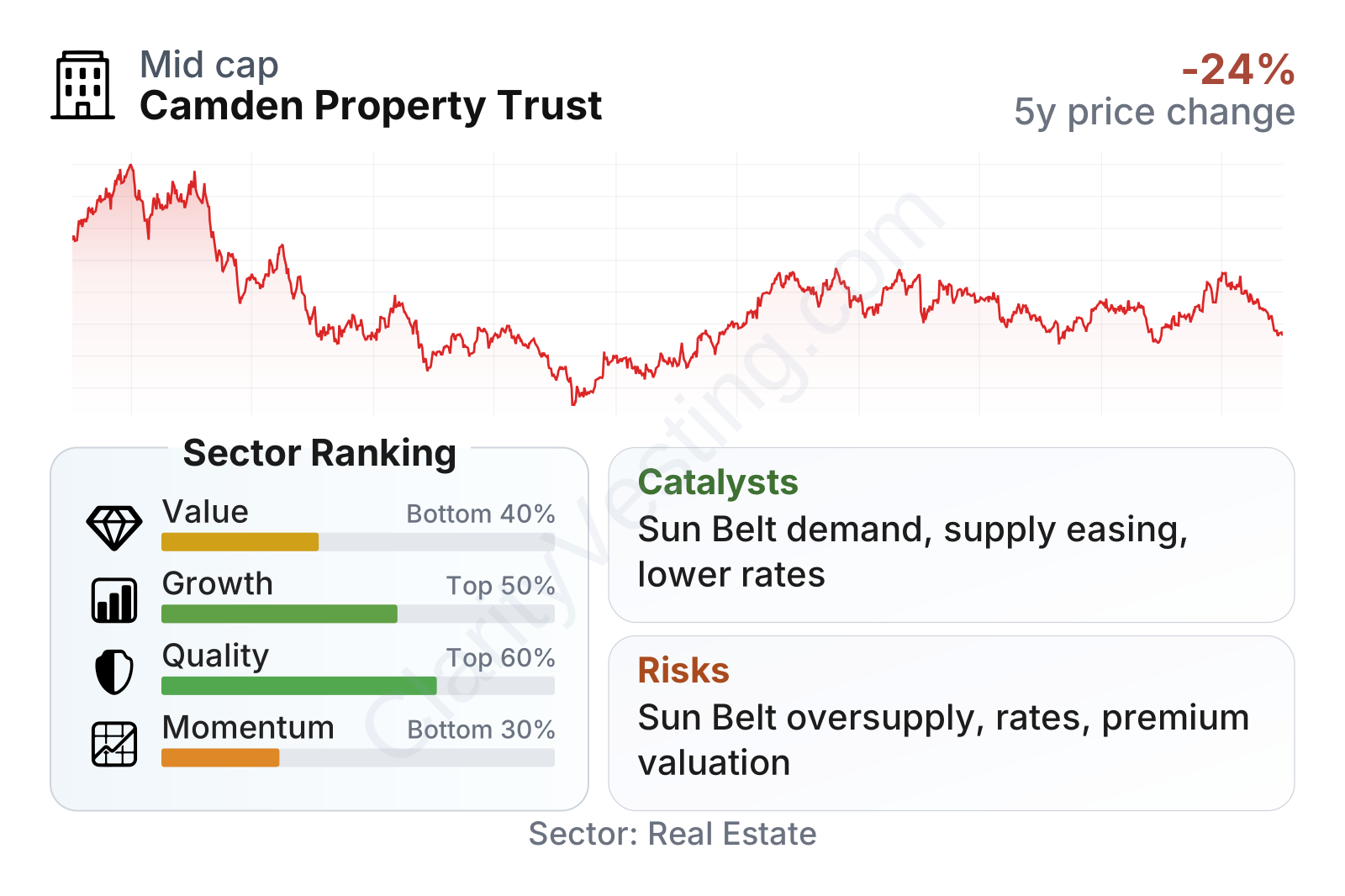
Camden sits in the large-cap range for residential REITs and its shares have shown lower volatility than the broader market, as reflected by a beta below 1. The overall picture is mixed: quality metrics are relatively solid versus the sector, growth is around the middle of the pack with strong long-term cash flow and dividend expansion, but valuation looks richer than many peers and recent share-price momentum has been weak.
The stock price history also reflects the rate-sensitive nature of apartment REITs. After a strong period in late 2021, the shares reset during the higher-rate environment and have spent the last few years moving unevenly. More recently, the price has recovered from earlier lows, but the longer trend still suggests that the market is balancing stable operations against valuation and interest-rate pressure.
Growth
Camden operates in a sector that benefits from a basic long-term need: housing. Apartment demand tends to be supported by population growth, household formation, limited affordability in homeownership, and job creation in major metro areas. That gives the residential rental market a durable structural base, although growth can still be cyclical depending on local supply conditions.
Camden’s strategy is coherent for long-term expansion. The company has historically concentrated on markets with favorable demographic trends, especially in the South and Southwest, where migration, employment growth, and business relocations have often outpaced the national average. For an apartment owner, that matters because rent growth is usually strongest where new residents and jobs are arriving faster than housing can adjust.
Revenue per share has moved higher over the past five years, which is an encouraging sign because it shows that growth has not come only from issuing more shares or using more leverage. The pace has moderated recently, but the broader direction remains positive.
Dividend per share has also increased steadily over the same period. For a REIT, that suggests management has been able to convert property cash generation into a rising shareholder payout while still funding operations and development activity.
A notable strength in the broader growth profile is free cash flow improvement over five years, which has grown much faster than the sector median. Recent year-over-year revenue growth has been slightly negative, however, so the near-term picture is not as strong as the longer record. This makes Camden less of a rapid-growth name and more of a business with moderate expansion potential supported by disciplined portfolio management.
As for catalysts, a few stand out. If interest rates become more favorable, apartment REIT valuations often improve because borrowing costs and property capitalization rates matter greatly to the sector. Camden could also benefit from new supply easing in some of its markets after a heavy apartment construction cycle. If demand stays healthy while deliveries slow, pricing power and occupancy could improve. In addition, continued migration to its focus markets remains an important long-term tailwind.
Recent company updates have also highlighted ongoing development and redevelopment activity, as well as capital recycling through selective dispositions and new investments. That does not create overnight change, but it can gradually improve the quality and earnings power of the portfolio if done well.
Risks
This article is for informational purposes only and does not constitute financial advice. Some content is AI-generated. See Disclaimer


