Stock Analysis · Copart Inc (CPRT)
Overview
Copart is a global vehicle remarketing company best known for operating online auctions for used, damaged, salvage, and clean-title vehicles. In simple terms, it helps sellers move vehicles efficiently to buyers ranging from dismantlers and rebuilders to dealers, exporters, and the general public in selected markets. The company also provides the land, storage, logistics, and digital auction tools needed to process very large volumes of vehicles.
Its business is closely tied to the auto insurance ecosystem. When a car is declared a total loss after an accident, flood, hail event, or theft recovery, insurers often send that vehicle to Copart to be sold through its platform. The company also works with dealers, fleet operators, rental car companies, charities, and individual sellers.
Revenue is mainly generated from service fees rather than from taking large balance-sheet risk on vehicle ownership. Based on recent annual disclosures, the main sources of revenue are approximately:
- U.S. service revenue: about 73% — auction fees, towing, storage, title processing, and other services tied to selling vehicles for third parties in the United States.
- International service revenue: about 20% — similar auction and related services in markets outside the United States, including the U.K., Germany, Brazil, Canada, the Middle East, and others.
- U.S. vehicle sales: about 6% — vehicles sold from inventory owned by Copart or acquired under certain arrangements.
- International vehicle sales: about 1% — direct vehicle sales outside the United States.
This mix matters because fee-based revenue is usually more resilient than pure resale revenue. It helps explain why Copart has historically produced unusually high margins for an industrial-services company.
The business has expanded revenue steadily over the last several years, while operating income and net income remained very strong. A notable change in the latest period is that revenue growth has slowed sharply, while selling and administrative costs have grown faster, which suggests a business that is still highly profitable but no longer moving at its earlier pace.
Key Figures
| Metric | Value | Sector ⓘ |
|---|---|---|
| Date | Oct 24, 2026 | |
| Context | ||
| Sector | Industrials | |
| Industry | Specialty Business Services | |
| Market Cap ⓘ | $25.78B | |
| Beta ⓘ | 1.06 | |
Value (Cheapness) | ||
| P/E Ratio ⓘ | 17.95 | 22.29 |
| P/B Ratio ⓘ | 2.90 | 1.98 |
| FCF Yield ⓘ | 4.92% | 6.26% |
| Dividend Yield ⓘ | N/A | 1.92% |
| EBIT / EV ⓘ | 8.22% | 4.83% |
| PEG ⓘ | 2.83 | |
Growth (Business expansion) | ||
| Revenue Growth ⓘ | 2.40% | 9.30% |
| RPS Growth (5Y CAGR) ⓘ | 7.66% | 7.76% |
| EPS Growth (5Y CAGR) ⓘ | 2.58% | -13.17% |
| BVPS Growth (5Y CAGR) ⓘ | 18.66% | 6.13% |
| Margin Growth (5Y Trend) ⓘ | 0.55% | 0.74% |
| FCF Growth (5Y CAGR) ⓘ | 10.85% | 10.79% |
| DPS Growth (5Y CAGR) ⓘ | 82.17% | 9.41% |
Quality (Business durability) | ||
| ROIC (Latest) ⓘ | N/A | 10.75% |
| ROA (Latest) ⓘ | 14.40% | 5.41% |
| ROIC (5Y Median) ⓘ | 20.15% | 9.37% |
| ROA (5Y Median) ⓘ | 17.98% | 4.95% |
| Net Debt / EBIT (Latest) ⓘ | -0.99 | 2.04 |
| Net Debt / EBIT (5Y Median) ⓘ | -0.93 | 2.27 |
| Net Debt / EBITDA (Latest) ⓘ | -0.88 | 1.39 |
| Net Debt / Assets ⓘ | -18.14% | 19.27% |
| EBITDA / Interest ⓘ | N/A | 9.58 |
| Operating Margin (Latest) ⓘ | 39.32% | 10.49% |
| Operating Margin (5Y Median) ⓘ | 40.17% | 10.30% |
| Debt to Equity (Latest) ⓘ | 0.97% | 64.82% |
| Profit Margin (Latest) ⓘ | 31.81% | 6.67% |
| Free Cash Flow (Latest) ⓘ | $1.27B | |
Momentum (Price trend) | ||
| 3Y Return ⓘ | -36.86% | +67.77% |
| 12M Return (excl. last month) ⓘ | -36.95% | +12.05% |
| 6M Return ⓘ | -18.24% | 0.00% |
| Price vs. 200-Day MA ⓘ | -15.70% | +0.67% |
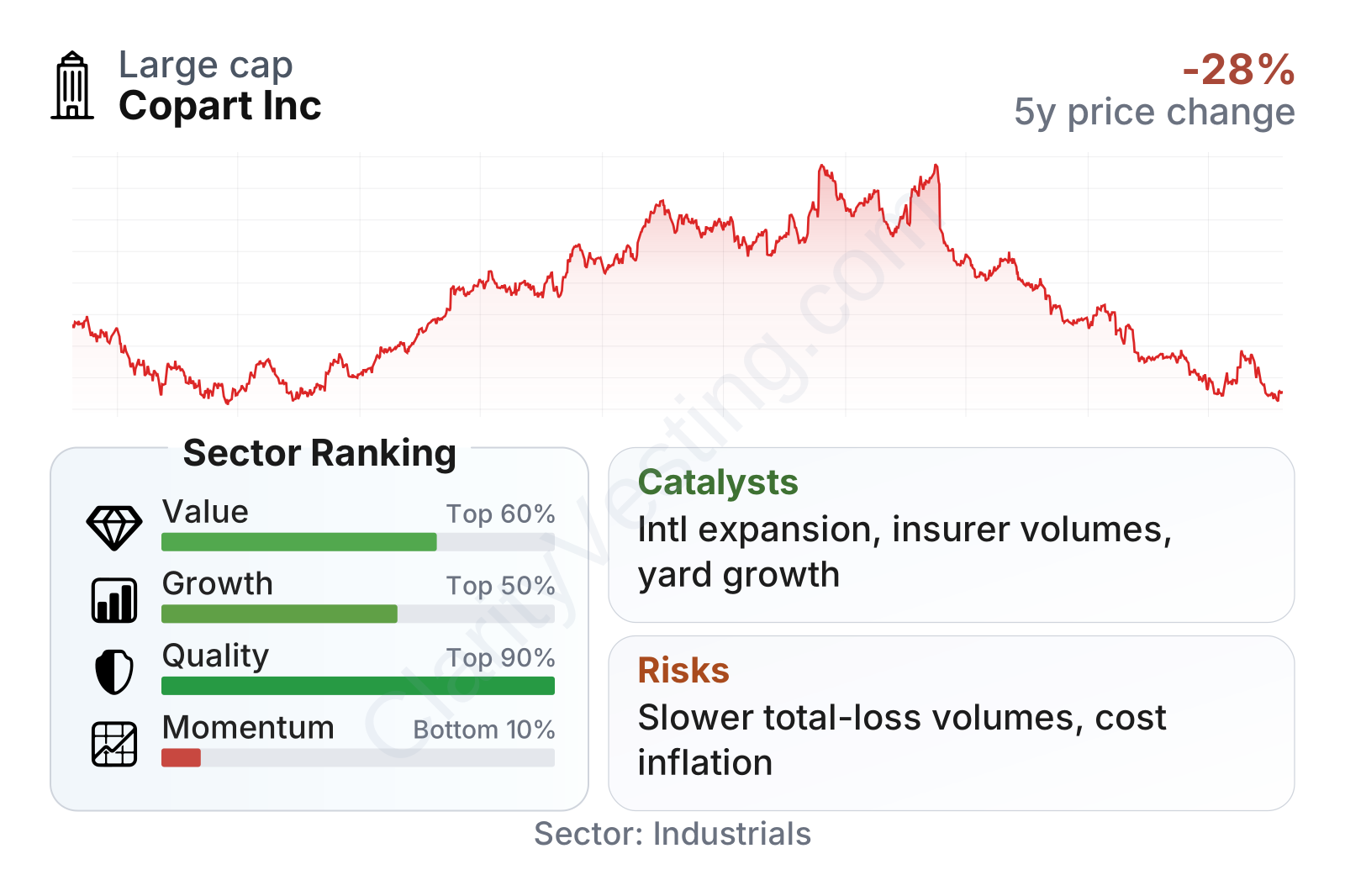
Copart remains a large company with a market value in the tens of billions of dollars, and its share-price volatility is close to the broader market. The standout feature in the table is quality: profitability, returns on assets, and balance-sheet strength are all far better than typical sector levels. Growth is more mixed, with long-term compounding still solid but recent revenue expansion noticeably slower than the sector median. Momentum is the weak point, reflecting a steep stock-price pullback over the last one to three years.
Growth
Copart operates in a niche with durable long-term demand. Vehicle accidents, weather-related damage, theft recoveries, aging car fleets, and the increasing complexity of repairs all support the flow of vehicles into salvage and remarketing channels. Modern vehicles are packed with sensors, cameras, and electronics, which often makes repairs more expensive. That can increase total-loss frequency and create more supply for auction platforms like Copart.
The company’s strategy for future growth is straightforward and logical. It continues to add land, storage capacity, and processing infrastructure near major population centers, because scale and local yard availability are critical in this business. It also benefits from a global digital buyer network: the more buyers participate, the more sellers may obtain competitive prices, which in turn can attract more volume. This creates a network effect that is difficult for smaller rivals to match.
Recent revenue growth has cooled from very strong double-digit levels seen earlier in the cycle to low single-digit growth most recently, including one brief negative period. That slowdown does not suggest a broken business, but it does show that Copart is moving through a more mature phase and facing tougher comparisons than in prior years.
Cash generation remains one of the clearest positives. Free cash flow has climbed meaningfully over the past several years and now sits well above the levels seen in 2022 and 2023. That gives Copart room to keep investing in land, yards, technology, and selective expansion without depending heavily on outside financing.
A meaningful catalyst is international expansion. Copart already has a strong U.S. position, so newer markets provide an additional runway if management can replicate its operating model abroad. Another catalyst is catastrophe-related volume. Major hail, flood, or storm events can temporarily increase the number of damaged vehicles entering auctions. This is not a growth engine management controls, but it can create bursts of activity.
Recent company disclosures also point to ongoing yard expansion and infrastructure investment. That may not look dramatic in a headline, but in this business, additional capacity can support future volumes and reinforce customer relationships with insurers and large commercial sellers.
Risks
This article is for informational purposes only and does not constitute financial advice. Some content is AI-generated. See Disclaimer