Stock Analysis · Cathay Pacific Airways Limited (CPCAF)
Overview
Cathay Pacific Airways Limited is a Hong Kong-based airline group centered on passenger air travel, cargo transportation, and related aviation services. Its best-known brands are Cathay Pacific and HK Express, and the group also has interests in loyalty, maintenance, catering, and other airline support activities. The company’s role is broader than simply flying people between cities: it operates a hub-and-spoke network through Hong Kong, which allows it to connect traffic between Mainland China, the rest of Asia, Europe, North America, and other long-haul markets.
The group’s revenue is mainly generated by transporting passengers, followed by air cargo, with a smaller contribution from ancillary and associated businesses. Based on recent annual reporting, the revenue mix is approximately:
- Passenger services: about 72% to 75% — ticket sales across premium, economy, and regional routes operated mainly by Cathay Pacific and HK Express.
- Cargo services: about 20% to 23% — air freight carried through Cathay Cargo, including e-commerce shipments, electronics, perishables, and other time-sensitive goods.
- Other services and recoveries: about 3% to 5% — this includes items such as airline-related support services and miscellaneous revenue streams.
- Associated companies and subsidiaries outside core flying operations: a low-single-share contribution to profit rather than revenue — this can include loyalty and aviation support activities, although the exact split varies by reporting period.
This mix matters because Cathay is not purely dependent on leisure travel. Cargo remains a meaningful earnings buffer, and HK Express adds exposure to the faster-growing low-cost segment in Asia. The business still revolves around a capital-intensive airline model, but it has more than one commercial engine.
The financial flow over the last several years shows a sharp recovery from pandemic-era losses into solid profitability. Revenue has more than doubled from 2021 levels, while interest expense has started to ease from its peak, reflecting a business that has moved from survival mode back into expansion and balance-sheet repair.
Key Figures
| Metric | Value | Sector ⓘ |
|---|---|---|
| Date | Oct 03, 2026 | |
| Context | ||
| Sector | Industrials | |
| Industry | Airlines | |
| Market Cap ⓘ | $11.31B | |
| Beta ⓘ | 0.43 | |
Value (Cheapness) | ||
| P/E Ratio ⓘ | 7.15 | 22.45 |
| P/B Ratio ⓘ | 0.20 | 1.98 |
| FCF Yield ⓘ | 286.60% | 6.31% |
| Dividend Yield ⓘ | 48.39% | 1.96% |
| EBIT / EV ⓘ | N/A | 4.81% |
| PEG ⓘ | 3.63 | |
Growth (Business expansion) | ||
| Revenue Growth ⓘ | 25.30% | 9.10% |
| RPS Growth (5Y CAGR) ⓘ | 25.13% | 7.75% |
| EPS Growth (5Y CAGR) ⓘ | N/A | -13.59% |
| BVPS Growth (5Y CAGR) ⓘ | -5.54% | 6.22% |
| Margin Growth (5Y Trend) ⓘ | 13.28% | 0.72% |
| FCF Growth (5Y CAGR) ⓘ | 24.82% | 10.98% |
| DPS Growth (5Y CAGR) ⓘ | 26.24% | 9.48% |
Quality (Business durability) | ||
| ROIC (Latest) ⓘ | 28.76% | 10.92% |
| ROA (Latest) ⓘ | 13.19% | 5.41% |
| ROIC (5Y Median) ⓘ | 7.81% | 9.21% |
| ROA (5Y Median) ⓘ | 5.51% | 4.94% |
| Net Debt / EBIT (Latest) ⓘ | 1.87 | 2.07 |
| Net Debt / EBIT (5Y Median) ⓘ | 4.17 | 2.28 |
| Net Debt / EBITDA (Latest) ⓘ | 1.02 | 1.43 |
| Net Debt / Assets ⓘ | 30.65% | 19.27% |
| EBITDA / Interest ⓘ | 6.61 | 9.53 |
| Operating Margin (Latest) ⓘ | 12.50% | 10.50% |
| Operating Margin (5Y Median) ⓘ | 12.05% | 10.27% |
| Debt to Equity (Latest) ⓘ | 109.44% | 65.48% |
| Profit Margin (Latest) ⓘ | 10.28% | 6.62% |
| Free Cash Flow (Latest) ⓘ | $32.42B | |
Momentum (Price trend) | ||
| 3Y Return ⓘ | +129.57% | +58.56% |
| 12M Return (excl. last month) ⓘ | +36.04% | +15.63% |
| 6M Return ⓘ | +17.94% | +4.19% |
| Price vs. 200-Day MA ⓘ | +78.15% | +0.93% |
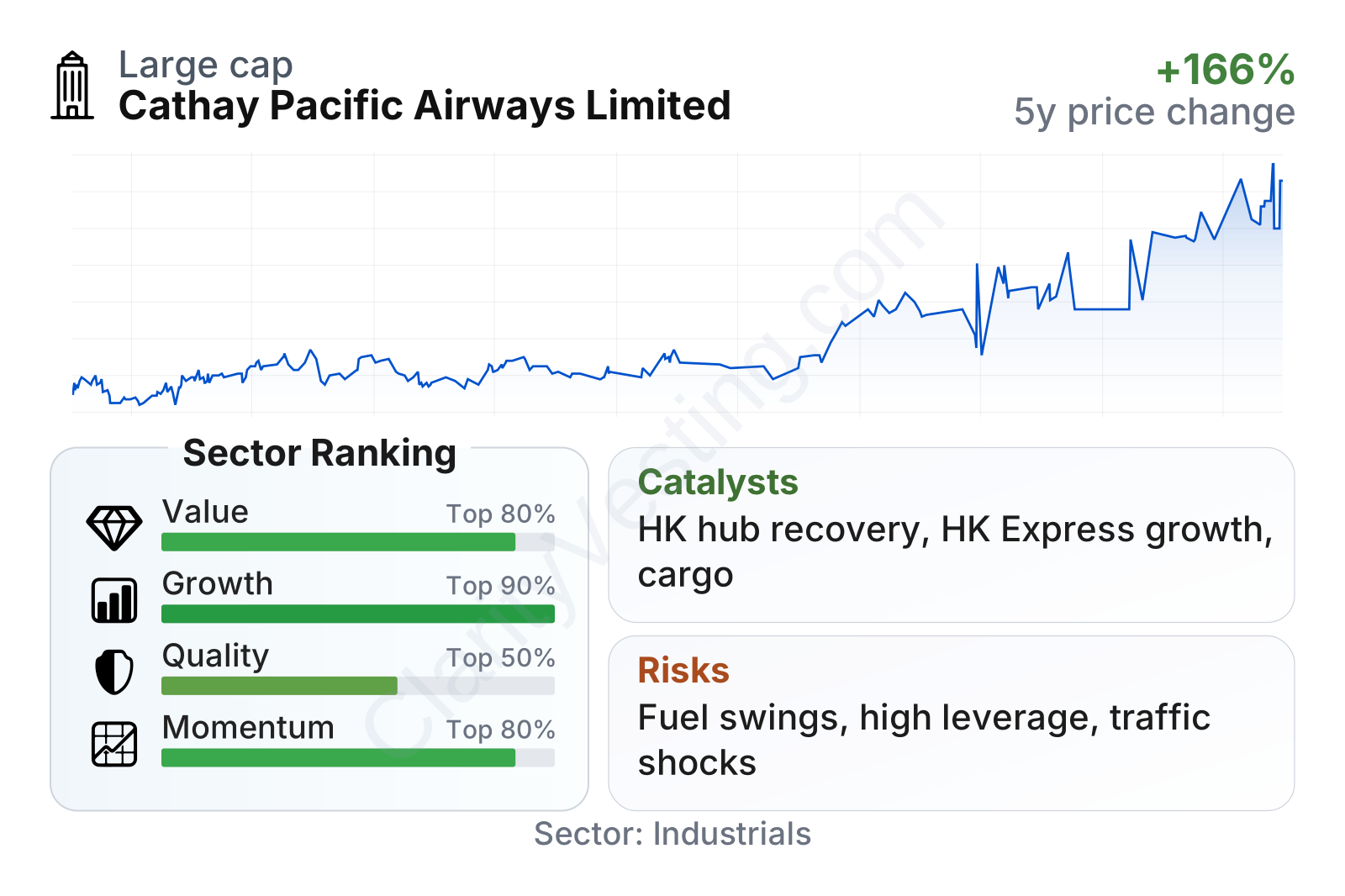
Cathay Pacific currently stands out more for valuation and growth than for absolute balance-sheet conservatism. The company screens cheaply relative to much of the airline and broader industrial universe, with a low earnings multiple and a price-to-book ratio far below sector norms. Growth metrics are strong, helped by the post-reopening recovery and the rebuilding of network capacity. Profitability indicators are also above many peers, especially return on capital and operating margin. The weaker points are leverage and interest coverage, which are acceptable for an airline but not especially comfortable compared with the best-capitalized competitors.
Growth
The airline sector is growing over the long run, especially in Asia-Pacific, where rising middle-class travel demand, cross-border tourism, premium business travel, and e-commerce freight all support volume expansion. Cathay is positioned in one of the world’s most strategically important aviation hubs. Hong Kong’s location gives the group access to both high-yield long-haul routes and dense regional traffic, while its cargo franchise benefits from Asia’s role in global trade and express shipping.
Cathay’s strategy is coherent for this environment. Management has focused on restoring flight capacity, rebuilding its workforce, modernizing the fleet, and expanding the dual-brand model with Cathay Pacific for full-service travel and HK Express for low-cost regional flying. That matters because different parts of Asian travel demand are growing at different speeds, and the group now has tools to address both premium international demand and price-sensitive short-haul demand.
Another growth support is cargo resilience. Passenger flying usually gets most of the attention, but Cathay Cargo remains an important differentiator. Hong Kong International Airport is one of the world’s largest cargo gateways, and Cathay’s position there gives it a scale advantage in freight that not every passenger airline can match. If global trade remains uneven, e-commerce and specialized freight can still provide support.
Recent growth indicators remain robust. Revenue growth has been well ahead of the sector median, and the longer-term trend in revenue per share and free cash flow has also been strong. That does not mean growth will continue at the same pace, because reopening effects naturally become harder to repeat. Still, the combination of capacity normalization, premium traffic recovery, and low-cost expansion gives Cathay more than one path to keep growing after the initial rebound phase fades.
A notable recent opportunity is the continued restoration of Hong Kong’s role as an international transit hub. As air connectivity normalizes further and Mainland China outbound demand keeps recovering, Cathay may continue to benefit from higher aircraft utilization, better route economics, and improved premium cabin demand. Fleet renewal and cabin investments also support pricing power on long-haul routes where service quality can influence customer choice.
Risks
This article is for informational purposes only and does not constitute financial advice. Some content is AI-generated. See Disclaimer


