Stock Analysis · ALS Limited (CPBLF)
Overview
ALS Limited is a testing, inspection, certification, and technical services company. In simple terms, it helps customers measure, verify, and analyze materials, products, and environments. Its laboratories and field teams support mining companies, pharmaceutical and food producers, environmental clients, industrial operators, and energy customers. The business is built around services that are often recurring, regulation-driven, and important to customers’ own operations, which gives ALS a steadier profile than many traditional industrial companies.
The group’s revenue mainly comes from laboratory testing and related technical services across several end markets. Based on the latest annual reporting, the business mix is led by commodities and life sciences, with smaller contributions from industrial and broader consumer-oriented testing activities.
- Commodities: about 54% of revenue. This includes geochemistry, metallurgical testing, mine-site services, inspection, and related work for minerals and energy customers.
- Life Sciences: about 40% of revenue. This covers environmental testing, food and pharmaceutical testing, and other analytical services tied to health, safety, and regulation.
- Industrial and other activities: about 6% of revenue. This includes asset care, tribology, oil and lubricant analysis, and selected industrial testing services.
Geographically, ALS is broadly international, with meaningful operations in Australia, the Americas, Europe, and Asia. That diversification matters because demand can be uneven across mining cycles and regional industrial activity. The operating model is also attractive in another way: once a customer has integrated a lab provider into compliance, mine development, or product release processes, switching can be inconvenient and risky.
The business has expanded meaningfully over the last several years, with revenue moving from a little above $2.1 billion in fiscal 2022 to above $3.3 billion in fiscal 2026. Over that period, operating profit and net income also recovered after a weak fiscal 2024. One point to watch is cost structure: selling and administrative expenses have grown alongside the company, so future margin progress depends on keeping acquisitions and expansion disciplined.
Key Figures
| Metric | Value | Sector ⓘ |
|---|---|---|
| Date | Oct 03, 2026 | |
| Context | ||
| Sector | Industrials | |
| Industry | Consulting Services | |
| Market Cap ⓘ | $8.86B | |
| Beta ⓘ | 1.15 | |
Value (Cheapness) | ||
| P/E Ratio ⓘ | 35.23 | 22.45 |
| P/B Ratio ⓘ | 4.65 | 1.98 |
| FCF Yield ⓘ | 5.37% | 6.31% |
| Dividend Yield ⓘ | 2.74% | 1.96% |
| EBIT / EV ⓘ | N/A | 4.81% |
| PEG ⓘ | N/A | |
Growth (Business expansion) | ||
| Revenue Growth ⓘ | 8.20% | 9.10% |
| RPS Growth (5Y CAGR) ⓘ | 10.89% | 7.75% |
| EPS Growth (5Y CAGR) ⓘ | -12.09% | -13.59% |
| BVPS Growth (5Y CAGR) ⓘ | 9.78% | 6.22% |
| Margin Growth (5Y Trend) ⓘ | -0.43% | 0.72% |
| FCF Growth (5Y CAGR) ⓘ | N/A | 10.98% |
| DPS Growth (5Y CAGR) ⓘ | 9.08% | 9.48% |
Quality (Business durability) | ||
| ROIC (Latest) ⓘ | N/A | 10.92% |
| ROA (Latest) ⓘ | 14.79% | 5.41% |
| ROIC (5Y Median) ⓘ | 13.38% | 9.21% |
| ROA (5Y Median) ⓘ | 7.16% | 4.94% |
| Net Debt / EBIT (Latest) ⓘ | 1.40 | 2.07 |
| Net Debt / EBIT (5Y Median) ⓘ | 2.94 | 2.28 |
| Net Debt / EBITDA (Latest) ⓘ | 1.01 | 1.43 |
| Net Debt / Assets ⓘ | 35.84% | 19.27% |
| EBITDA / Interest ⓘ | 8.84 | 9.53 |
| Operating Margin (Latest) ⓘ | 16.13% | 10.50% |
| Operating Margin (5Y Median) ⓘ | 17.56% | 10.27% |
| Debt to Equity (Latest) ⓘ | 92.48% | 65.48% |
| Profit Margin (Latest) ⓘ | 9.60% | 6.62% |
| Free Cash Flow (Latest) ⓘ | $476.43M | |
Momentum (Price trend) | ||
| 3Y Return ⓘ | +136.03% | +58.56% |
| 12M Return (excl. last month) ⓘ | +45.94% | +15.63% |
| 6M Return ⓘ | +10.30% | +4.19% |
| Price vs. 200-Day MA ⓘ | +74.01% | +0.93% |
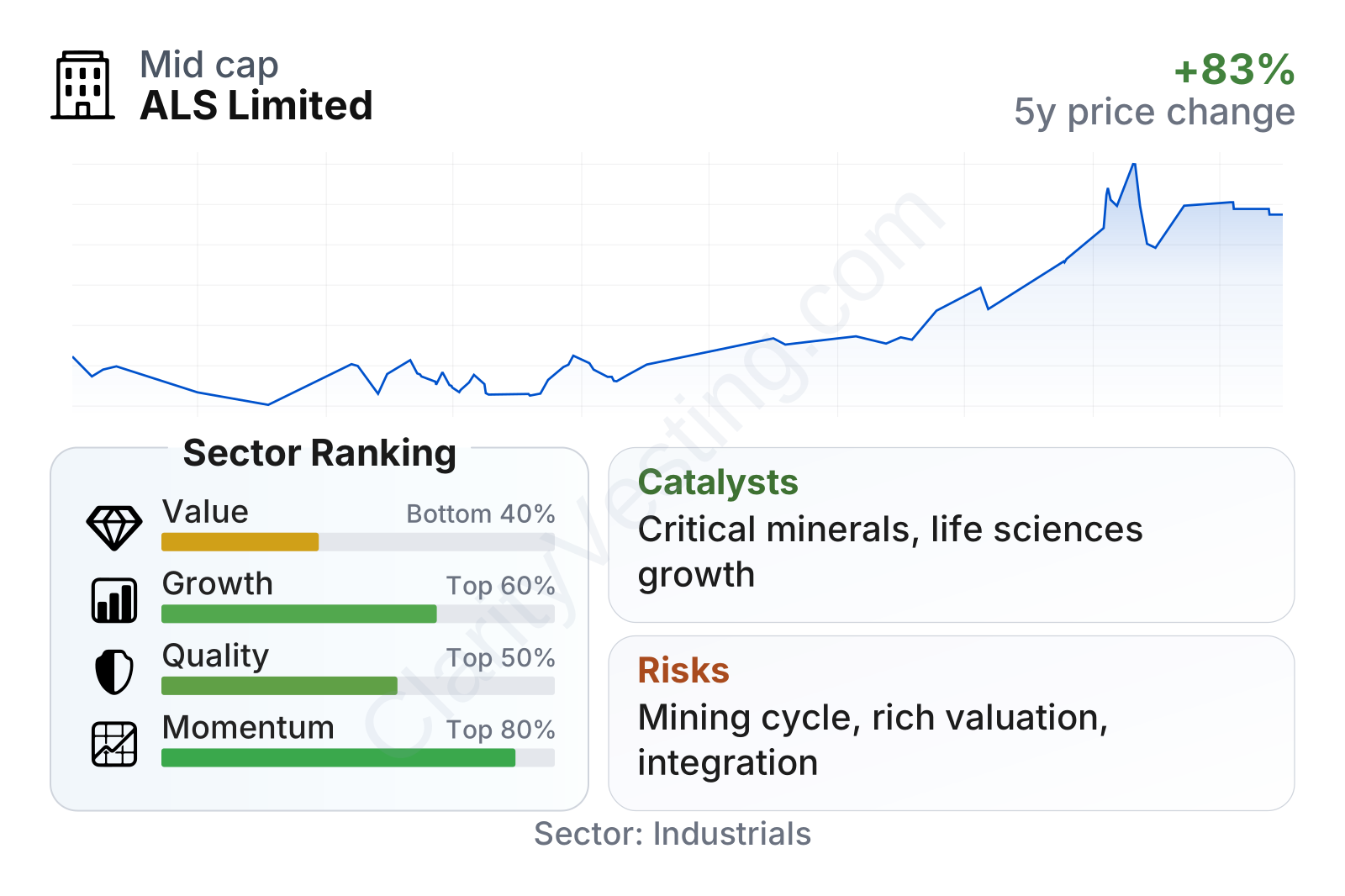
ALS sits in the large mid-cap range and has shown strong market performance over the last three years, with returns ahead of the broader sector median. On quality, the picture is solid: profitability ratios and operating margins are better than many peers, and leverage measured against EBIT and EBITDA looks manageable. Growth metrics are more mixed. Revenue and book value growth have been respectable over five years, but earnings growth has been uneven, reflecting margin pressure and a weaker period before the recent rebound. On valuation, the shares screen richer than the sector on earnings and book value multiples, which means the market is already recognizing the company’s stronger operating profile.
Growth
ALS operates in sectors with favorable long-term drivers. Environmental and food testing benefit from tighter regulation, public health standards, and contamination monitoring. Pharmaceutical testing is supported by outsourcing trends and the complexity of quality control. In commodities, long-term demand is linked to mine development, resource replenishment, and energy transition metals such as copper, lithium, and nickel. These are not straight-line growth markets, but they are structurally relevant and usually require specialized analytical services.
The company’s strategy also makes sense for future expansion. ALS has been building scale in life sciences, where demand tends to be less cyclical than mining, while keeping its established strength in commodities. That combination can reduce volatility across the full cycle. The group has also used acquisitions to add capabilities and deepen its laboratory network, which is important in a business where local presence, turnaround times, accreditation, and customer trust matter.
Recent performance supports that broader growth case. Revenue has risen at a healthy pace over several years, and revenue per share growth over five years is ahead of the sector median. The rebound in operating income and net income after fiscal 2024 suggests the company has been able to absorb prior pressure and restore earnings momentum. Another encouraging sign is that free cash generation remains substantial, which gives ALS flexibility to invest in new labs, bolt-on deals, and shareholder distributions without relying entirely on external funding.
A meaningful catalyst is continued spending tied to critical minerals and mine exploration, where ALS already has deep customer relationships and technical credibility. Another is the expansion of life sciences testing, especially in environmental and pharmaceutical services, where regulatory complexity tends to favor established providers with accredited lab networks. If ALS continues shifting its mix toward these areas while preserving margins, the business could become both larger and more resilient.
Risks
This article is for informational purposes only and does not constitute financial advice. Some content is AI-generated. See Disclaimer