Stock Analysis · Campbell’s Co (CPB)
Overview
Campbell’s Co is a packaged food company focused on shelf-stable meals, snacks, soups, sauces, and beverages sold mainly in North America. The business is built around well-known grocery brands that benefit from repeat purchases, broad supermarket distribution, and demand that tends to be steadier than in many other consumer categories. In recent years, the company has become more concentrated around two core areas: meals and beverages on one side, and snacks on the other.
Based on the company’s latest annual reporting for fiscal 2026, revenue is primarily generated from the following segments:
- Snacks: approximately 52% of total net sales. This includes brands such as Goldfish crackers, Snyder’s of Hanover pretzels, Cape Cod chips, Kettle Brand chips, Lance sandwiches, Late July snacks, and other savory snack products.
- Meals & Beverages: approximately 48% of total net sales. This includes Campbell’s condensed and ready-to-serve soups, broths, pasta sauces, simple meals, V8 beverages, and related grocery items.
The business mix matters because snacks typically provide brand strength and convenience-led demand, while meals and beverages offer pantry staples with strong household penetration. That combination can help stabilize sales, but it also leaves Campbell’s exposed to shifts in consumer spending, retailer pricing pressure, and input-cost swings.
Over the last several years, revenue expanded from roughly $8.6 billion to above $10.2 billion before slipping back to about $9.7 billion in the latest period. At the same time, profitability narrowed meaningfully, with higher interest expense and weaker net income showing that sales growth alone has not translated into stronger earnings quality.
The long-term picture shows a company that had been able to lift revenue and gross profit, but more recently saw operating income and net income come under pressure. Interest costs also moved materially higher than a few years ago, which is an important theme for understanding the current investment case.
Key Figures
| Metric | Value | Sector ⓘ |
|---|---|---|
| Date | Oct 03, 2026 | |
| Context | ||
| Sector | Consumer Defensive | |
| Industry | Packaged Foods | |
| Market Cap ⓘ | $6.03B | |
| Beta ⓘ | 0.02 | |
Value (Cheapness) | ||
| P/E Ratio ⓘ | 15.44 | 18.16 |
| P/B Ratio ⓘ | 1.58 | 1.27 |
| FCF Yield ⓘ | 11.24% | 12.39% |
| Dividend Yield ⓘ | 7.78% | 2.83% |
| EBIT / EV ⓘ | 6.65% | 6.45% |
| PEG ⓘ | 0.53 | |
Growth (Business expansion) | ||
| Revenue Growth ⓘ | -7.90% | 3.80% |
| RPS Growth (5Y CAGR) ⓘ | 3.46% | 6.20% |
| EPS Growth (5Y CAGR) ⓘ | -6.51% | -14.64% |
| BVPS Growth (5Y CAGR) ⓘ | 3.87% | 3.26% |
| Margin Growth (5Y Trend) ⓘ | -4.85% | -0.25% |
| FCF Growth (5Y CAGR) ⓘ | -7.82% | 4.65% |
| DPS Growth (5Y CAGR) ⓘ | 1.20% | 6.86% |
Quality (Business durability) | ||
| ROIC (Latest) ⓘ | N/A | 12.58% |
| ROA (Latest) ⓘ | 2.61% | 6.35% |
| ROIC (5Y Median) ⓘ | 9.78% | 10.36% |
| ROA (5Y Median) ⓘ | 4.15% | 5.44% |
| Net Debt / EBIT (Latest) ⓘ | 7.91 | 1.91 |
| Net Debt / EBIT (5Y Median) ⓘ | 6.21 | 2.32 |
| Net Debt / EBITDA (Latest) ⓘ | 5.33 | 1.36 |
| Net Debt / Assets ⓘ | 43.09% | 21.25% |
| EBITDA / Interest ⓘ | 3.92 | 9.61 |
| Operating Margin (Latest) ⓘ | 8.74% | 8.96% |
| Operating Margin (5Y Median) ⓘ | 11.13% | 9.53% |
| Debt to Equity (Latest) ⓘ | 185.38% | 71.66% |
| Profit Margin (Latest) ⓘ | 4.14% | 5.40% |
| Free Cash Flow (Latest) ⓘ | $678.00M | |
Momentum (Price trend) | ||
| 3Y Return ⓘ | -43.63% | +15.25% |
| 12M Return (excl. last month) ⓘ | -22.09% | +2.63% |
| 6M Return ⓘ | -5.61% | +2.43% |
| Price vs. 200-Day MA ⓘ | -11.54% | +0.43% |
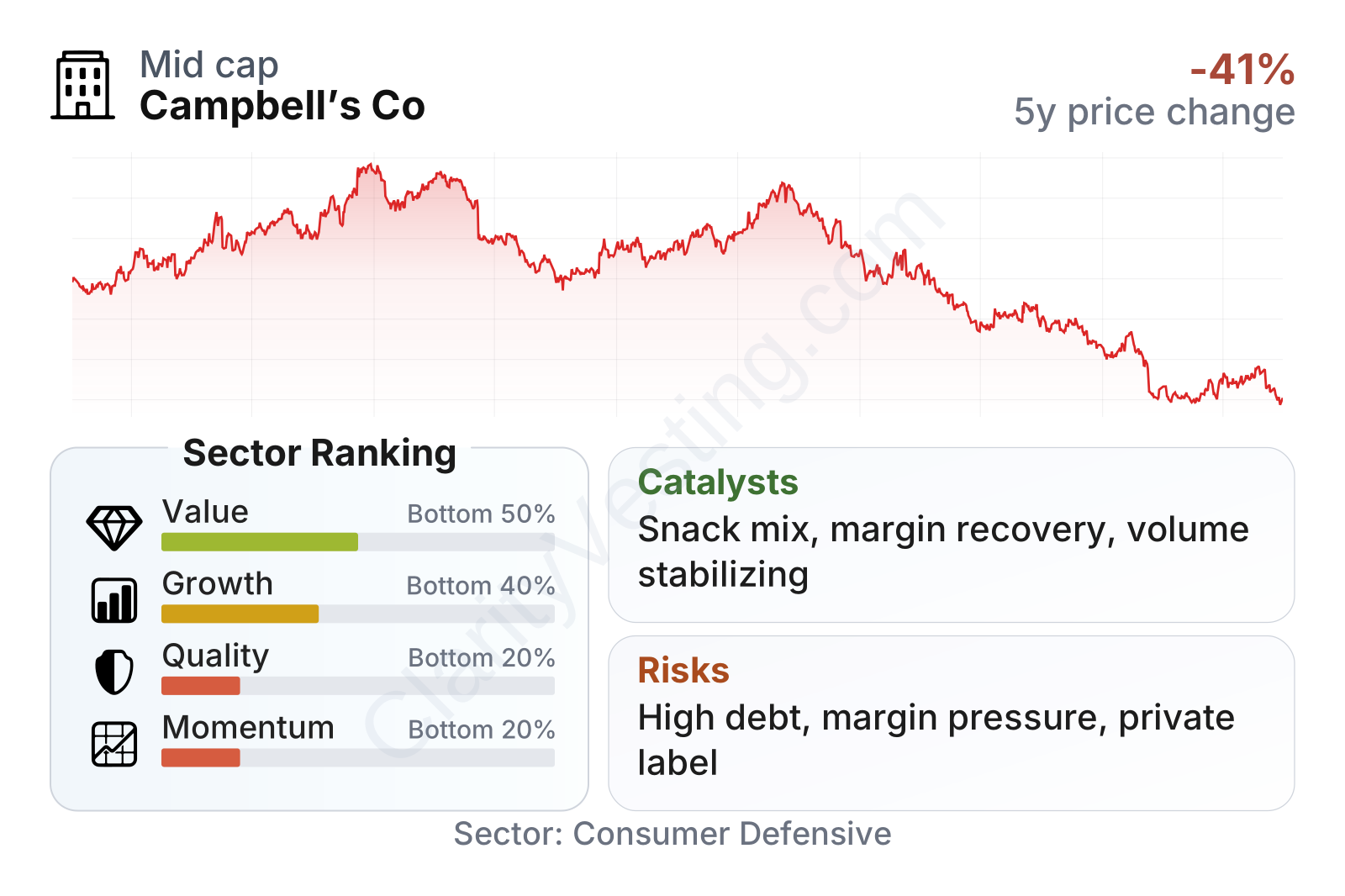
Campbell’s currently looks like a mid-sized defensive food company with very low share-price volatility, but its broader profile is mixed. Valuation metrics are not demanding relative to the sector, the dividend yield is unusually high, and EBIT relative to enterprise value is close to sector norms. However, growth, quality, and momentum all rank in the lower part of the peer group. The weakest points are leverage, returns on assets, and recent share-price performance, while the more favorable elements are the moderate earnings multiple and the cash generation that still remains meaningful in absolute dollars.
Growth
The packaged foods sector is not a fast-growing industry, but it is large, durable, and supported by recurring household demand. Growth usually comes from brand strength, pricing, product innovation, distribution gains, and portfolio shifts toward categories with better consumer traction. In that context, snacks are generally a more attractive category than legacy center-store staples because they benefit from convenience, portability, and frequent purchases. Campbell’s heavier snack exposure therefore gives it a more relevant growth angle than a soup-focused profile alone would suggest.
The challenge is that the company’s recent execution does not yet show strong momentum. After a stretch of positive year-over-year sales gains through much of 2024 and 2025, revenue turned negative again, reaching a decline of roughly 8% in the latest reading. That is notably weaker than the sector median, which remains positive. This suggests Campbell’s is currently dealing with volume pressure, portfolio headwinds, or both.
Management’s strategy still has logic for the long term. The company continues to emphasize brand investment, product renovation, supply chain execution, and category management in snacks and meal staples. These are sensible priorities in packaged food, where shelf space, brand recognition, and operational consistency matter more than rapid disruption. If inflation in ingredients and freight stays more manageable, a larger share of pricing could begin flowing through to margins rather than simply offsetting costs.
Cash generation remains one of the more constructive parts of the profile. Free cash flow has been uneven, but it has stayed substantial in dollar terms and rebounded after a weaker period. That matters because mature food companies often rely on cash discipline rather than high revenue growth to create business resilience.
A meaningful near-term catalyst would be stabilization in volumes and a better balance between pricing and consumer demand. Another potential support is continued focus on snacks, where brands such as Goldfish and Snyder’s of Hanover have stronger category relevance than slower-growing pantry staples. If management can improve mix, protect shelf presence, and recover margins, the earnings profile could look stronger than the recent headline sales trend suggests.
Risks
This article is for informational purposes only and does not constitute financial advice. Some content is AI-generated. See Disclaimer