Stock Analysis · CapitaLand Integrated Commercial Trust (CPAMF)
Overview
CapitaLand Integrated Commercial Trust is a Singapore-listed real estate investment trust, or REIT, focused on income-producing commercial properties. Its portfolio is built around retail malls, integrated developments that combine shopping, offices and transport links, and a smaller group of office and other commercial assets. The trust is managed by CapitaLand Integrated Commercial Trust Management Limited and is part of the wider CapitaLand group, one of the largest real estate platforms in Asia.
For a long-term reader, the simplest way to understand the business is this: it owns major urban properties, collects rent from tenants, and aims to grow cash distributions and property value over time. Its assets are concentrated mainly in Singapore, with a smaller presence overseas, which gives the portfolio a strong link to one of Asia’s most established commercial real estate markets.
The main revenue sources come from rental income generated by different property types. Based on the trust’s latest annual reporting structure, the mix is approximately:
- Retail properties: about 60% to 70% of gross revenue. This includes shopping malls and the retail parts of mixed-use developments, with income coming from base rent, turnover-linked rent, and related property revenue.
- Office properties: about 20% to 30% of gross revenue. This includes office towers and office space within integrated developments, typically supported by longer lease structures than retail.
- Integrated developments, business, lodging and other income: about 10% to 15%. This incorporates commercial space that does not fit neatly into stand-alone retail or office categories, plus other property-related revenue streams.
The business model is relatively straightforward, but the asset quality matters a lot. CapitaLand Integrated Commercial Trust owns several well-known central-city properties connected to dense transport and shopping districts. That tends to support occupancy, tenant demand, and rent resilience better than weaker suburban or secondary assets.
The flow of earnings has also improved over the last several years. Revenue has risen from roughly $1.3 billion in 2021 to more than $1.6 billion in 2025, while interest expense, after peaking in 2024, eased in 2025. That combination suggests the portfolio has been producing more income while financing pressure has become somewhat more manageable.
Key Figures
| Metric | Value | Sector ⓘ |
|---|---|---|
| Date | Oct 03, 2026 | |
| Context | ||
| Sector | Real Estate | |
| Industry | REIT - Retail | |
| Market Cap ⓘ | $13.80B | |
| Beta ⓘ | 0.50 | |
Value (Cheapness) | ||
| P/E Ratio ⓘ | 13.46 | 17.35 |
| P/B Ratio ⓘ | 0.62 | 0.86 |
| FCF Yield ⓘ | 12.82% | 7.47% |
| Dividend Yield ⓘ | 6.82% | 4.75% |
| EBIT / EV ⓘ | N/A | 3.81% |
| PEG ⓘ | 6.77 | |
Growth (Business expansion) | ||
| Revenue Growth ⓘ | 7.50% | 5.30% |
| RPS Growth (5Y CAGR) ⓘ | 8.65% | 5.96% |
| EPS Growth (5Y CAGR) ⓘ | -44.87% | -11.41% |
| BVPS Growth (5Y CAGR) ⓘ | 7.24% | 0.41% |
| Margin Growth (5Y Trend) ⓘ | -21.85% | 0.53% |
| FCF Growth (5Y CAGR) ⓘ | 2.55% | 5.40% |
| DPS Growth (5Y CAGR) ⓘ | 17.10% | 5.02% |
Quality (Business durability) | ||
| ROIC (Latest) ⓘ | 11.10% | 5.77% |
| ROE (Latest) ⓘ | 13.68% | 7.64% |
| ROA (Latest) ⓘ | 8.21% | 2.85% |
| ROIC (5Y Median) ⓘ | 5.12% | 4.20% |
| ROE (5Y Median) ⓘ | 6.19% | 6.03% |
| ROA (5Y Median) ⓘ | 3.54% | 2.45% |
| Net Debt / EBIT (Latest) ⓘ | 3.47 | 7.57 |
| Net Debt / EBIT (5Y Median) ⓘ | 7.39 | 8.41 |
| Net Debt / EBITDA (Latest) ⓘ | 3.46 | 5.12 |
| Net Debt / Assets ⓘ | 34.92% | 37.84% |
| EBITDA / Interest ⓘ | 3.68 | 4.11 |
| Operating Margin (Latest) ⓘ | 86.88% | 35.40% |
| Operating Margin (5Y Median) ⓘ | 76.56% | 36.59% |
| Debt to Equity (Latest) ⓘ | 58.09% | 89.06% |
| Profit Margin (Latest) ⓘ | 73.70% | 19.99% |
| Free Cash Flow (Latest) ⓘ | $1.77B | |
Momentum (Price trend) | ||
| 3Y Return ⓘ | +53.19% | +30.60% |
| 12M Return (excl. last month) ⓘ | +8.64% | +7.55% |
| 6M Return ⓘ | -2.46% | +0.69% |
| Price vs. 200-Day MA ⓘ | +9.71% | -2.30% |
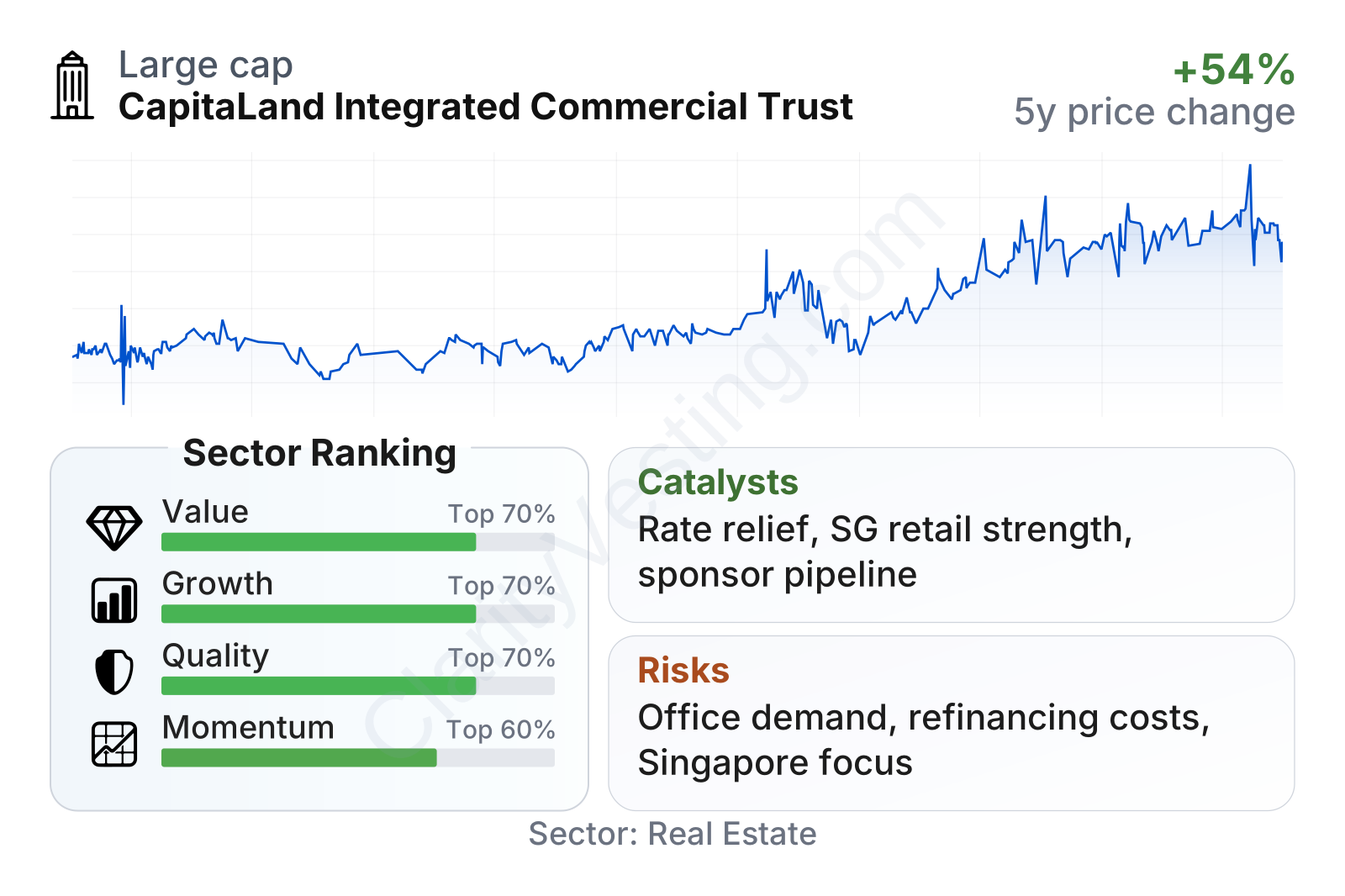
CapitaLand Integrated Commercial Trust is a large REIT with a market value around $13 billion and a relatively low beta near 0.5, which means its share price has historically moved less than the broader market. On valuation, the trust screens cheaper than much of its sector on both earnings and book value multiples, while its trailing cash flow yield and dividend yield are above sector norms. Quality metrics are also solid: returns on assets, equity, and invested capital are comfortably ahead of many peers, and leverage appears more moderate than the sector median. The weaker areas are mostly tied to accounting earnings trends, where EPS has been pressured over five years, and to some margin volatility that reflects the interest-rate cycle and property market conditions rather than a simple deterioration in the underlying assets.
Growth
CapitaLand Integrated Commercial Trust operates in a sector that is mature rather than fast-growing, but that does not mean growth is absent. High-quality REITs can expand through rent increases, better occupancy, redevelopment, asset enhancement projects, and acquisitions. In this case, the trust’s emphasis on prime integrated developments is important because these assets usually benefit from steady foot traffic, strong transport connectivity, and tenant demand from both retailers and office occupiers.
Its strategy makes sense for long-term expansion because it is focused on assets that are hard to replicate. In dense city-center locations, large mixed-use properties often have structural advantages: they can attract shoppers, office workers, and commuters at the same time. That can support more stable leasing and creates room for selective rent resets when market conditions are favorable.
Revenue per share has trended upward over the last five years, with a brief pause in 2024 before a strong step up in 2025. That is a useful sign because it shows growth has not come only from adding more assets; on a per-share basis, the trust has still been moving forward.
The dividend trend has also been notably strong. Distribution per share has increased every year shown, and the five-year growth rate stands well above the sector median. For a REIT, that matters because distributions are a central part of the business model. Rising payouts generally indicate that operating cash flow and portfolio income have recovered well since the pandemic period and subsequent rate shock.
Several catalysts could support future growth. Singapore retail leasing has benefited from tourism normalization and resilient consumer traffic in prime districts. Office demand in premium, centrally located buildings has also held up better than in weaker submarkets. On top of that, lower or stabilizing interest rates would be meaningful for the trust because financing costs directly influence distributable income. The trust also has access to a large sponsor ecosystem through CapitaLand, which can create opportunities for redevelopment, acquisitions, or asset recycling when market conditions allow.
Recent company reporting has highlighted continued operational resilience across its core portfolio, including healthy occupancy and positive rental reversions in important segments. That does not guarantee rapid growth, but it does support the case that future progress can come from execution and asset quality rather than from taking outsized risk.
Risks
This article is for informational purposes only and does not constitute financial advice. Some content is AI-generated. See Disclaimer