Stock Analysis · Cementos Pacasmayo SAA (CPAC)
Overview
Cementos Pacasmayo SAA is a Peruvian building materials company focused mainly on the northern part of the country. It produces and sells cement, concrete, precast products, and construction materials used in housing, commercial buildings, infrastructure, and self-construction. In simple terms, it is tied closely to the everyday need to build roads, homes, warehouses, schools, and public works.
The company’s business model is relatively easy to understand: it extracts raw materials, manufactures cement and related products, and distributes them through its own network and third-party channels. Because cement is heavy and expensive to transport over long distances, regional scale matters. That gives Cementos Pacasmayo a strong position in northern Peru, where proximity to customers and logistics infrastructure can be an important advantage.
Its revenue base is centered on a few core product lines. Based on company reporting and segment disclosures, the mix is broadly concentrated as follows:
- Cement: approximately 70% to 80% of revenue. This is the main product and includes bagged and bulk cement sold to distributors, construction companies, and individual builders.
- Concrete: approximately 10% to 15% of revenue. This includes ready-mix concrete used in larger construction and infrastructure projects.
- Mortar, precast, and other construction materials: approximately 5% to 10% of revenue. These products support masonry, finishing, and industrial construction needs.
- Lime and other complementary products or services: generally a small share of revenue. These activities are useful operationally but are not the main earnings driver.
The income structure also shows a business that has kept a fairly stable revenue base over the last several years while improving gross profit and operating income. Costs of production remain the largest outflow, as expected in a heavy materials business, but margins have held up better than many industrial peers.
The long-term pattern is encouraging: sales have moved within a relatively narrow band, but profitability improved more noticeably through 2024 before softening in 2025 at the net income level. That suggests the company has been doing more than simply relying on volume growth; pricing, product mix, and cost discipline have also mattered.
Key Figures
| Metric | Value | Sector ⓘ |
|---|---|---|
| Date | Nov 21, 2026 | |
| Context | ||
| Sector | Basic Materials | |
| Industry | Building Materials | |
| Market Cap ⓘ | $1.11B | |
| Beta ⓘ | 0.11 | |
Value (Cheapness) | ||
| P/E Ratio ⓘ | 14.51 | 15.60 |
| P/B Ratio ⓘ | N/A | 2.20 |
| FCF Yield ⓘ | 12.21% | 5.22% |
| Dividend Yield ⓘ | 4.73% | 1.93% |
| EBIT / EV ⓘ | 10.94% | 8.17% |
| PEG ⓘ | 1.13 | |
Growth (Business expansion) | ||
| Revenue Growth ⓘ | 16.30% | 10.90% |
| RPS Growth (5Y CAGR) ⓘ | 2.23% | 4.49% |
| EPS Growth (5Y CAGR) ⓘ | 16.34% | -9.13% |
| BVPS Growth (5Y CAGR) ⓘ | -0.01% | 5.53% |
| Margin Growth (5Y Trend) ⓘ | 1.71% | -1.54% |
| FCF Growth (5Y CAGR) ⓘ | 33.71% | 0.37% |
| DPS Growth (5Y CAGR) ⓘ | -16.37% | 5.68% |
Quality (Business durability) | ||
| ROIC (Latest) ⓘ | 10.44% | 8.91% |
| ROA (Latest) ⓘ | 7.93% | 5.01% |
| ROIC (5Y Median) ⓘ | 11.61% | 7.91% |
| ROA (5Y Median) ⓘ | 5.38% | 3.90% |
| Net Debt / EBIT (Latest) ⓘ | 1.88 | 1.33 |
| Net Debt / EBIT (5Y Median) ⓘ | 4.30 | 1.69 |
| Net Debt / EBITDA (Latest) ⓘ | 1.44 | 0.95 |
| Net Debt / Assets ⓘ | 28.00% | 12.22% |
| EBITDA / Interest ⓘ | 7.77 | 12.78 |
| Operating Margin (Latest) ⓘ | 22.14% | 13.23% |
| Operating Margin (5Y Median) ⓘ | 16.98% | 11.87% |
| Debt to Equity (Latest) ⓘ | 91.44% | 40.11% |
| Profit Margin (Latest) ⓘ | 11.22% | 7.03% |
| Free Cash Flow (Latest) ⓘ | $134.95M | |
Momentum (Price trend) | ||
| 3Y Return ⓘ | +210.54% | +45.33% |
| 12M Return (excl. last month) ⓘ | +91.00% | +16.67% |
| 6M Return ⓘ | +22.10% | -8.36% |
| Price vs. 200-Day MA ⓘ | +13.51% | -8.36% |
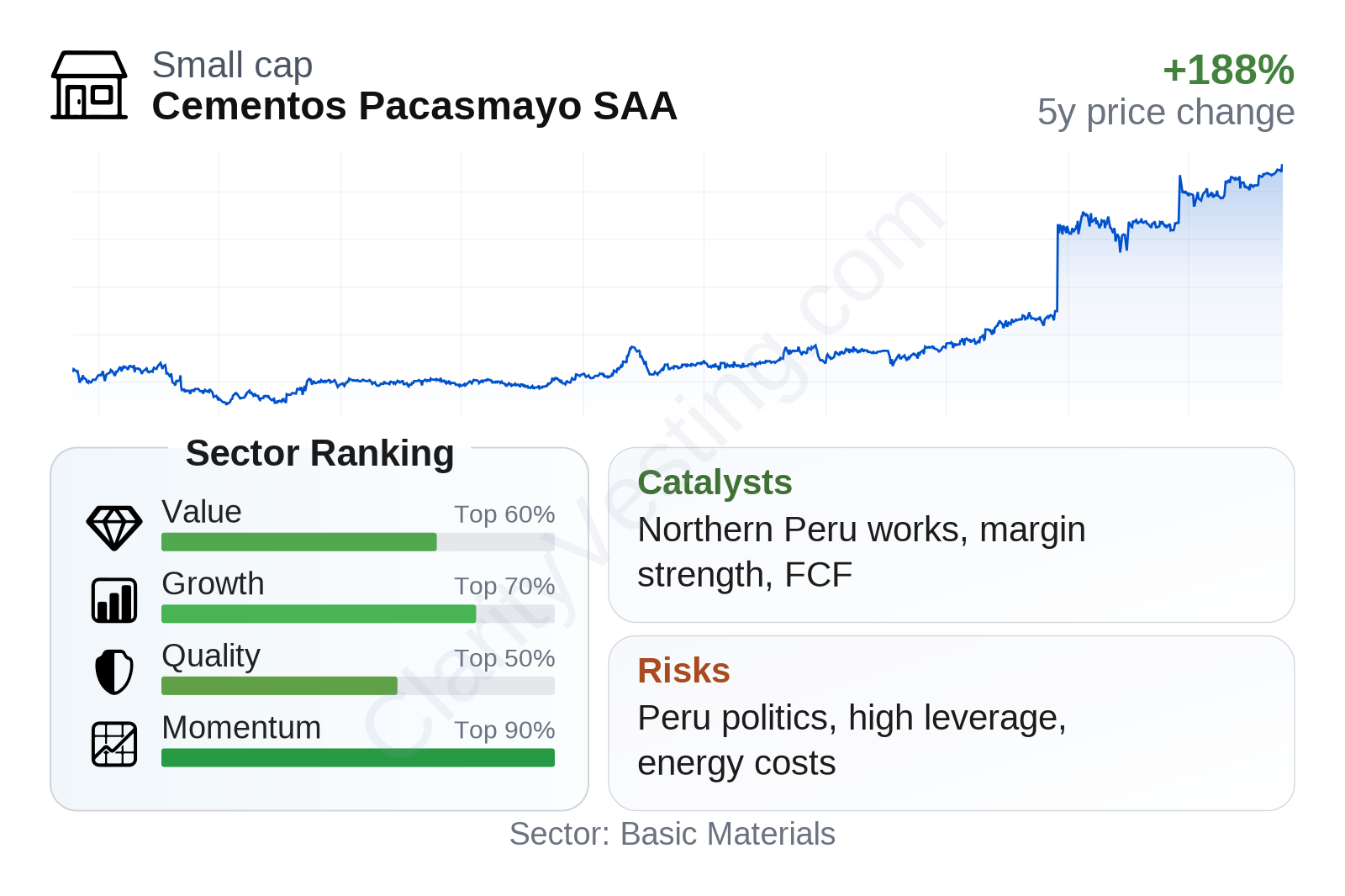
Cementos Pacasmayo is a mid-sized building materials company with unusually low share-price volatility for a cyclical stock, reflected in a beta close to zero. On valuation, the earnings multiple sits somewhat below the sector median, while cash generation looks notably stronger than average through free cash flow yield and EBIT relative to enterprise value. Quality metrics are also solid, with returns on capital and assets above sector medians and operating margins comfortably ahead of peers. Growth is more mixed over longer periods, but recent momentum in revenue, earnings, and share performance has been strong.
Growth
Cement demand is tied to urbanization, housing formation, public infrastructure, mining-related construction, and industrial development. Peru remains a country with long-term infrastructure needs, and the northern region where Cementos Pacasmayo operates still has room for investment in transportation, sanitation, housing, and reconstruction projects. That means the company operates in a sector that can grow over time, even if results move in cycles from year to year.
The company’s strategy also makes industrial sense. Cement is not a business where global reach automatically wins; local production, distribution density, access to limestone reserves, and reliable service matter more. Cementos Pacasmayo’s position in northern Peru gives it a practical geographic moat. It can serve a large regional market without facing the same transport disadvantages an outside supplier would face.
Recent revenue trends point to a clear rebound. After a weaker stretch in 2023 and a flatter 2024, year-over-year revenue growth accelerated through 2025 and into 2026, reaching low- to mid-teens percentages in the latest periods. That matters because cement is a volume-heavy business: sustained growth usually reflects either stronger construction activity, improved pricing, or both.
Cash generation has also improved meaningfully versus earlier years, even though it has not moved in a straight line. Free cash flow turned negative in one earlier period, then recovered strongly and remained positive afterward. The latest trailing figure is substantial relative to the company’s size, which supports balance-sheet flexibility, dividends, and capacity spending when needed.
Potential catalysts are fairly tangible rather than speculative. Public and private construction in northern Peru, post-weather reconstruction needs, mining investment, and improved execution on higher-margin products such as concrete and precast can all support results. If operating margins remain near current levels while volumes rise, earnings growth can outpace revenue growth. The recent stock performance suggests the market has already recognized some of this improvement, but the underlying business backdrop still appears constructive.
Risks
This article is for informational purposes only and does not constitute financial advice. Some content is AI-generated. See Disclaimer