Stock Analysis · Copa Holdings SA (CPA)
Overview
Copa Holdings S.A. is a Latin American airline group best known for operating Copa Airlines and Copa Airlines Colombia. Its business is centered on passenger air travel across the Americas, using Panama City as a connecting hub that links North America, Central America, the Caribbean, and South America. This hub model is important because it allows the company to gather travelers from many smaller city pairs and route them efficiently through one central airport, which can support strong aircraft utilization and a broad network without relying only on local demand in one country.
The company’s revenue is still dominated by transporting passengers, while cargo and other ancillary activities play a smaller role. Based on recent annual reporting patterns, the revenue mix can be described approximately as follows:
- Passenger revenue: about 90% to 93% — ticket sales for leisure and business travelers across Copa’s route network.
- Other operating revenue: about 4% to 7% — mainly loyalty-related activity, change fees, baggage fees, and other travel-related services.
- Cargo and mail revenue: about 2% to 4% — transport of freight and mail using available belly capacity on passenger flights.
Copa is not one of the world’s largest airlines, but it is a meaningful regional operator with a focused network and a reputation for operational discipline. Over the last several years, revenue and earnings have recovered strongly from the pandemic shock, while operating profitability has remained notably stronger than many airline peers. The business flow also shows a favorable pattern: revenue has grown materially since 2021, operating income has expanded faster than overhead, and interest expense has become easier to absorb as profitability improved.
Key Figures
| Metric | Value | Sector ⓘ |
|---|---|---|
| Date | Oct 24, 2026 | |
| Context | ||
| Sector | Industrials | |
| Industry | Airlines | |
| Market Cap ⓘ | $5.52B | |
| Beta ⓘ | 1.03 | |
Value (Cheapness) | ||
| P/E Ratio ⓘ | 8.89 | 22.29 |
| P/B Ratio ⓘ | 1.94 | 1.98 |
| FCF Yield ⓘ | 3.09% | 6.26% |
| Dividend Yield ⓘ | 5.20% | 1.92% |
| EBIT / EV ⓘ | 12.28% | 4.83% |
| PEG ⓘ | 0.94 | |
Growth (Business expansion) | ||
| Revenue Growth ⓘ | 25.70% | 9.30% |
| RPS Growth (5Y CAGR) ⓘ | 25.42% | 7.76% |
| EPS Growth (5Y CAGR) ⓘ | -5.43% | -13.17% |
| BVPS Growth (5Y CAGR) ⓘ | 21.87% | 6.13% |
| Margin Growth (5Y Trend) ⓘ | 15.51% | 0.74% |
| FCF Growth (5Y CAGR) ⓘ | 90.18% | 10.79% |
| DPS Growth (5Y CAGR) ⓘ | N/A | 9.41% |
Quality (Business durability) | ||
| ROIC (Latest) ⓘ | 14.59% | 10.75% |
| ROA (Latest) ⓘ | 9.34% | 5.41% |
| ROIC (5Y Median) ⓘ | 17.20% | 9.37% |
| ROA (5Y Median) ⓘ | 10.40% | 4.95% |
| Net Debt / EBIT (Latest) ⓘ | 0.28 | 2.04 |
| Net Debt / EBIT (5Y Median) ⓘ | 2.50 | 2.27 |
| Net Debt / EBITDA (Latest) ⓘ | 0.19 | 1.39 |
| Net Debt / Assets ⓘ | 3.20% | 19.27% |
| EBITDA / Interest ⓘ | 11.43 | 9.58 |
| Operating Margin (Latest) ⓘ | 20.34% | 10.49% |
| Operating Margin (5Y Median) ⓘ | 22.25% | 10.30% |
| Debt to Equity (Latest) ⓘ | 17.25% | 64.82% |
| Profit Margin (Latest) ⓘ | 15.71% | 6.67% |
| Free Cash Flow (Latest) ⓘ | $170.65M | |
Momentum (Price trend) | ||
| 3Y Return ⓘ | +99.94% | +67.77% |
| 12M Return (excl. last month) ⓘ | +20.41% | +12.05% |
| 6M Return ⓘ | +15.41% | 0.00% |
| Price vs. 200-Day MA ⓘ | +4.34% | +0.67% |
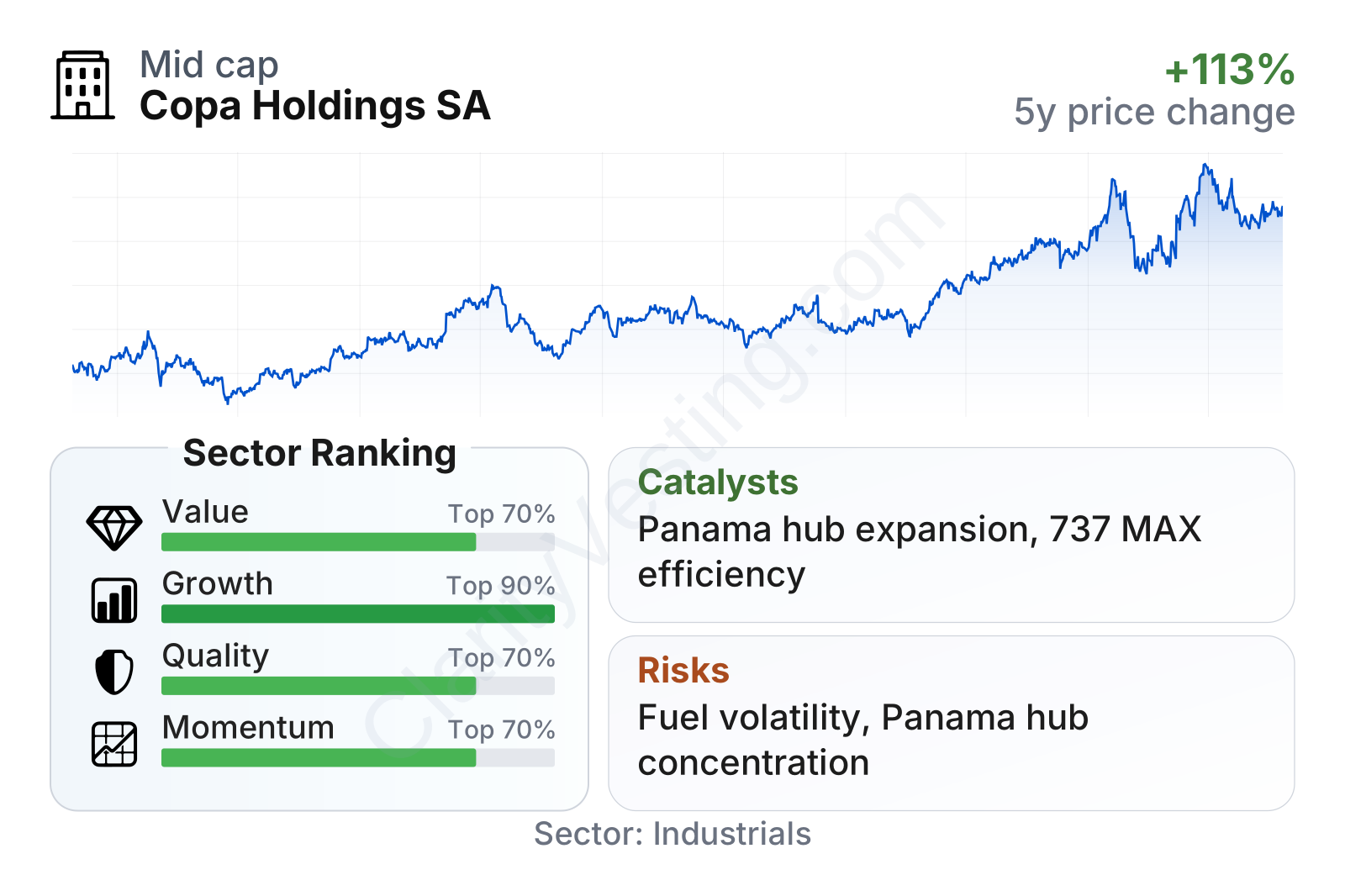
Copa’s profile stands out most in growth, profitability, and balance-sheet strength. Growth metrics rank near the top of the sector, supported by strong revenue expansion, rising revenue per share, and a sharp improvement in operating margins over the last five years. Quality is also solid, with returns on capital and assets above sector medians, while leverage is now much lower than what is typical for airlines. Valuation multiples remain well below the broader sector despite that stronger operating profile, although free cash flow yield is less striking than the earnings multiple because cash generation has been more uneven from period to period.
The stock chart also shows that the market has gradually re-rated the company upward since 2022, though with the volatility that is common in airlines. Even after that climb, the earnings multiple still sits far below the industry median, which suggests the market continues to apply a discount for the airline sector’s cyclical and external-risk nature.
Growth
Air travel in Latin America remains a growth market over the long run, helped by relatively low air-travel penetration in several countries, ongoing tourism demand, cross-border family travel, and business connectivity needs across the region. Copa is positioned inside that trend through its hub strategy in Panama, which gives it a geographic advantage for north-south traffic flows in the Americas. That does not make growth linear every year, but it does provide a practical framework for network expansion.
The company’s strategy appears coherent for future growth. Copa has historically emphasized fleet commonality, schedule reliability, and disciplined capacity additions rather than aggressive expansion at any cost. That matters in airlines because a route network can become less profitable quickly if too much capacity is added. Copa’s approach has generally been to expand where connecting demand, aircraft efficiency, and margins can support it.
Recent revenue growth suggests the company has moved beyond a simple post-pandemic rebound and is again finding demand momentum. After growth slowed and briefly turned negative in parts of 2024, the pace accelerated again into 2025 and 2026, reaching the mid-20% range most recently. That is a strong signal for an airline, especially because it comes after the recovery phase had largely already played out.
Cash generation has been positive but less stable than the revenue trend. Free cash flow has shown the usual airline swings tied to fleet spending, working capital, and timing effects. Even so, the broader five-year pattern points to a business that has materially improved its ability to translate operating recovery into cash, which is important for debt reduction, dividends, and future aircraft investments.
Several catalysts can support future expansion. Copa continues to benefit from the strategic role of Tocumen International Airport in Panama as a continental connection point. Fleet modernization with Boeing 737 MAX aircraft can improve fuel efficiency and operating economics over time. The company has also continued to add destinations and frequencies in selected markets, which can deepen the network effect of its hub. In practical terms, every well-chosen new route can make the rest of the network more useful, not just add one isolated source of revenue.
Recent company communications have also highlighted continued demand strength, capacity growth, and resilient margins. For a network airline, that combination is significant: growth alone is not enough if it damages profitability, but Copa has so far preserved an unusually strong margin structure while expanding.
Risks
This article is for informational purposes only and does not constitute financial advice. Some content is AI-generated. See Disclaimer


