Stock Analysis · Citycon Oyj (COYJF)
Overview
Citycon Oyj is a Nordic real estate company focused mainly on owning, managing, and developing grocery-anchored shopping centers, urban mixed-use properties, and assets connected to everyday services. Its portfolio is concentrated in Finland, Sweden, and Norway, with many properties located in or near dense urban areas and public transport hubs. In simple terms, Citycon earns money by owning places where people shop for essentials, use services, and in some cases live or commute.
The business model is more defensive than a traditional discretionary retail landlord because grocery stores, pharmacies, health services, and daily-needs tenants tend to attract repeat visits even in weaker economic periods. Citycon has also spent years repositioning parts of its portfolio toward mixed-use urban locations rather than depending only on classic mall traffic.
Based on the company’s reporting structure and property profile, the main revenue sources are approximately:
- Rental income from retail and service tenants: about 75% to 85%. This includes base rent from grocery stores, specialty shops, health and public services, restaurants, and other tenants operating in Citycon’s properties.
- Recoveries and service charges: about 10% to 20%. These are amounts collected from tenants for property operating costs, maintenance, utilities, and similar items.
- Other property-related income and development-related items: about 5% to 10%. This can include parking, temporary leasing effects, and gains or fees connected to development or asset management activities, although these are less central than recurring rent.
Geographically, the company’s earnings power is tied primarily to the Nordic region, which gives Citycon exposure to relatively stable institutions and mature real estate markets, but also limits diversification outside those countries.
The broad financial pattern has been uneven rather than steadily compounding. Revenue has stayed in a fairly narrow range over recent years, while operating profit and net income have moved much more sharply because property revaluations and financing costs have had a large impact. That is common in real estate, but it means headline profit can swing much more than the underlying rent collection suggests.
Key Figures
| Metric | Value | Sector ⓘ |
|---|---|---|
| Date | Nov 21, 2026 | |
| Context | ||
| Sector | Real Estate | |
| Industry | Real Estate - Diversified | |
| Market Cap ⓘ | $1.26B | |
| Beta ⓘ | 0.69 | |
Value (Cheapness) | ||
| P/E Ratio ⓘ | 11.55 | 17.59 |
| P/B Ratio ⓘ | N/A | 1.58 |
| FCF Yield ⓘ | 6.29% | 5.76% |
| Dividend Yield ⓘ | N/A | 4.81% |
| EBIT / EV ⓘ | 8.08% | 4.97% |
| PEG ⓘ | N/A | |
Growth (Business expansion) | ||
| Revenue Growth ⓘ | 5.10% | 5.70% |
| RPS Growth (5Y CAGR) ⓘ | -4.48% | 5.96% |
| EPS Growth (5Y CAGR) ⓘ | N/A | -3.46% |
| BVPS Growth (5Y CAGR) ⓘ | -18.62% | 0.32% |
| Margin Growth (5Y Trend) ⓘ | 4.56% | -0.65% |
| FCF Growth (5Y CAGR) ⓘ | N/A | 5.08% |
| DPS Growth (5Y CAGR) ⓘ | -13.71% | 5.00% |
Quality (Business durability) | ||
| ROIC (Latest) ⓘ | 7.79% | 5.13% |
| ROE (Latest) ⓘ | 6.34% | 7.64% |
| ROA (Latest) ⓘ | 1.95% | 3.05% |
| ROIC (5Y Median) ⓘ | 2.12% | 4.20% |
| ROE (5Y Median) ⓘ | 0.22% | 6.03% |
| ROA (5Y Median) ⓘ | 0.11% | 2.41% |
| Net Debt / EBIT (Latest) ⓘ | 12.48 | 7.59 |
| Net Debt / EBIT (5Y Median) ⓘ | 10.47 | 8.34 |
| Net Debt / EBITDA (Latest) ⓘ | 9.69 | 5.43 |
| Net Debt / Assets ⓘ | 58.22% | 38.21% |
| EBITDA / Interest ⓘ | 1.57 | 4.20 |
| Operating Margin (Latest) ⓘ | 63.00% | 34.59% |
| Operating Margin (5Y Median) ⓘ | 20.17% | 37.64% |
| Debt to Equity (Latest) ⓘ | 204.83% | 90.32% |
| Profit Margin (Latest) ⓘ | 26.04% | 20.10% |
| Free Cash Flow (Latest) ⓘ | $79.49M | |
Momentum (Price trend) | ||
| 3Y Return ⓘ | -19.89% | +27.88% |
| 12M Return (excl. last month) ⓘ | -27.94% | +1.16% |
| 6M Return ⓘ | -44.31% | -3.06% |
| Price vs. 200-Day MA ⓘ | -32.33% | -0.73% |
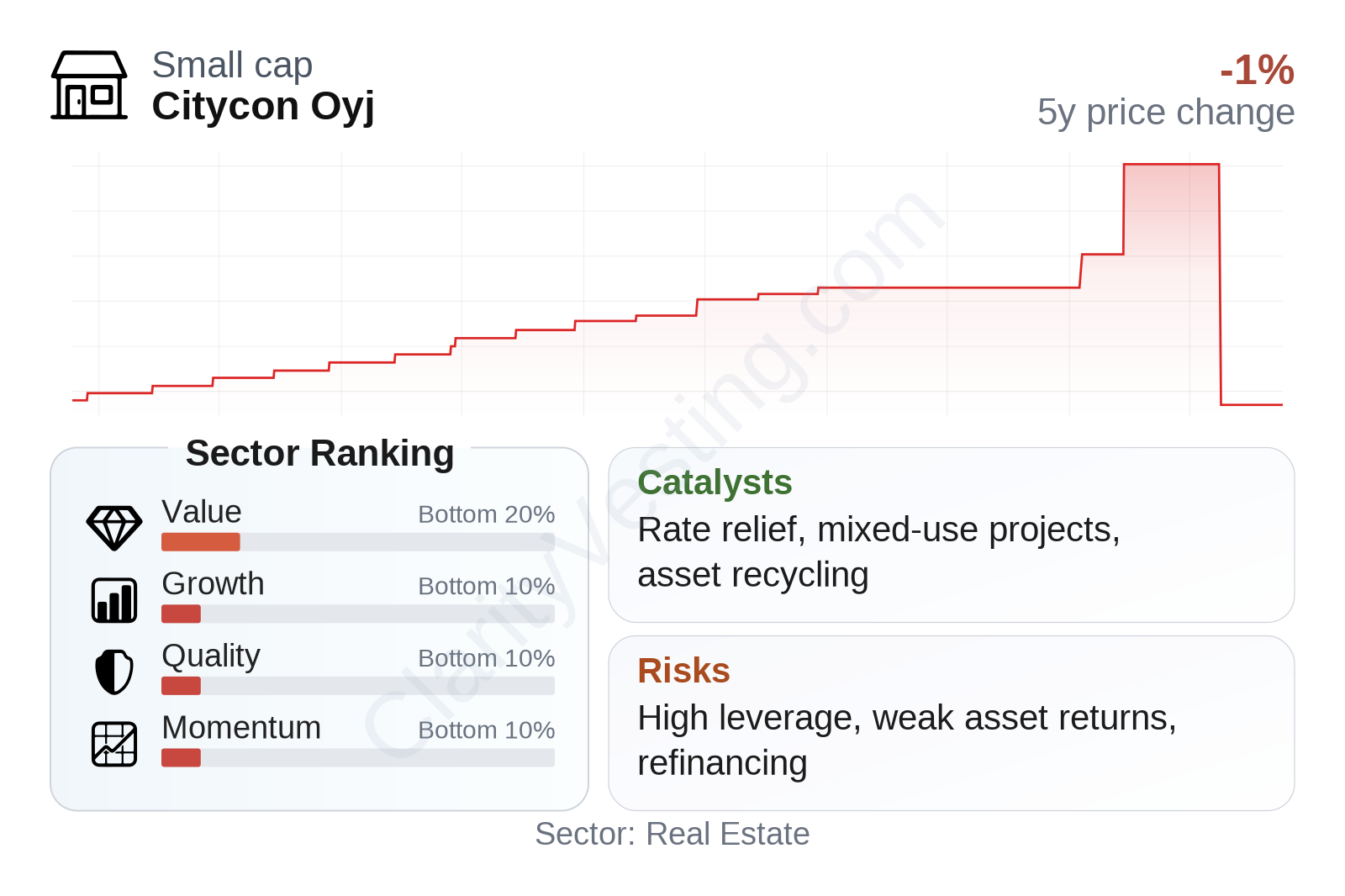
Citycon is a mid-sized real estate company with relatively low share price volatility, as shown by its beta below 1. On valuation multiples, the shares screen cheaper than much of the sector, with earnings and enterprise-value-based measures looking modest. Free cash flow yield is also slightly better than the sector median. However, the table also shows why the market is cautious: growth ranks near the bottom of the sector, quality metrics are mixed, and balance-sheet leverage is clearly heavier than average. Momentum is weak as well, meaning the stock has materially underperformed much of the real estate group over recent periods.
Growth
Citycon operates in a part of real estate that still has a practical role: urban retail and service locations centered on daily needs. That is not a high-growth industry in the way technology or specialized logistics can be, but it can remain relevant for a long time if the properties are well located and tenant demand stays resilient. The company’s emphasis on grocery-anchored centers and mixed-use urban assets makes strategic sense because these formats are generally better protected from e-commerce pressure than discretionary retail-heavy malls.
Another favorable point is that Nordic cities remain relatively urbanized, and properties integrated with transport, residential density, and public services can keep their usefulness even when consumer spending is uneven. If Citycon can continue improving occupancy, tenant mix, and redevelopment execution, growth can come less from opening entirely new markets and more from extracting better income from the existing portfolio.
That said, the growth record has not been strong on a per-share basis. Revenue per share was relatively stable for several years before dropping in the latest annual period shown. This helps explain why the company ranks poorly on longer-term growth measures despite recent year-over-year revenue improvement. For a long-term perspective, this is more a case of operational stabilization than clear expansion.
The dividend pattern also reflects that reset. The payout was fairly steady for several years and then moved down noticeably. For a property company, that matters because dividends often signal the durability of recurring cash generation. A lower payout can be sensible if management is prioritizing balance-sheet strength, but it also shows that the company is still adjusting to a tougher financing environment.
A meaningful catalyst is interest-rate direction. Real estate companies like Citycon are highly sensitive to financing costs and property valuations. If rates stabilize or decline, pressure on interest expense and valuation marks can ease, which may help reported earnings and refinancing flexibility. Another catalyst is redevelopment and mixed-use intensification around existing properties, especially where Citycon can add residential or service elements to already established sites. Recent company communications have also emphasized portfolio optimization and capital recycling, which can support future income quality if executed well.
Risks
This article is for informational purposes only and does not constitute financial advice. Some content is AI-generated. See Disclaimer