Stock Analysis · Coursera Inc (COUR)
Overview
Coursera is an online learning platform that connects individual learners, businesses, universities, and governments with digital courses, certificates, degrees, and job-relevant training. The company works with universities and industry partners to host educational content on its platform, then earns revenue from subscriptions, course enrollments, enterprise contracts, and degree-related services. Its main appeal is scale: one platform can serve a casual learner taking a single course, a company training employees, or a university delivering a full online degree.
Coursera reports revenue in three main segments. Based on its latest annual reporting structure, the mix is approximately:
- Consumer: about 52% of revenue. This includes individual learners paying for course certificates, guided projects, subscriptions such as Coursera Plus, and some entry-level credentials.
- Enterprise: about 33% of revenue. This serves businesses, campuses, and government customers that buy learning solutions for employee, student, or workforce development.
- Degrees: about 15% of revenue. This includes services tied to online degrees delivered with university partners.
The business model is asset-light compared with traditional education providers because Coursera does not need to build physical campuses. At the same time, it still has meaningful platform, product development, and partner-related costs. Over the last several years, revenue has continued to rise, gross profit has improved, and operating losses have narrowed, showing a business that is scaling but has not yet fully crossed into durable profitability.
The long-term pattern is encouraging on the operating side: revenue has grown steadily from 2021 through 2025, while net losses have become much smaller. Research and development remains a major expense, which fits a platform company still investing in product capabilities and content tools.
Key Figures
| Metric | Value | Sector ⓘ |
|---|---|---|
| Date | Oct 17, 2026 | |
| Context | ||
| Sector | Consumer Defensive | |
| Industry | Education & Training Services | |
| Market Cap ⓘ | $1.45B | |
| Beta ⓘ | 1.25 | |
Value (Cheapness) | ||
| P/E Ratio ⓘ | N/A | 17.88 |
| P/B Ratio ⓘ | 0.86 | 1.29 |
| FCF Yield ⓘ | 1.97% | 12.39% |
| Dividend Yield ⓘ | N/A | 2.85% |
| EBIT / EV ⓘ | -23.42% | 6.43% |
| PEG ⓘ | N/A | |
Growth (Business expansion) | ||
| Revenue Growth ⓘ | 59.60% | 4.10% |
| RPS Growth (5Y CAGR) ⓘ | 6.05% | 6.18% |
| EPS Growth (5Y CAGR) ⓘ | N/A | -13.59% |
| BVPS Growth (5Y CAGR) ⓘ | -12.19% | 3.20% |
| Margin Growth (5Y Trend) ⓘ | N/A | -0.15% |
| FCF Growth (5Y CAGR) ⓘ | N/A | 4.10% |
| DPS Growth (5Y CAGR) ⓘ | N/A | 6.79% |
Quality (Business durability) | ||
| ROIC (Latest) ⓘ | -14.47% | 12.34% |
| ROA (Latest) ⓘ | -9.26% | 6.30% |
| ROIC (5Y Median) ⓘ | -17.33% | 10.49% |
| ROA (5Y Median) ⓘ | -12.48% | 5.44% |
| Net Debt / EBIT (Latest) ⓘ | N/A | 1.96 |
| Net Debt / EBIT (5Y Median) ⓘ | N/A | 2.35 |
| Net Debt / EBITDA (Latest) ⓘ | N/A | 1.38 |
| Net Debt / Assets ⓘ | -44.26% | 21.51% |
| EBITDA / Interest ⓘ | N/A | 9.46 |
| Operating Margin (Latest) ⓘ | -16.11% | 8.87% |
| Operating Margin (5Y Median) ⓘ | -22.90% | 9.53% |
| Debt to Equity (Latest) ⓘ | 0.83% | 72.35% |
| Profit Margin (Latest) ⓘ | -15.39% | 5.40% |
| Free Cash Flow (Latest) ⓘ | $28.60M | |
Momentum (Price trend) | ||
| 3Y Return ⓘ | -72.68% | +20.92% |
| 12M Return (excl. last month) ⓘ | -52.42% | +2.13% |
| 6M Return ⓘ | -13.57% | +1.26% |
| Price vs. 200-Day MA ⓘ | -14.92% | +1.39% |
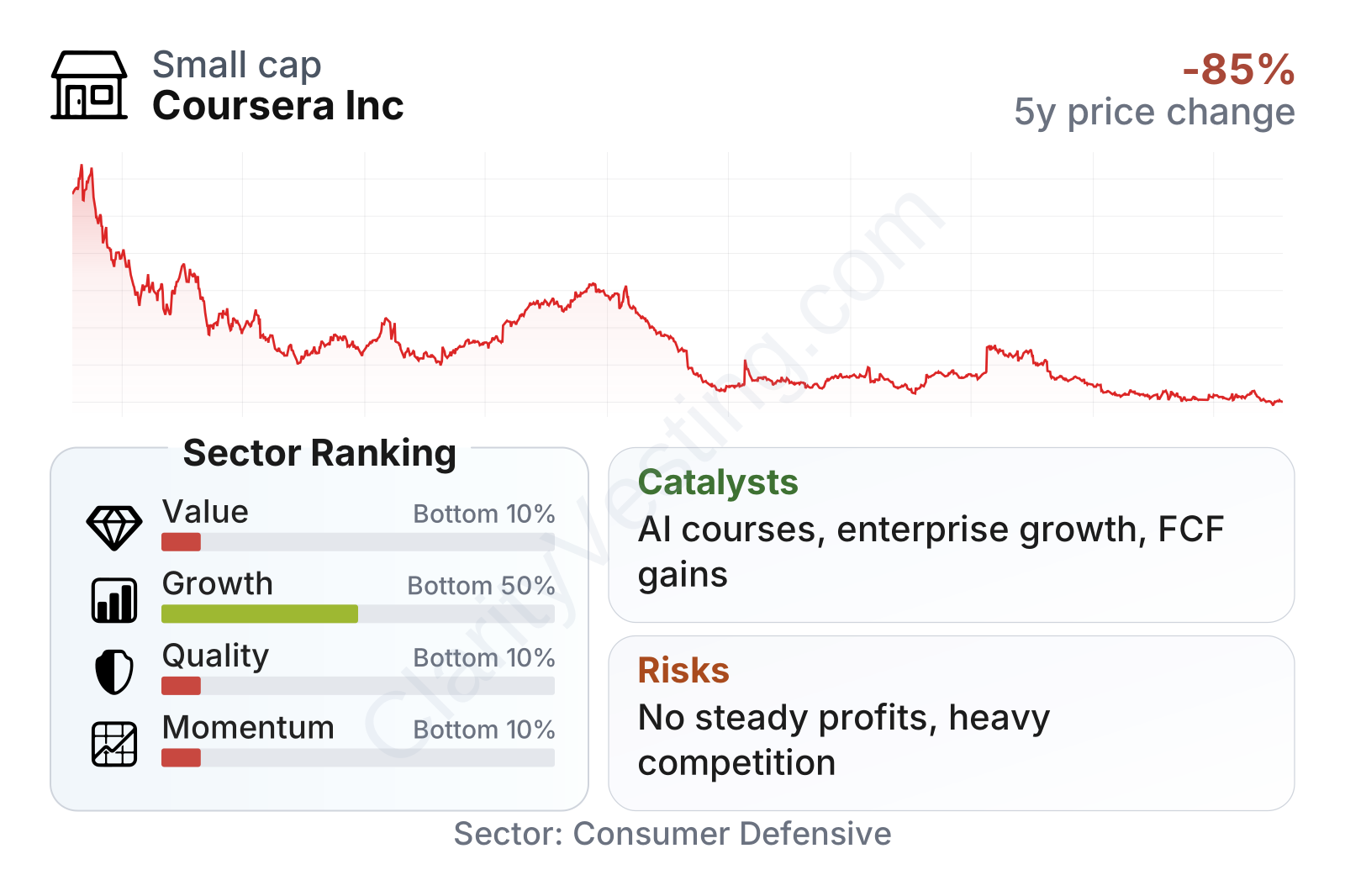
Coursera is a relatively small public company with a market value around the low-single-digit billions and a stock that has been volatile, with a beta above 1. The factor breakdown shows a mixed picture: weak quality, value, and momentum rankings, but a growth profile that still contains some notable positives. The most important contrast is that revenue expansion and positive free cash flow stand beside negative margins and returns on capital.
The stock price history also shows how sharply market expectations have reset since 2021. Shares have fallen dramatically from post-IPO levels, which often happens when a company shifts from being valued mainly on long-term growth potential to being judged more on profitability, execution, and consistency.
Growth
Coursera operates in a sector with durable long-term demand. Online education, professional reskilling, digital credentials, and workforce training all benefit from powerful structural trends: technology changes job requirements quickly, employers increasingly value verified skills, and many learners prefer lower-cost, flexible formats over traditional in-person options. Those tailwinds support the category even if growth rates can vary by year.
Coursera’s strategy also makes sense for that environment. It is positioned across several demand pools instead of relying on only one: direct-to-consumer learning, enterprise workforce training, and university-linked degrees. That diversification matters because it allows one part of the business to offset weakness in another. The enterprise segment is particularly important strategically because organizations tend to sign recurring contracts and care about measurable outcomes such as retention, productivity, and skill development.
Revenue growth has clearly decelerated from the very strong levels seen earlier in Coursera’s public-company life, but the business has still remained in growth mode. More recently, the reported year-over-year rate shows a sharp acceleration, which stands out versus the broader sector. Whether that pace proves sustainable is a key question, but it does indicate the company still has the ability to re-accelerate under the right conditions.
Cash generation has improved materially. Free cash flow moved from negative territory a few years ago to clearly positive levels more recently, even though accounting profits remain negative. That is an important sign for a platform business because it suggests the underlying model can generate cash while management continues to refine spending and scale operations.
A major catalyst is the rise of AI-related training demand. Coursera has expanded course catalogs and professional content tied to artificial intelligence, data science, and technology skills, areas where learner and enterprise interest has been strong. The company has also introduced platform features using generative AI to support content creation, translation, discovery, and learner assistance. If these tools improve course production efficiency and global reach, they could strengthen both growth and margins over time.
Another opportunity comes from governments and institutions looking to close skill gaps at scale. Coursera’s platform is well suited to large, distributed learner groups because content can be delivered digitally across regions without the physical limitations of traditional education. In a world where labor markets increasingly reward credentials and practical skills, that positioning remains relevant.
Risks
This article is for informational purposes only and does not constitute financial advice. Some content is AI-generated. See Disclaimer


