Stock Analysis · Coty Inc (COTY)
Overview
Coty is a global beauty company focused on fragrances, cosmetics, skin care, and body care. Its portfolio mixes prestige brands sold through department stores, specialty beauty chains, travel retail, and e-commerce with mass-market brands distributed through drugstores, supermarkets, and large retail chains. The company also operates a large licensing model, meaning it develops and sells beauty products under brand names owned by fashion houses and celebrities, alongside a smaller set of owned brands.
Based on the company’s recent annual reporting structure, Coty’s revenue comes mainly from two segments:
- Prestige — about 65% to 70% of revenue. This includes prestige fragrances, skin care, and cosmetics under brands such as Hugo Boss, Burberry, Gucci, Marc Jacobs, Chloé, and Kylie Cosmetics. Fragrance is the biggest contributor within this segment.
- Consumer Beauty — about 30% to 35% of revenue. This includes mass fragrances, color cosmetics, skin care, and body care under brands such as CoverGirl, Max Factor, Rimmel, Adidas, and Sally Hansen.
Geographically, Coty is broadly international, with Europe, the Middle East and Africa representing the largest regional exposure, followed by the Americas and Asia-Pacific. That diversity helps reduce dependence on a single country, but it also exposes the business to currency swings and uneven consumer demand across regions.
Coty’s business model is attractive on paper because beauty products can carry high gross margins, especially in prestige fragrance, and strong brands can support repeat purchases. The challenge is that profitability can vary sharply depending on marketing spending, inventory discipline, retailer demand, and impairment or restructuring charges. The latest flow of revenue and costs shows that gross profit remains substantial, but recent operating performance has been pressured by a very large rise in selling and administrative expenses, which has pushed operating results into the red despite multi-billion-dollar sales.
Over the last several years, revenue expanded from a little above $5.3 billion to around $5.8 billion, but the path has not been smooth. Gross profit stayed solid, while overhead costs rose enough to erase operating earnings in the latest period. That makes Coty today less of a simple brand-scale case and more of an execution and cost-control case.
Key Figures
| Metric | Value | Sector ⓘ |
|---|---|---|
| Date | Nov 14, 2026 | |
| Context | ||
| Sector | Consumer Defensive | |
| Industry | Household & Personal Products | |
| Market Cap ⓘ | $3.82B | |
| Beta ⓘ | 0.85 | |
Value (Cheapness) | ||
| P/E Ratio ⓘ | N/A | 18.98 |
| P/B Ratio ⓘ | 1.33 | 2.42 |
| FCF Yield ⓘ | 11.05% | 6.95% |
| Dividend Yield ⓘ | N/A | 2.68% |
| EBIT / EV ⓘ | -5.57% | 7.79% |
| PEG ⓘ | 0.18 | |
Growth (Business expansion) | ||
| Revenue Growth ⓘ | -1.40% | 4.00% |
| RPS Growth (5Y CAGR) ⓘ | 1.00% | 6.22% |
| EPS Growth (5Y CAGR) ⓘ | -30.80% | -10.65% |
| BVPS Growth (5Y CAGR) ⓘ | -3.06% | 3.24% |
| Margin Growth (5Y Trend) ⓘ | -14.24% | -0.23% |
| FCF Growth (5Y CAGR) ⓘ | -10.90% | 4.88% |
| DPS Growth (5Y CAGR) ⓘ | -31.56% | 6.57% |
Quality (Business durability) | ||
| ROIC (Latest) ⓘ | -4.88% | 11.61% |
| ROA (Latest) ⓘ | -5.26% | 6.27% |
| ROIC (5Y Median) ⓘ | 3.97% | 10.52% |
| ROA (5Y Median) ⓘ | 0.72% | 5.46% |
| Net Debt / EBIT (Latest) ⓘ | N/A | 1.82 |
| Net Debt / EBIT (5Y Median) ⓘ | 7.76 | 2.31 |
| Net Debt / EBITDA (Latest) ⓘ | 26.74 | 1.25 |
| Net Debt / Assets ⓘ | 26.94% | 20.03% |
| EBITDA / Interest ⓘ | 0.55 | 9.67 |
| Operating Margin (Latest) ⓘ | -6.40% | 8.97% |
| Operating Margin (5Y Median) ⓘ | 8.99% | 9.61% |
| Debt to Equity (Latest) ⓘ | 96.57% | 67.67% |
| Profit Margin (Latest) ⓘ | -9.74% | 5.40% |
| Free Cash Flow (Latest) ⓘ | $421.60M | |
Momentum (Price trend) | ||
| 3Y Return ⓘ | -59.07% | +19.66% |
| 12M Return (excl. last month) ⓘ | -31.79% | +3.06% |
| 6M Return ⓘ | +89.67% | +3.17% |
| Price vs. 200-Day MA ⓘ | +57.54% | +2.91% |
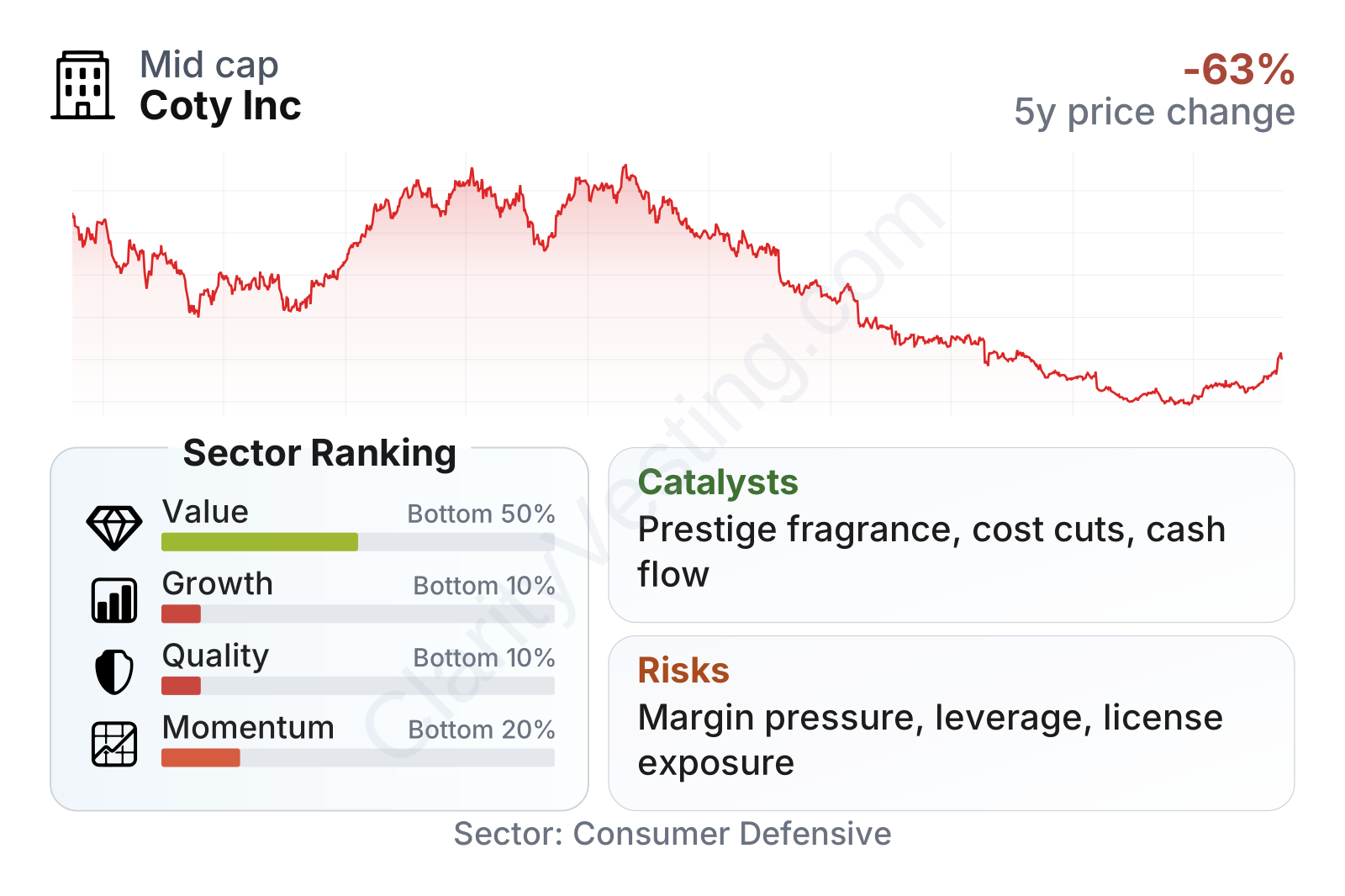
Coty is now a mid-sized company within the consumer products space, and the market’s view has become much more cautious over time. The share price has fallen heavily over the last several years, even though there has been a sharp rebound in the most recent six-month period. The metrics table points to a mixed picture: valuation signals look less demanding than many peers on some measures such as price-to-book and free-cash-flow yield, but growth, profitability, and balance-sheet quality rank near the bottom of the sector. In other words, the stock appears statistically inexpensive in some areas because the business is currently under pressure.
Growth
The beauty industry is generally considered a resilient consumer category over long periods. Fragrances, skin care, and cosmetics benefit from brand loyalty, global distribution, product innovation, and growing demand in travel retail and premium beauty. Coty is positioned in segments that can grow over time, especially prestige fragrance, which has been one of the stronger areas of the beauty market in recent years.
Coty’s strategy also makes sense conceptually. The company has been emphasizing prestige beauty, expanding fragrance lines, supporting e-commerce, and trying to improve its supply chain and cost base. Prestige is important because it usually carries stronger pricing power than mass beauty. Coty has also highlighted innovation pipelines, category expansion around existing brands, and wider distribution in faster-growing channels.
The difficulty is that recent growth has slowed materially. Coty posted double-digit year-over-year growth in several periods during 2023, then moved into a much weaker pattern with flat to negative revenue changes across much of 2025 and 2026. That slowdown matters because it suggests the company is no longer benefiting from the same post-reopening and premium-fragrance momentum that supported earlier expansion.
Free cash flow remains one of the more constructive parts of the picture. Even with weaker earnings, Coty has continued to generate hundreds of millions of dollars in trailing free cash flow. That gives the company some flexibility to pay down debt, support brand investments, and absorb operating volatility. For a company in transition, cash generation is a meaningful stabilizer.
A key potential catalyst is any successful turnaround in margins through tighter cost control and a normalization of selling expenses. Another is continued strength in prestige fragrance launches and licensing renewals, where Coty has meaningful know-how and retailer relationships. If management can combine stable sales with better cost discipline, earnings could improve faster than revenue.
Recent company communications have also emphasized transformation efforts, productivity measures, and simplification initiatives. These steps do not create demand on their own, but they can improve operating leverage if revenue stabilizes. That is especially relevant for Coty because the gap between gross profit and final earnings has become unusually wide.
Risks
This article is for informational purposes only and does not constitute financial advice. Some content is AI-generated. See Disclaimer