Stock Analysis · Costco Wholesale Corp (COST)
Overview
Costco Wholesale Corp operates a membership-based warehouse retail model. Instead of focusing on high markups, the company aims to sell a limited assortment of products at very low prices and make a meaningful portion of its economics from recurring membership fees. Its warehouses sell groceries, fresh food, household essentials, health and beauty items, apparel, electronics, home goods, seasonal merchandise, gas, and selected services such as pharmacy, optical, travel, hearing aids, tire installation, and other member-related offerings.
The business is built around high sales volume, fast inventory turnover, and a reputation for value. Costco’s model is relatively simple for consumers: members pay an annual fee to shop, and in return they get access to low prices on a broad range of everyday needs. That structure helps create repeat traffic and gives the company predictable recurring revenue from renewals.
Based on recent company filings, Costco’s main sources of revenue can be summarized as follows:
- Net sales: about 98% of total revenue. This includes merchandise sold in warehouses, online sales, and other direct retail activity.
- Membership fees: about 2% of total revenue. This is small as a share of revenue, but strategically important because it carries much higher profitability than merchandise sales.
Within merchandise sales, the company groups sales into a few broad categories. Approximate category shares of net sales from recent annual reporting are:
- Foods and sundries: about 38%. This includes packaged foods, beverages, candy, tobacco, and cleaning supplies.
- Fresh foods: about 19%. This includes meat, produce, deli, bakery, and related perishables.
- Non-foods: about 25%. This includes hardlines, softlines, small appliances, home furnishings, health and beauty aids, and similar items.
- Ancillary and other: about 18%. This includes gas stations, pharmacy, optical, food courts, hearing aids, and certain business services.
Geographically, the United States remains the largest market by far, with Canada and other international markets adding diversification. E-commerce is still a minority of total revenue, but it extends Costco’s reach and supports categories that work well online, including appliances, electronics, and selected higher-ticket products.
The financial flow also shows a clear pattern: revenue has kept rising steadily, while operating income and net income have expanded along with it. Interest expense remains very small relative to the size of the business, which fits Costco’s conservative balance sheet profile.
Key Figures
| Metric | Value | Sector ⓘ |
|---|---|---|
| Date | Oct 17, 2026 | |
| Context | ||
| Sector | Consumer Defensive | |
| Industry | Discount Stores | |
| Market Cap ⓘ | $425.16B | |
| Beta ⓘ | 0.87 | |
Value (Cheapness) | ||
| P/E Ratio ⓘ | 46.22 | 17.88 |
| P/B Ratio ⓘ | 11.85 | 1.29 |
| FCF Yield ⓘ | 2.21% | 12.39% |
| Dividend Yield ⓘ | 0.59% | 2.85% |
| EBIT / EV ⓘ | 3.00% | 6.43% |
| PEG ⓘ | 4.43 | |
Growth (Business expansion) | ||
| Revenue Growth ⓘ | 11.10% | 4.10% |
| RPS Growth (5Y CAGR) ⓘ | 7.53% | 6.18% |
| EPS Growth (5Y CAGR) ⓘ | 11.91% | -13.59% |
| BVPS Growth (5Y CAGR) ⓘ | 14.79% | 3.20% |
| Margin Growth (5Y Trend) ⓘ | 0.33% | -0.15% |
| FCF Growth (5Y CAGR) ⓘ | 27.97% | 4.10% |
| DPS Growth (5Y CAGR) ⓘ | 13.20% | 6.79% |
Quality (Business durability) | ||
| ROIC (Latest) ⓘ | N/A | 12.34% |
| ROA (Latest) ⓘ | 10.74% | 6.30% |
| ROIC (5Y Median) ⓘ | 23.77% | 10.49% |
| ROA (5Y Median) ⓘ | 10.61% | 5.44% |
| Net Debt / EBIT (Latest) ⓘ | -1.00 | 1.96 |
| Net Debt / EBIT (5Y Median) ⓘ | -0.36 | 2.35 |
| Net Debt / EBITDA (Latest) ⓘ | -0.81 | 1.38 |
| Net Debt / Assets ⓘ | -13.06% | 21.51% |
| EBITDA / Interest ⓘ | 99.03 | 9.46 |
| Operating Margin (Latest) ⓘ | 3.85% | 8.87% |
| Operating Margin (5Y Median) ⓘ | 3.85% | 9.53% |
| Debt to Equity (Latest) ⓘ | 23.95% | 72.35% |
| Profit Margin (Latest) ⓘ | 3.04% | 5.40% |
| Free Cash Flow (Latest) ⓘ | $9.39B | |
Momentum (Price trend) | ||
| 3Y Return ⓘ | +75.24% | +20.92% |
| 12M Return (excl. last month) ⓘ | -5.98% | +2.13% |
| 6M Return ⓘ | -2.38% | +1.26% |
| Price vs. 200-Day MA ⓘ | -0.82% | +1.39% |
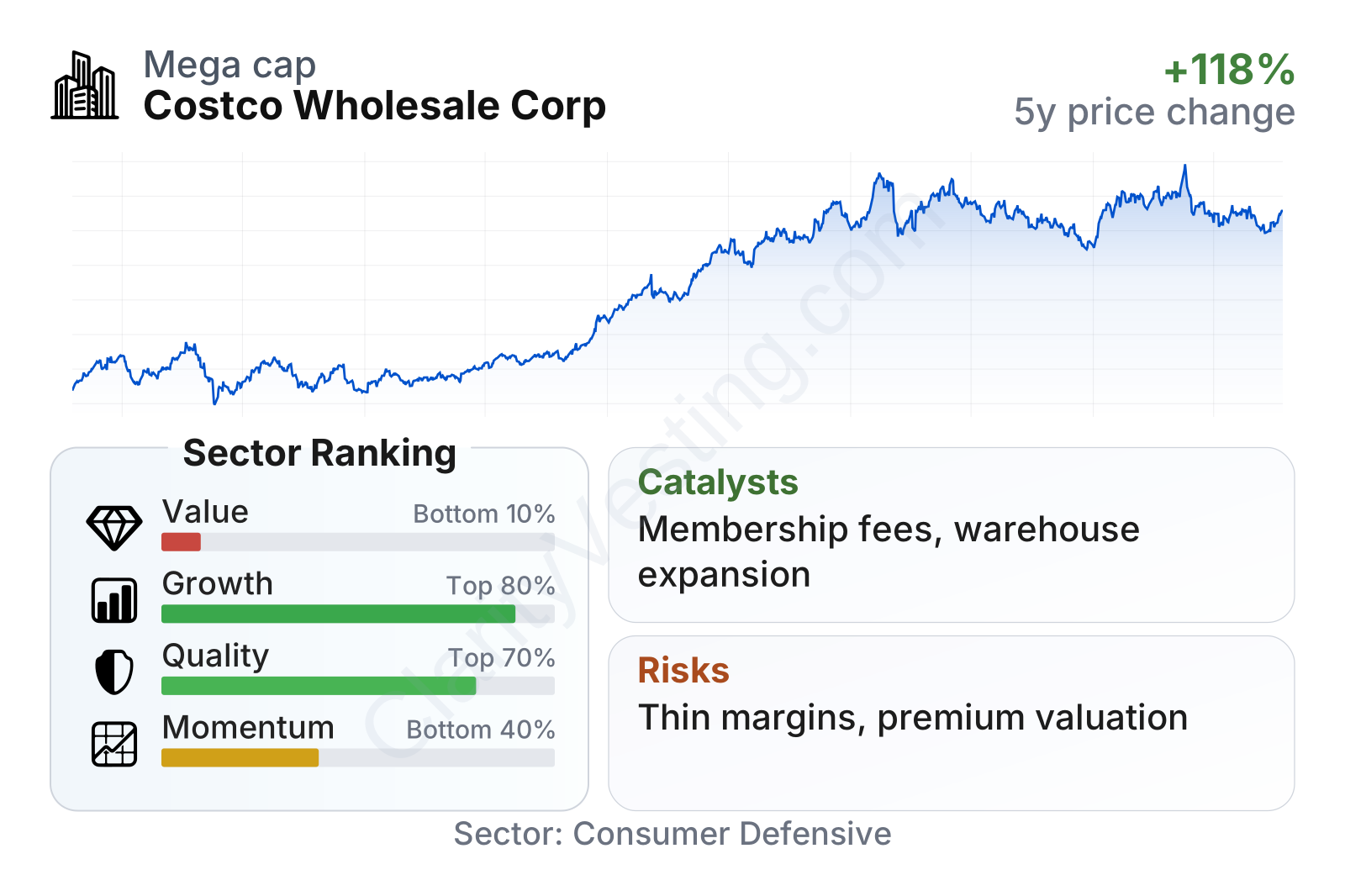
Costco is one of the largest companies in U.S. retail, and its share price has produced a strong multi-year climb despite some recent volatility. The metrics table points to a business with solid quality and growth characteristics, supported by high returns on assets, strong long-term earnings expansion, and unusually low leverage for the sector. At the same time, the stock ranks poorly on traditional value measures, reflecting a market price that already assumes a high level of consistency and resilience.
Growth
Costco operates in a sector that is mature, but the company still has several growth levers. Consumer staples and discount retail tend to be structurally durable because households continue to spend on groceries, fuel, and basic goods in nearly every economic environment. Costco’s positioning within that space is especially attractive because it combines value pricing with a paid membership model, which can strengthen customer loyalty and encourage repeat visits.
The company’s strategy for future growth is straightforward and coherent: open more warehouses, increase sales per warehouse, expand internationally, improve digital convenience, and raise membership income over time through more members, better renewal rates, and occasional fee increases. This approach does not depend on speculative technologies or abrupt shifts in consumer behavior. It relies on execution, scale, and maintaining a strong value perception.
Recent revenue growth has remained healthy, with year-over-year expansion generally staying ahead of the sector median. Growth has not been perfectly smooth, but the broader trend still points to a retailer that continues to gain volume at a large scale. That matters because Costco already starts from a very high revenue base, so sustained low-double-digit growth is more meaningful than it would be for a much smaller chain.
Cash generation has also improved meaningfully over time. Free cash flow has risen from the mid-single-digit billions to roughly the high-single-digit billions in a relatively short period. That gives Costco room to fund new warehouses, invest in logistics and technology, and continue returning capital without leaning heavily on debt.
One of the strongest practical catalysts is membership economics. Membership fees represent only a small share of revenue, but they contribute disproportionately to profit stability. When Costco grows its member base or lifts annual fees, the earnings impact can be notable because the incremental cost of that revenue is low. Another catalyst is international expansion, where the company still has a much smaller footprint than in the U.S., leaving room for long-duration store growth.
Recent company updates have also pointed to continued warehouse openings and steady comparable sales momentum, including e-commerce support and traffic growth. In a retail landscape where many chains struggle to defend volumes, Costco’s ability to keep attracting visits is a meaningful advantage.
Risks
This article is for informational purposes only and does not constitute financial advice. Some content is AI-generated. See Disclaimer


