Stock Analysis · Compass Inc (COMP)
Overview
Compass Inc is a U.S. residential real estate brokerage and technology company. In simple terms, it helps people buy, sell, and rent homes, while also providing software and services to the real estate agents who work on its platform. The company’s pitch is that better tools, marketing support, and a large agent network can help agents win more listings and close more transactions.
Its business is still centered on brokerage activity, so revenue rises and falls largely with home sales volumes and home prices. When the housing market is active, Compass benefits from more transactions and higher commission pools. When mortgage rates rise and housing demand slows, revenue can come under pressure.
Based on company filings, Compass generates most of its revenue from commissions and related fees tied to residential real estate transactions. The main sources are:
- Residential real estate brokerage commissions and related services: approximately more than 90% of revenue. This includes the company’s share of commissions from home purchase and sale transactions handled by agents on the Compass platform.
- Ancillary and other services: approximately less than 10% of revenue. This includes offerings connected to the transaction ecosystem, such as title, escrow, mortgage-related partnerships, and other support services where available by market.
Over the last several years, the business has shown how sensitive it is to housing activity. Revenue fell sharply from 2021 through 2023 as the U.S. housing market slowed, then recovered in 2024 and strengthened further in 2025. At the same time, operating losses narrowed significantly, which suggests cost controls have improved even if profitability remains thin.
The long-term pattern is mixed but improving: sales recovered strongly in 2025 after a difficult housing downturn, and losses became much smaller than they were in 2021–2023. The main issue is that gross profit and operating income still move heavily with transaction conditions, so the business has not yet shown the steadiness typical of stronger platform companies.
Key Figures
| Metric | Value | Sector ⓘ |
|---|---|---|
| Date | Oct 17, 2026 | |
| Context | ||
| Sector | Real Estate | |
| Industry | Real Estate Services | |
| Market Cap ⓘ | $6.72B | |
| Beta ⓘ | 2.32 | |
Value (Cheapness) | ||
| P/E Ratio ⓘ | 146.00 | 17.38 |
| P/B Ratio ⓘ | 1.85 | 0.85 |
| FCF Yield ⓘ | 1.90% | 7.38% |
| Dividend Yield ⓘ | N/A | 4.85% |
| EBIT / EV ⓘ | -2.52% | 3.78% |
| PEG ⓘ | N/A | |
Growth (Business expansion) | ||
| Revenue Growth ⓘ | 109.00% | 5.30% |
| RPS Growth (5Y CAGR) ⓘ | -11.32% | 6.02% |
| EPS Growth (5Y CAGR) ⓘ | N/A | -11.37% |
| BVPS Growth (5Y CAGR) ⓘ | -14.78% | 0.45% |
| Margin Growth (5Y Trend) ⓘ | N/A | -0.22% |
| FCF Growth (5Y CAGR) ⓘ | N/A | 5.40% |
| DPS Growth (5Y CAGR) ⓘ | N/A | 5.02% |
Quality (Business durability) | ||
| ROIC (Latest) ⓘ | -4.84% | 5.69% |
| ROE (Latest) ⓘ | 3.57% | 7.56% |
| ROA (Latest) ⓘ | 1.35% | 2.85% |
| ROIC (5Y Median) ⓘ | -41.47% | 4.22% |
| ROE (5Y Median) ⓘ | -52.59% | 6.03% |
| ROA (5Y Median) ⓘ | -23.86% | 2.44% |
| Net Debt / EBIT (Latest) ⓘ | N/A | 7.59 |
| Net Debt / EBIT (5Y Median) ⓘ | N/A | 8.40 |
| Net Debt / EBITDA (Latest) ⓘ | 31.80 | 5.27 |
| Net Debt / Assets ⓘ | 40.99% | 37.76% |
| EBITDA / Interest ⓘ | 1.31 | 4.10 |
| Operating Margin (Latest) ⓘ | -2.49% | 35.29% |
| Operating Margin (5Y Median) ⓘ | -6.27% | 37.31% |
| Debt to Equity (Latest) ⓘ | 137.93% | 88.87% |
| Profit Margin (Latest) ⓘ | 0.64% | 19.61% |
| Free Cash Flow (Latest) ⓘ | $127.80M | |
Momentum (Price trend) | ||
| 3Y Return ⓘ | +341.28% | +30.75% |
| 12M Return (excl. last month) ⓘ | +11.40% | +4.36% |
| 6M Return ⓘ | +32.14% | -2.52% |
| Price vs. 200-Day MA ⓘ | -4.04% | -2.34% |
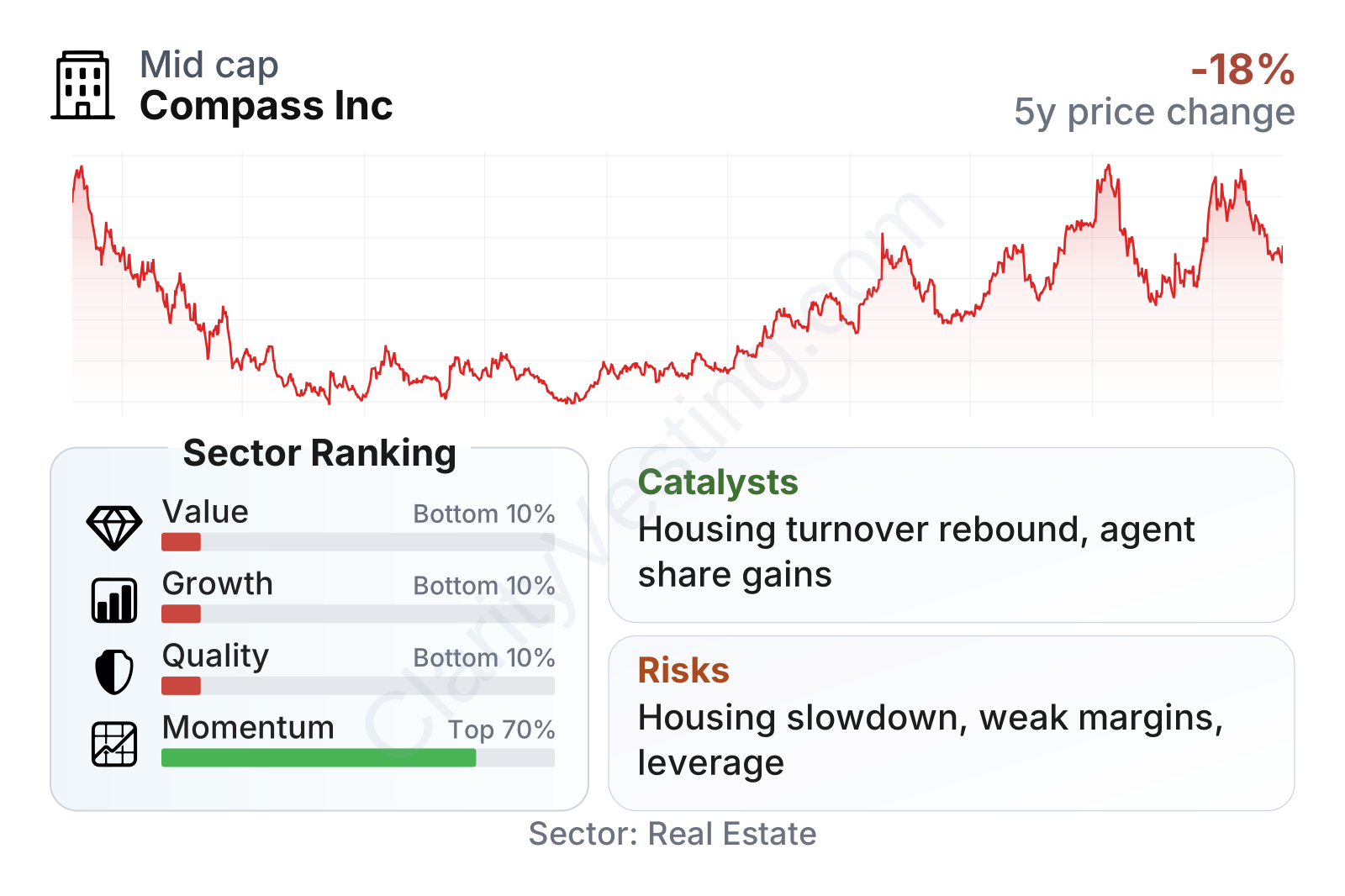
Compass is now a mid-sized public company within real estate services, but the operating profile remains uneven. Recent share-price performance has been strong over multi-year and medium-term periods, yet the fundamentals table is far less flattering. Value, growth, and quality rank near the bottom of the sector, reflecting very slim profitability, weak long-term per-share trends, and a valuation that already assumes meaningful improvement.
One feature that stands out is volatility. The stock has moved through a deep post-IPO decline, a recovery phase, and then sharp swings again in 2026. That behavior fits a company whose results are tied to the housing cycle and whose margins remain narrow.
Growth
Compass operates in a very large market: U.S. residential real estate brokerage. That market is mature rather than new, but it still offers room for share gains because it is fragmented and highly competitive. Growth for Compass therefore depends less on the market expanding rapidly and more on taking share, recruiting productive agents, increasing transactions per agent, and selling more services around each transaction.
The company’s strategy broadly makes sense. Compass has spent years building software for agents, marketing tools, client relationship management features, listing support, and an integrated operating platform. If that platform helps agents close more deals or work more efficiently, it can support agent retention and recruiting. Scale also matters in brokerage because a larger network can improve brand visibility, referral flow, and local market presence.
Revenue per share still shows the damage from the housing slowdown after 2021, but the last two annual readings point to recovery. That matters because long-term shareholders ultimately need growth that is not only absolute, but also durable on a per-share basis. At this stage, the rebound is visible, but it has not yet erased the earlier decline.
Compass does not currently present an income profile as part of its equity case. This is a company centered on operational recovery and market-share execution rather than cash distributions to shareholders.
A meaningful catalyst is any broad improvement in U.S. housing turnover. If mortgage rates ease or buyers and sellers become more active, transaction volumes could improve materially. Because Compass earns mostly from commissions, even a moderate housing recovery can have a large effect on revenue and margins. Another catalyst is further expansion of adjacent services tied to the home transaction, which could lift revenue per client and make the business less dependent on pure brokerage commissions.
Recent company updates have also emphasized cost discipline and adjusted profitability progress. That is important because Compass does not need a perfect housing market to improve results; it also needs tighter control over expenses. If management can keep expenses from rising as quickly as revenue in a better market, operating leverage could become much more visible.
Risks
This article is for informational purposes only and does not constitute financial advice. Some content is AI-generated. See Disclaimer


