Stock Analysis · Americold Realty Trust (COLD)
Overview
Americold Realty Trust is a real estate investment trust focused on temperature-controlled warehouses. In simple terms, it owns and operates cold storage facilities that keep food and other perishable products frozen or refrigerated as they move through the supply chain. Its customers include food producers, distributors, retailers, and companies involved in imports and exports. This is a specialized part of logistics because handling frozen and chilled products requires expensive infrastructure, strict food-safety procedures, and locations close to ports, production regions, and major consumption areas.
The company makes money from both storage and warehouse-related services. Based on its recent annual reporting structure, revenue is mainly generated from the warehouse segment, with a smaller contribution from transportation and third-party managed business activities.
- Warehouse revenue: approximately 85% to 90% of total revenue. This includes fixed storage charges, handling services such as moving pallets in and out, and other value-added services performed inside cold storage facilities.
- Transportation revenue: approximately 5% to 10%. This comes from arranging or providing transportation services linked to customers’ cold-chain needs.
- Third-party managed and other revenue: approximately 3% to 7%. This includes fees from facilities managed for others and other related services.
Geographically, Americold has a large footprint in the United States and also operates internationally, which matters because many large food customers want logistics partners that can support them across regions. The business model combines real estate income characteristics with operating exposure: unlike a more traditional landlord, Americold’s results depend not only on occupancy and rent-like storage income, but also on labor efficiency, throughput volumes, energy costs, and warehouse utilization.
The financial flow over the last several years shows a business with multibillion-dollar revenue, but also one where operating costs and interest expense absorb a large share of that revenue. Gross profit improved through 2024, yet bottom-line profitability remained under pressure, which helps explain why the stock’s long-term performance has been weak despite the strategic importance of the assets.
Key Figures
| Metric | Value | Sector ⓘ |
|---|---|---|
| Date | Oct 17, 2026 | |
| Context | ||
| Sector | Real Estate | |
| Industry | REIT - Industrial | |
| Market Cap ⓘ | $3.96B | |
| Beta ⓘ | 0.94 | |
Value (Cheapness) | ||
| P/E Ratio ⓘ | N/A | 17.38 |
| P/B Ratio ⓘ | 1.68 | 0.85 |
| FCF Yield ⓘ | -5.22% | 7.38% |
| Dividend Yield ⓘ | 6.59% | 4.85% |
| EBIT / EV ⓘ | -3.61% | 3.78% |
| PEG ⓘ | 5.84 | |
Growth (Business expansion) | ||
| Revenue Growth ⓘ | 1.80% | 5.30% |
| RPS Growth (5Y CAGR) ⓘ | -3.26% | 6.02% |
| EPS Growth (5Y CAGR) ⓘ | 38.21% | -11.37% |
| BVPS Growth (5Y CAGR) ⓘ | -10.27% | 0.45% |
| Margin Growth (5Y Trend) ⓘ | -2.06% | -0.22% |
| FCF Growth (5Y CAGR) ⓘ | -0.18% | 5.40% |
| DPS Growth (5Y CAGR) ⓘ | 1.22% | 5.02% |
Quality (Business durability) | ||
| ROIC (Latest) ⓘ | -3.54% | 5.69% |
| ROE (Latest) ⓘ | -16.97% | 7.56% |
| ROA (Latest) ⓘ | -5.74% | 2.85% |
| ROIC (5Y Median) ⓘ | 0.38% | 4.22% |
| ROE (5Y Median) ⓘ | -2.75% | 6.03% |
| ROA (5Y Median) ⓘ | -1.21% | 2.44% |
| Net Debt / EBIT (Latest) ⓘ | N/A | 7.59 |
| Net Debt / EBIT (5Y Median) ⓘ | 80.84 | 8.40 |
| Net Debt / EBITDA (Latest) ⓘ | 66.17 | 5.27 |
| Net Debt / Assets ⓘ | 58.63% | 37.76% |
| EBITDA / Interest ⓘ | 0.42 | 4.10 |
| Operating Margin (Latest) ⓘ | -11.98% | 35.29% |
| Operating Margin (5Y Median) ⓘ | 1.21% | 37.31% |
| Debt to Equity (Latest) ⓘ | 191.34% | 88.87% |
| Profit Margin (Latest) ⓘ | -17.45% | 19.61% |
| Free Cash Flow (Latest) ⓘ | -$206.63M | |
Momentum (Price trend) | ||
| 3Y Return ⓘ | -41.69% | +30.75% |
| 12M Return (excl. last month) ⓘ | +17.77% | +4.36% |
| 6M Return ⓘ | +18.49% | -2.52% |
| Price vs. 200-Day MA ⓘ | +4.37% | -2.34% |
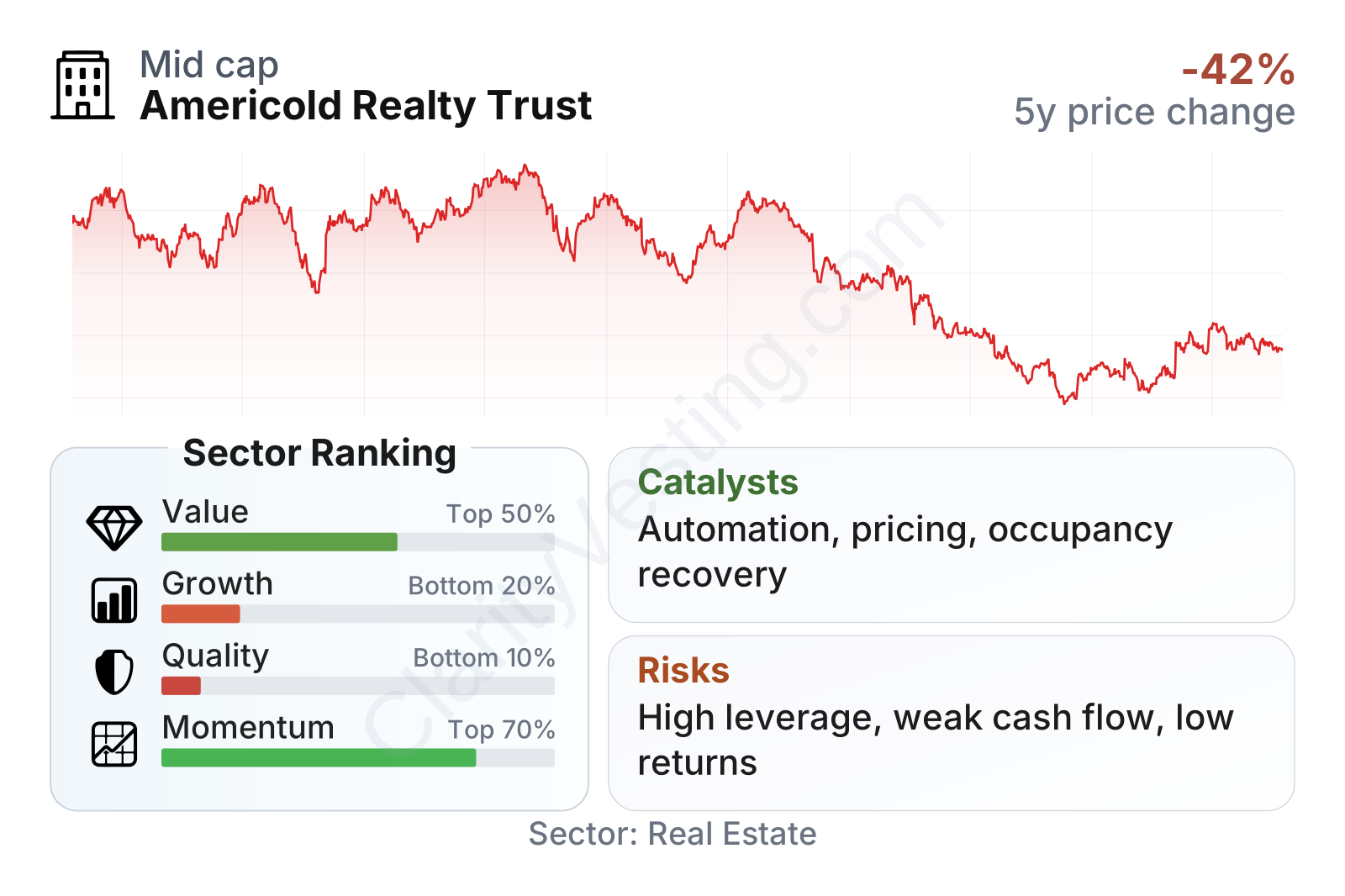
Americold is a mid-sized public REIT with a stock price that has been volatile and, over the past few years, clearly weaker than much of the real estate sector. The latest factor view is mixed. Dividend yield stands above the sector median, and recent share-price momentum has improved, especially over the last six to twelve months. However, the broader picture is less favorable: growth ranks near the bottom of the sector, profitability measures are weak, and free cash flow is currently negative. In other words, the market has recently shown more confidence, but the operating and balance-sheet profile still looks fragile.
Growth
Cold storage is part of a long-term relevant industry. Food supply chains are becoming more complex, frozen and prepared foods remain important in consumer spending, and stricter inventory and food-safety requirements support demand for specialized refrigerated infrastructure. These are favorable structural conditions because cold warehouses are difficult and costly to build, especially in well-located markets.
Americold’s strategy also makes sense in principle. The company has historically pursued growth through a combination of acquisitions, development, automation, and deeper relationships with large food customers. A larger network can be useful because major customers often prefer a provider that can serve multiple regions and offer integrated handling, storage, and transportation support. This creates a scale logic that smaller local operators may struggle to match.
Still, the recent growth record is underwhelming. Revenue growth has been modest versus the broader real estate sector, and revenue per share has trended down over the last five years. That suggests growth in the asset base has not translated cleanly into stronger economics for each share outstanding.
The revenue-per-share trend points to a business that has added scale without yet producing stronger per-share output. For long-term analysis, that matters more than raw revenue alone because it helps show whether expansion is becoming more productive for shareholders over time.
The dividend has been comparatively steady, with only limited growth over the last five years. That stability can be seen as a sign of management trying to preserve consistency, but the lack of stronger dividend expansion also reflects the company’s constrained earnings and cash generation.
As a catalyst, recent company updates have centered on network optimization, pricing discipline, occupancy management, and efforts to improve warehouse economics. If those initiatives lead to better margins and stronger cash generation, the company could benefit meaningfully because even small operational improvements can have a large effect when interest costs are high. Another potential tailwind is any easing in financing pressure if borrowing conditions improve, since Americold’s business is capital intensive and sensitive to the cost of debt.
Recent public company communications have also continued to emphasize development projects, automation, and customer contract wins or renewals as part of the path to higher utilization. Those are credible opportunities, but the key question is execution: the market likely needs to see better profitability, not just a larger footprint.
Risks
This article is for informational purposes only and does not constitute financial advice. Some content is AI-generated. See Disclaimer


