Stock Analysis · Columbia Banking System Inc (COLB)
Overview
Columbia Banking System is a regional bank holding company headquartered in the Pacific Northwest. Through Columbia State Bank, Umpqua Bank, and related banking subsidiaries, it provides everyday banking services to consumers, small businesses, middle-market companies, and certain specialized commercial clients. Its footprint is concentrated in western U.S. states, especially Washington, Oregon, California, Idaho, and neighboring markets. For a long-term reader, the simplest way to think about Columbia is as a traditional relationship bank: it gathers deposits, makes loans, earns interest on the spread between the two, and adds fee-based services around that core activity.
The company’s revenue is dominated by net interest income, which is the money left after paying depositors and other funding costs and collecting interest from loans and securities. Non-interest income is smaller but still meaningful because it adds diversification beyond lending.
Based on recent annual disclosures, the main revenue sources are approximately:
- Net interest income after provision for credit losses: about 75% to 85%. This is the core banking engine and includes income from commercial real estate loans, commercial and industrial loans, residential real estate lending, consumer lending, and the securities portfolio.
- Service charges and deposit-related fees: about 5% to 8%. This includes account fees, treasury management, card-related charges, and other routine banking fees.
- Wealth management, trust, and advisory fees: about 3% to 6%. These services support higher-value commercial and personal clients and tend to be less balance-sheet intensive than lending.
- Mortgage banking and other loan-related fees: about 2% to 5%. This can include mortgage gain-on-sale income, servicing-related activity, and certain origination fees.
- Other non-interest income: about 5% to 10%. This usually includes bank-owned life insurance income, capital markets-related activity, and miscellaneous banking services.
After the combination with Umpqua, the business became much larger and more diversified by geography, lending mix, and client base. That matters because regional banks are often judged not just by size, but by the stability of their deposits, the quality of their loan book, and their ability to maintain profits through changing interest-rate environments.
The broad revenue trend has been upward over the last several years, helped by the Umpqua merger and a larger earning-asset base. At the same time, funding and interest costs increased sharply as rates moved higher, so stronger revenue did not fully translate into equally strong profitability at every stage. That trade-off is central to understanding Columbia today.
Key Figures
| Metric | Value | Sector ⓘ |
|---|---|---|
| Date | Oct 10, 2026 | |
| Context | ||
| Sector | Financial Services | |
| Industry | Banks - Regional | |
| Market Cap ⓘ | $7.99B | |
| Beta ⓘ | 0.69 | |
Value (Cheapness) | ||
| P/E Ratio ⓘ | 11.08 | 12.38 |
| P/B Ratio ⓘ | 1.08 | 1.23 |
| FCF Yield ⓘ | 16.03% | 10.23% |
| Dividend Yield ⓘ | 5.09% | 3.01% |
| EBIT / EV ⓘ | 8.50% | 8.08% |
| PEG ⓘ | 2.26 | |
Growth (Business expansion) | ||
| Revenue Growth ⓘ | 35.10% | 9.50% |
| RPS Growth (5Y CAGR) ⓘ | 15.89% | 12.21% |
| EPS Growth (5Y CAGR) ⓘ | -15.48% | -9.62% |
| BVPS Growth (5Y CAGR) ⓘ | 20.52% | 4.98% |
| Margin Growth (5Y Trend) ⓘ | -18.96% | -4.07% |
| FCF Growth (5Y CAGR) ⓘ | 2.20% | 4.76% |
| DPS Growth (5Y CAGR) ⓘ | 7.77% | 8.79% |
Quality (Business durability) | ||
| ROIC (Latest) ⓘ | 6.37% | 9.35% |
| ROE (Latest) ⓘ | 9.27% | 13.91% |
| ROA (Latest) ⓘ | 1.07% | 1.53% |
| ROIC (5Y Median) ⓘ | 5.92% | 7.86% |
| ROE (5Y Median) ⓘ | 9.33% | 12.22% |
| ROA (5Y Median) ⓘ | 1.03% | 1.29% |
| Net Debt / EBIT (Latest) ⓘ | 4.43 | 0.99 |
| Net Debt / EBIT (5Y Median) ⓘ | 2.82 | 0.73 |
| Net Debt / EBITDA (Latest) ⓘ | 3.94 | 0.93 |
| Operating Margin (Latest) ⓘ | 26.78% | 22.19% |
| Operating Margin (5Y Median) ⓘ | 24.23% | 24.30% |
| Debt to Equity (Latest) ⓘ | 64.55% | 60.24% |
| Profit Margin (Latest) ⓘ | 28.38% | 26.49% |
| Free Cash Flow (Latest) ⓘ | $1.28B | |
Momentum (Price trend) | ||
| 3Y Return ⓘ | +71.41% | +88.52% |
| 12M Return (excl. last month) ⓘ | +18.17% | +19.65% |
| 6M Return ⓘ | +1.26% | +6.00% |
| Price vs. 200-Day MA ⓘ | -2.39% | +3.61% |
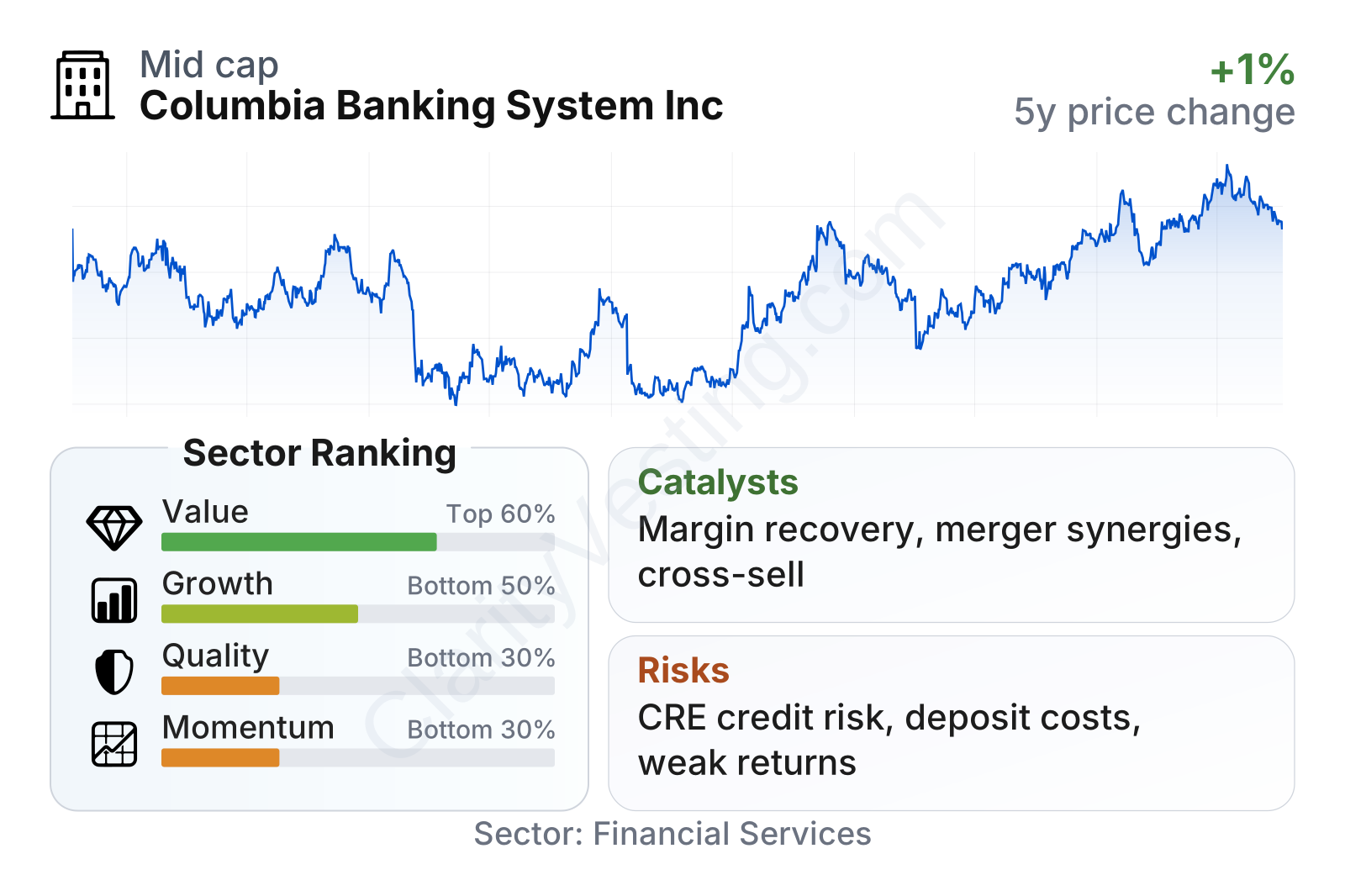
Columbia is a mid-sized regional bank with a market value around $8 billion and a relatively low beta near 0.65, suggesting the stock has historically moved less sharply than the broader market. In the latest metrics, valuation looks slightly cheaper than the sector median on both earnings and book value multiples, while the dividend yield is notably above the sector median. Revenue growth has been strong, largely reflecting the larger combined company after the merger, but quality metrics such as return on equity and return on assets remain below many regional-bank peers. In other words, the market is not pricing Columbia like a top-tier bank franchise, but it is also not valuing it like a deeply troubled institution.
The stock-price history also reflects the pressure regional banks faced during the 2023 banking turmoil. Shares dropped sharply during that period, then gradually recovered. Even after the rebound, the trading pattern suggests the market still wants clearer evidence that the company can consistently convert its larger scale into stronger returns.
Growth
Columbia operates in a sector that is mature rather than fast-growing, so long-term expansion usually comes from population and business growth in local markets, selective acquisitions, better product cross-selling, and improved efficiency. On that front, the company has an attractive regional footprint. The Pacific Northwest and parts of the West Coast have historically offered favorable household formation, small-business activity, and commercial banking demand compared with many slower-growth U.S. banking markets.
The company’s strategy broadly makes sense for future growth. The Umpqua transaction gave Columbia a larger scale, a broader deposit base, and a more meaningful presence in several western states. Management has emphasized integration, operating efficiency, relationship banking, and specialty commercial lending capabilities. If those pieces continue to improve, the combined franchise could produce better earnings power than either organization would likely have generated alone.
Earnings per share show that the business has not followed a straight line. Profitability dipped after 2021, then began to recover in 2024 and 2025. That pattern is important: it suggests the bank is still in the process of turning size into durable bottom-line performance. A long-term case here depends less on rapid loan growth and more on steadier margins, lower integration drag, and disciplined credit results.
Book value per share has increased strongly over the past several years, especially after the merger reshaped the balance sheet. For banks, book value is a useful anchor because it reflects the capital base supporting future lending and earnings. Columbia’s improvement here is one of the more constructive long-term signals, even though the market has been slower to reward it with a premium valuation.
Potential catalysts are fairly clear. First, lower funding pressure or a more favorable interest-rate backdrop could support net interest margin. Second, additional merger integration benefits could lift efficiency. Third, commercial banking, treasury management, and wealth offerings can deepen relationships with existing clients without requiring the same balance-sheet growth as pure lending. In recent company communications, management has also highlighted capital strength, deposit stability, and continued execution on expense discipline, all of which can matter more than headline growth for a regional bank at this stage.
Recent developments have generally pointed to operational normalization rather than a dramatic transformation. The main opportunity is not a single breakthrough event; it is the possibility that a larger western regional bank gradually earns better returns as integration matures and industry conditions become less strained.
Risks
This article is for informational purposes only and does not constitute financial advice. Some content is AI-generated. See Disclaimer