Stock Analysis · Coca-Cola Consolidated Inc (COKE)
Overview
Coca-Cola Consolidated is the largest Coca-Cola bottler in the United States. It does not own the Coca-Cola brand itself; instead, it manufactures, sells, and distributes beverages that are owned or licensed by The Coca-Cola Company and other partners. Its business is centered on getting drinks onto store shelves, into restaurants, and through vending and food-service channels across a large U.S. territory.
The company’s revenue mainly comes from selling finished beverages, with a smaller contribution from distribution and other activities tied to its route network and customer support services. Based on recent annual reporting, the mix is heavily concentrated in sparkling soft drinks, followed by still beverages and then other sources.
- Sparkling soft drinks: about 70% to 75% of sales volume. This includes core carbonated brands such as Coca-Cola, Sprite, Fanta, and other flavored soft drinks.
- Still beverages: about 25% to 30% of sales volume. This category includes water, sports drinks, tea, coffee, juice, energy-related offerings, and other non-carbonated products.
- Other revenue: a small share of total revenue, including items such as distribution-related activities, freight, and other customer service arrangements.
Geographically, the business is overwhelmingly concentrated in the United States. That makes Coca-Cola Consolidated simpler to understand than many global beverage groups, but it also means results depend heavily on U.S. consumer demand, weather, regional execution, and domestic input costs.
The business model is attractive when execution is strong: beverage demand is usually steady, route density can create local scale advantages, and price increases can partly offset higher packaging and ingredient costs. Over the last several years, the company has also improved profitability materially, showing that disciplined pricing, package mix, and operating efficiency can make a major difference even in a relatively mature industry.
The long-term pattern has been favorable: revenue has continued to rise, gross profit has expanded faster than costs in several periods, and net income has grown much more sharply than sales since 2021. That suggests the recent progress has not come only from volume growth, but also from better margins and stronger operating discipline.
Key Figures
| Metric | Value | Sector ⓘ |
|---|---|---|
| Date | Oct 04, 2026 | |
| Context | ||
| Sector | Consumer Defensive | |
| Industry | Beverages - Non-Alcoholic | |
| Market Cap ⓘ | $12.78B | |
| Beta ⓘ | 0.55 | |
Value (Cheapness) | ||
| P/E Ratio ⓘ | 25.50 | 18.17 |
| P/B Ratio ⓘ | N/A | 1.27 |
| FCF Yield ⓘ | 5.04% | 12.39% |
| Dividend Yield ⓘ | 0.53% | 2.83% |
| EBIT / EV ⓘ | 5.97% | 6.38% |
| PEG ⓘ | 3.04 | |
Growth (Business expansion) | ||
| Revenue Growth ⓘ | 10.60% | 3.80% |
| RPS Growth (5Y CAGR) ⓘ | 9.87% | 6.20% |
| EPS Growth (5Y CAGR) ⓘ | -38.75% | -14.56% |
| BVPS Growth (5Y CAGR) ⓘ | N/A | 3.26% |
| Margin Growth (5Y Trend) ⓘ | 6.10% | -0.25% |
| FCF Growth (5Y CAGR) ⓘ | 14.30% | 4.65% |
| DPS Growth (5Y CAGR) ⓘ | 79.45% | 6.86% |
Quality (Business durability) | ||
| ROIC (Latest) ⓘ | 27.69% | 12.58% |
| ROA (Latest) ⓘ | 10.89% | 6.32% |
| ROIC (5Y Median) ⓘ | 22.94% | 10.36% |
| ROA (5Y Median) ⓘ | 11.49% | 5.44% |
| Net Debt / EBIT (Latest) ⓘ | 2.75 | 1.91 |
| Net Debt / EBIT (5Y Median) ⓘ | 0.93 | 2.32 |
| Net Debt / EBITDA (Latest) ⓘ | 2.23 | 1.36 |
| Net Debt / Assets ⓘ | 55.27% | 21.25% |
| EBITDA / Interest ⓘ | 11.89 | 9.61 |
| Operating Margin (Latest) ⓘ | 11.58% | 8.91% |
| Operating Margin (5Y Median) ⓘ | 9.67% | 9.53% |
| Debt to Equity (Latest) ⓘ | -524.19% | 71.66% |
| Profit Margin (Latest) ⓘ | 7.15% | 5.39% |
| Free Cash Flow (Latest) ⓘ | $644.71M | |
Momentum (Price trend) | ||
| 3Y Return ⓘ | +213.77% | +15.25% |
| 12M Return (excl. last month) ⓘ | +68.03% | +2.49% |
| 6M Return ⓘ | -1.09% | +2.26% |
| Price vs. 200-Day MA ⓘ | +5.58% | +0.43% |
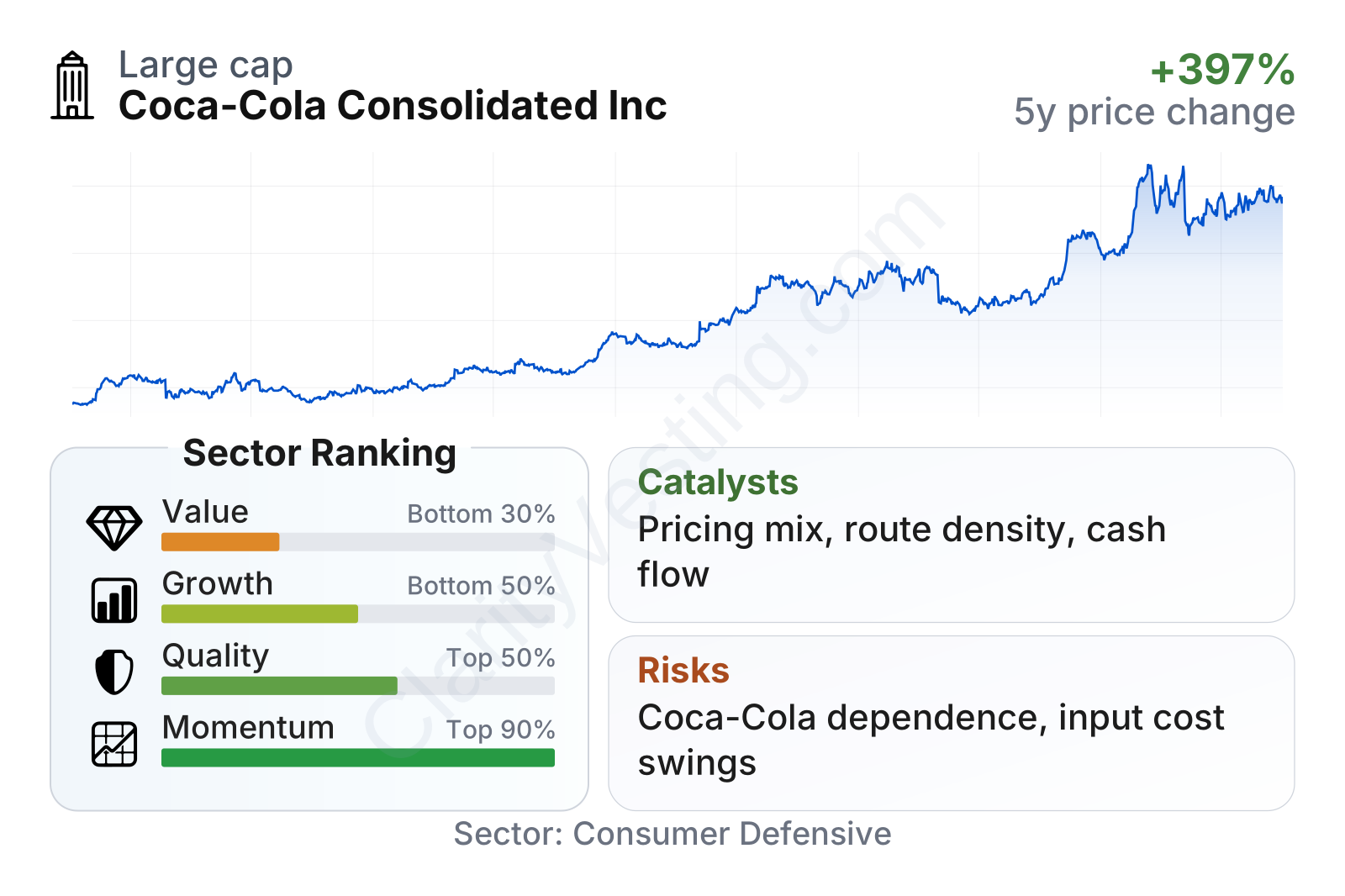
Coca-Cola Consolidated is a mid-sized public company by market value, and its stock has been much less volatile than the broader market, as shown by a beta well below 1. The quality profile stands out more than the valuation profile: returns on capital and assets are clearly above sector medians, margins are above average, and recent price performance has been exceptionally strong. By contrast, the valuation section looks less favorable, with a price-to-earnings ratio above the sector median, a lower free-cash-flow yield than many peers, and only a small dividend yield. In simple terms, the market is paying up for a business that has recently executed very well.
Growth
The non-alcoholic beverage sector is not a high-growth field in the way software or semiconductors can be, but it is resilient and benefits from everyday consumption. Growth typically comes from pricing, premium packaging, channel mix, product innovation, and share gains in local markets rather than from explosive end-market expansion. That is an important distinction for long-term readers: Coca-Cola Consolidated operates in a stable sector where strong execution can matter more than headline industry growth.
The company’s strategy appears coherent for that kind of environment. It benefits from a large exclusive territory, a dense delivery network, and a portfolio anchored by some of the best-known beverage brands in the country. Management has also emphasized revenue growth management, package mix, and operational productivity. Those are practical levers in bottling: even modest improvements in route efficiency, pricing, cooler placement, and product mix can have a noticeable effect on earnings.
Recent revenue trends show a business that has generally kept growing, although not in a straight line every quarter. Annual sales increased from about $5.6 billion in 2021 to about $7.2 billion in 2025, and the latest year-over-year growth rate remains above the sector median. That points to an operation that is still expanding despite operating in a mature category. The pace has fluctuated, but the broader trajectory remains positive.
Cash generation is another constructive point. Free cash flow has moved upward over the past several years and recently reached roughly the mid-$600 million range on a trailing basis. This matters because cash is what funds dividends, debt service, equipment investment, and balance-sheet flexibility. It also helps confirm that the margin improvement has translated into real financial capacity rather than only accounting gains.
A notable catalyst is the company’s ability to keep improving revenue per case and channel mix while extending distribution in convenience, food service, and immediate-consumption locations. In beverages, small shifts toward higher-value packages and on-the-go purchases can produce outsized profit benefits. Another helpful factor is the continued consumer shift toward a broader set of drink occasions beyond traditional soda, including sports drinks, water, tea, and energy-adjacent products. Coca-Cola Consolidated participates in that wider portfolio through its licensed brands.
Recent company updates have also pointed to ongoing operational investment, including technology, equipment, and supply chain capabilities. That may not look exciting on the surface, but in a distribution-heavy business it can support better service levels, improved inventory control, and stronger labor productivity over time. For a bottler, these are meaningful growth enablers.
Risks
This article is for informational purposes only and does not constitute financial advice. Some content is AI-generated. See Disclaimer


