Stock Analysis · Croda International Plc (COIHF)
Overview
Croda International Plc is a U.K.-based specialty chemicals company that develops high-value ingredients and formulations used in consumer care, life sciences, and industrial markets. In simple terms, it makes performance ingredients that help customers improve products such as skin care, crop treatments, pharmaceutical delivery systems, coatings, lubricants, and other specialized applications. This is not a commodity chemical producer focused mainly on volume. Croda’s model is built more around formulation know-how, customer relationships, regulatory expertise, and research-driven products that can support higher margins than standard bulk chemicals.
The company reports through three main business areas. Based on recent annual reporting, revenue is roughly distributed as follows:
- Consumer Care: about 46% of revenue. This division supplies ingredients for beauty care, personal care, home care, fragrances, and related formulations. It is the largest segment and includes products used in skin care, hair care, and cleansing applications.
- Life Sciences: about 34% of revenue. This includes crop protection ingredients, seed enhancement technologies, and pharmaceutical excipients and delivery systems. It is an important growth platform because it serves both agriculture and health-related end markets.
- Industrial Specialties: about 20% of revenue. This segment serves markets such as coatings, polymers, lubricants, energy, and other industrial applications where specialty additives can improve performance.
Geographically, Croda sells globally rather than depending on one single country. That broad footprint helps diversify demand, although it also exposes the company to different regional economic cycles, currencies, and regulatory regimes.
One notable feature of the business is its emphasis on innovation. Croda has consistently invested in research and development, and its products are often embedded in customer formulations where switching can take time because of qualification, testing, or regulatory requirements. That can make revenue more resilient than in purely price-driven chemical markets, even if it does not fully shield the company from weaker demand periods.
The long-term picture shows a business that generated close to $1.9 billion to $2.1 billion in revenue in 2021-2022, then moved through a clear downturn in 2023-2024 before stabilizing. Operating profit fell much more sharply than sales, which suggests that mix, pricing, and cost absorption mattered significantly during the slowdown. The latest annual revenue level points to recovery from the trough, but profitability has not yet returned to earlier highs.
Key Figures
| Metric | Value | Sector ⓘ |
|---|---|---|
| Date | Oct 03, 2026 | |
| Context | ||
| Sector | Basic Materials | |
| Industry | Specialty Chemicals | |
| Market Cap ⓘ | $5.02B | |
| Beta ⓘ | 0.93 | |
Value (Cheapness) | ||
| P/E Ratio ⓘ | 48.00 | 17.61 |
| P/B Ratio ⓘ | 2.83 | 1.77 |
| FCF Yield ⓘ | 5.16% | 5.87% |
| Dividend Yield ⓘ | 3.43% | 2.06% |
| EBIT / EV ⓘ | N/A | 6.43% |
| PEG ⓘ | 0.48 | |
Growth (Business expansion) | ||
| Revenue Growth ⓘ | 2.90% | 11.30% |
| RPS Growth (5Y CAGR) ⓘ | -2.59% | 4.46% |
| EPS Growth (5Y CAGR) ⓘ | -30.83% | -13.11% |
| BVPS Growth (5Y CAGR) ⓘ | 5.53% | 5.51% |
| Margin Growth (5Y Trend) ⓘ | -7.36% | -1.57% |
| FCF Growth (5Y CAGR) ⓘ | -2.36% | 0.55% |
| DPS Growth (5Y CAGR) ⓘ | 4.01% | 6.02% |
Quality (Business durability) | ||
| ROIC (Latest) ⓘ | N/A | 9.31% |
| ROA (Latest) ⓘ | 6.24% | 4.94% |
| ROIC (5Y Median) ⓘ | 10.11% | 7.91% |
| ROA (5Y Median) ⓘ | 4.76% | 3.93% |
| Net Debt / EBIT (Latest) ⓘ | 1.14 | 1.40 |
| Net Debt / EBIT (5Y Median) ⓘ | 2.04 | 1.70 |
| Net Debt / EBITDA (Latest) ⓘ | 0.75 | 0.91 |
| Net Debt / Assets ⓘ | 16.37% | 13.69% |
| EBITDA / Interest ⓘ | 17.03 | 11.93 |
| Operating Margin (Latest) ⓘ | 14.88% | 13.07% |
| Operating Margin (5Y Median) ⓘ | 15.78% | 11.86% |
| Debt to Equity (Latest) ⓘ | 36.06% | 40.43% |
| Profit Margin (Latest) ⓘ | 4.61% | 6.57% |
| Free Cash Flow (Latest) ⓘ | $258.62M | |
Momentum (Price trend) | ||
| 3Y Return ⓘ | -14.37% | +65.06% |
| 12M Return (excl. last month) ⓘ | +39.54% | +36.05% |
| 6M Return ⓘ | +25.44% | +1.89% |
| Price vs. 200-Day MA ⓘ | +1.41% | +1.03% |
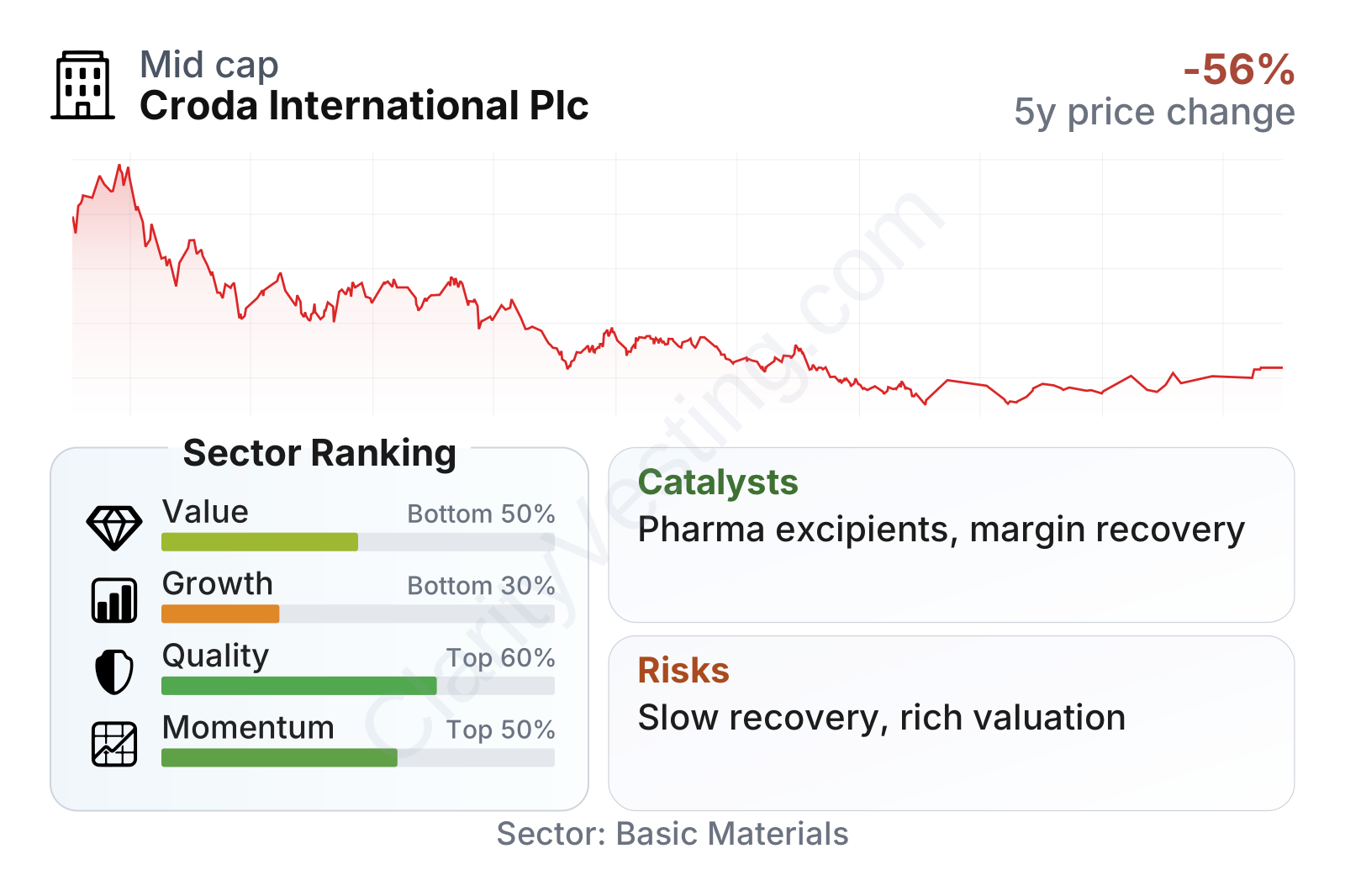
Croda looks financially solid in several important areas, but recent growth has been weak and valuation remains demanding relative to much of the sector. Profitability quality is still respectable: operating margin is above the sector median, return on assets is also better than average, and leverage is controlled, with net debt below many peers on both EBIT and EBITDA measures. Interest coverage is strong, which reduces balance-sheet pressure.
The weaker side is growth. Recent revenue growth was only around 3%, well below the sector median, while five-year trends for revenue per share, earnings per share, free cash flow, and margin direction all show a difficult period. That helps explain why the shares have had a rough multiyear run even though shorter-term price performance has improved over the last 6 to 12 months.
On valuation, the shares screen as expensive on earnings and book value compared with the sector median. Free cash flow yield is closer to sector norms, and the dividend yield is above average at roughly 3.4%, but the overall picture still suggests that the market is paying for recovery potential rather than current growth strength.
Growth
Croda operates in parts of the chemical industry that generally have better structural prospects than bulk chemicals. Personal care ingredients, pharmaceutical excipients, drug delivery systems, crop technologies, and sustainability-linked formulations all benefit from long-term demand drivers such as aging populations, health and wellness spending, premium beauty products, higher agricultural productivity needs, and tighter environmental standards. Those are attractive end markets, especially for a company positioned around specialized ingredients instead of low-cost commodity output.
The strategy also makes sense on paper. Croda has spent years pushing its portfolio toward higher-value niches with stronger technical barriers, lower direct price competition, and more recurring customer relationships. That matters because specialty chemicals can create better economics when the products solve a specific customer problem and become part of a validated formulation. In pharmaceuticals and crop solutions especially, approval timelines, formulation expertise, and reliability can become meaningful advantages.
A useful growth catalyst is the company’s exposure to life sciences, particularly pharma-related delivery systems and agricultural technologies. These activities tend to offer stronger differentiation than many industrial chemical lines. If demand in consumer care and crop markets normalizes while pharma continues to expand, Croda could see a more favorable sales mix than during the recent downturn.
Another positive factor is that recent price performance has improved after a long reset, suggesting the market has started to recognize some stabilization. The business is not posting strong top-line acceleration yet, but it no longer appears to be in the same sharp earnings slide seen earlier in the cycle.
Recent company communications have also emphasized portfolio focus, cost discipline, and operational improvement. For a business like Croda, recovery does not require dramatic revenue expansion alone. A better product mix, improved plant utilization, and steadier customer ordering can all help margins rebound materially because specialty ingredient businesses carry meaningful operating leverage.
Risks
This article is for informational purposes only and does not constitute financial advice. Some content is AI-generated. See Disclaimer