Stock Analysis · Cogent Biosciences Inc (COGT)
Overview
Cogent Biosciences is a clinical-stage biotechnology company focused on precision medicines for genetically defined diseases. Its main work is in oncology and rare diseases driven by abnormal signaling in the KIT receptor, a well-known target in mast cell disorders and gastrointestinal stromal tumors. In simple terms, the company is trying to develop drugs that are designed to block disease-causing mutations more selectively than older treatments.
The company’s lead candidate is bezuclastinib, an oral KIT inhibitor being studied in systemic mastocytosis and gastrointestinal stromal tumors. Cogent is also developing CGT4859, another targeted program intended to broaden its pipeline. Because the business is still in the clinical stage, the investment case depends much more on drug development progress, trial results, and future regulatory milestones than on current commercial sales.
At this stage, Cogent does not yet operate like a mature pharmaceutical company. Revenue has been minimal and irregular, and operating expenses are dominated by research and development. Based on recent annual reporting, the business mix is best understood as follows:
- Product revenue: approximately 0%. Cogent has not yet established a marketed product base.
- Collaboration, license, or other operating revenue: a very small amount, with recent annual totals low enough that percentages are not economically meaningful for understanding the business.
- Research and development spending: roughly 82% of 2025 operating expenses, reflecting the company’s focus on advancing clinical programs.
- Selling, general, and administrative spending: roughly 19% of 2025 operating expenses, showing that most cash use is still going into development rather than commercialization.
The clearest business pattern is that expenses have been rising as the pipeline advances, while revenue remains close to zero. That is normal for an early biotech, but it means valuation is mainly tied to the perceived future value of its drug candidates rather than present-day earnings.
The cost structure shows a company that has become steadily more development-intensive over time. Research spending has expanded sharply year after year and remains the core use of capital, while the absence of meaningful revenue confirms that Cogent is still in the phase where clinical execution matters more than current income.
Key Figures
| Metric | Value | Sector ⓘ |
|---|---|---|
| Date | Oct 03, 2026 | |
| Context | ||
| Sector | Healthcare | |
| Industry | Biotechnology | |
| Market Cap ⓘ | $5.56B | |
| Beta ⓘ | 0.31 | |
Value (Cheapness) | ||
| P/E Ratio ⓘ | N/A | 24.06 |
| P/B Ratio ⓘ | 10.15 | 3.08 |
| FCF Yield ⓘ | -5.57% | 3.07% |
| Dividend Yield ⓘ | N/A | 2.05% |
| EBIT / EV ⓘ | -7.58% | 0.63% |
| PEG ⓘ | N/A | |
Growth (Business expansion) | ||
| Revenue Growth ⓘ | -100.00% | 7.50% |
| RPS Growth (5Y CAGR) ⓘ | N/A | 8.70% |
| EPS Growth (5Y CAGR) ⓘ | -20.23% | -18.20% |
| BVPS Growth (5Y CAGR) ⓘ | 4.42% | 3.95% |
| Margin Growth (5Y Trend) ⓘ | N/A | -0.58% |
| FCF Growth (5Y CAGR) ⓘ | N/A | 0.88% |
| DPS Growth (5Y CAGR) ⓘ | N/A | 6.80% |
Quality (Business durability) | ||
| ROIC (Latest) ⓘ | -47.64% | 3.29% |
| ROA (Latest) ⓘ | -59.85% | 3.02% |
| ROIC (5Y Median) ⓘ | -72.37% | 4.75% |
| ROA (5Y Median) ⓘ | -51.99% | 1.93% |
| Net Debt / EBIT (Latest) ⓘ | N/A | 1.33 |
| Net Debt / EBIT (5Y Median) ⓘ | N/A | 1.83 |
| Net Debt / EBITDA (Latest) ⓘ | N/A | 0.99 |
| Net Debt / Assets ⓘ | 7.56% | 5.33% |
| EBITDA / Interest ⓘ | N/A | 9.63 |
| Operating Margin (Latest) ⓘ | N/A | 9.25% |
| Operating Margin (5Y Median) ⓘ | N/A | 7.80% |
| Debt to Equity (Latest) ⓘ | 45.88% | 28.99% |
| Profit Margin (Latest) ⓘ | N/A | 3.60% |
| Free Cash Flow (Latest) ⓘ | -$309.24M | |
Momentum (Price trend) | ||
| 3Y Return ⓘ | +230.79% | +37.48% |
| 12M Return (excl. last month) ⓘ | +187.09% | +20.85% |
| 6M Return ⓘ | -10.36% | +9.73% |
| Price vs. 200-Day MA ⓘ | -13.26% | +4.69% |
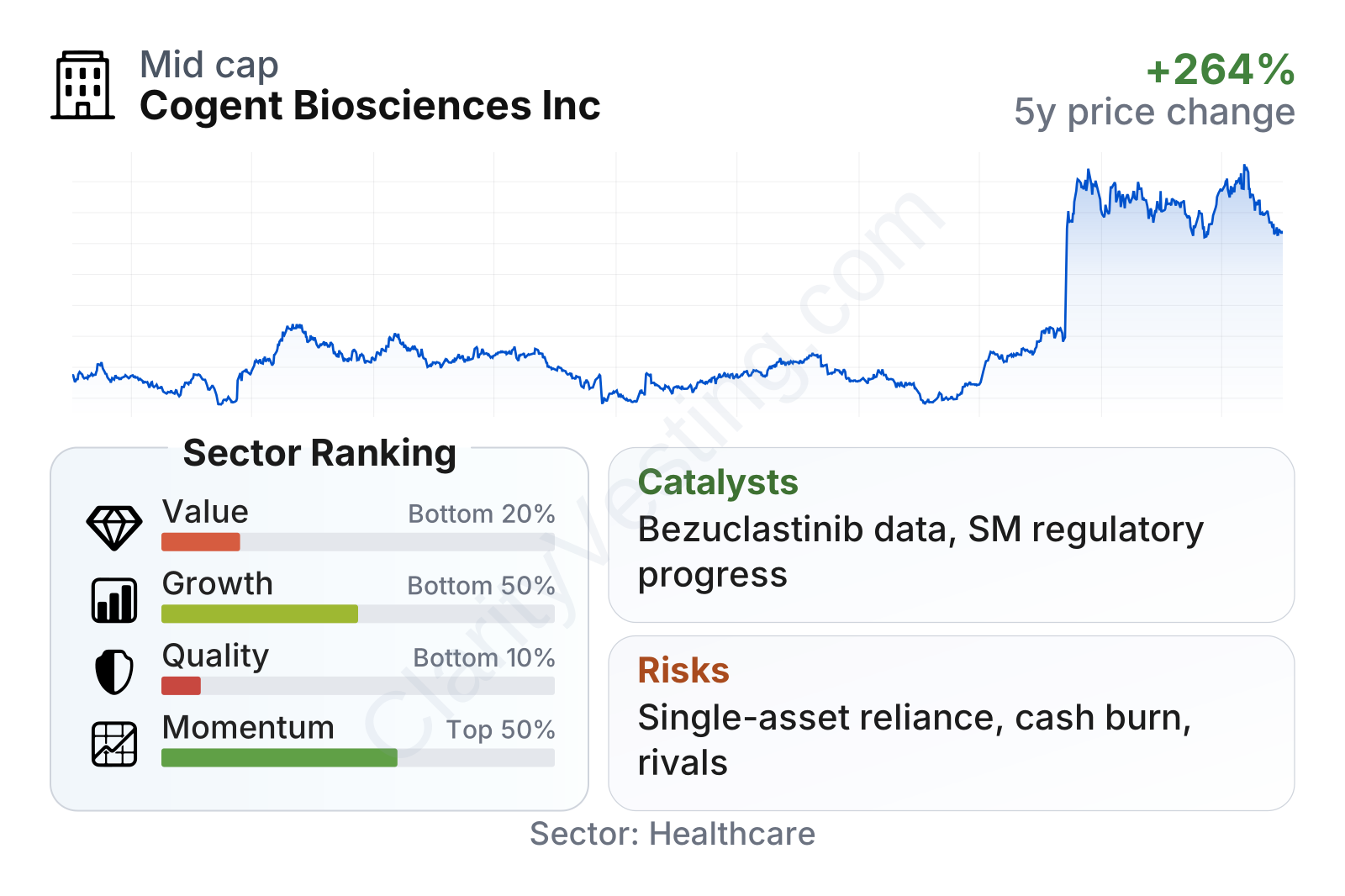
Cogent is a mid-sized biotech by market value, but its financial profile looks much weaker than the typical Healthcare peer on traditional measures. Value and quality rankings sit near the bottom of the sector, which is not surprising for a company with no established product revenue, negative free cash flow, and deeply negative returns on capital. At the same time, share-price momentum over the last year and over three years has been far stronger than the sector median, showing that the market has recently been willing to pay up for pipeline progress despite weak accounting fundamentals.
Growth
Cogent operates in one of the most attractive parts of biotech: targeted therapies for cancer and rare diseases. This is a growth area because successful drugs for genetically defined patient groups can achieve strong pricing, durable demand, and in some cases expansion into additional indications. In systemic mastocytosis especially, there is a clear need for newer therapies that are both effective and tolerable over long treatment periods.
The company’s strategy is logical. Rather than trying to compete broadly across many disease areas, it is concentrating on a small number of programs built around a validated biological target. That focus can be an advantage because it allows management to direct capital toward the highest-value clinical readouts. Bezuclastinib is the central asset, and if it continues to show favorable efficacy and safety, it could support a meaningful commercial opportunity in mast cell disease and possibly in additional KIT-driven settings.
Reported revenue trends do not say much about the underlying growth potential because Cogent is not yet a commercial-stage company. The recent decline simply reinforces that investors are not paying for current sales growth; they are paying for the probability that the pipeline turns into future product revenue.
A major catalyst for long-term value creation is clinical progress in bezuclastinib. Recent company updates have centered on advancing late-stage and registration-supporting work in systemic mastocytosis, including studies that could define its role against current standards of care. Positive data, regulatory alignment, or signs of best-in-class positioning would likely matter far more than near-term income statement changes.
Another supportive element is strategic optionality. A company with a focused pipeline and a validated target can become more visible to larger pharmaceutical groups if data continue to improve. That does not create value on its own, but it can influence how the market weighs the future commercial potential of the platform.
Cash generation remains clearly negative and has moved further down as development spending has increased. That is common for an advancing biotech pipeline, but it also means the growth path is expensive and dependent on disciplined capital management until a product reaches the market.
Risks
This article is for informational purposes only and does not constitute financial advice. Some content is AI-generated. See Disclaimer


