Stock Analysis · Contact Energy Limited (COENF)
Overview
Contact Energy Limited is a New Zealand electricity and gas company with a business model that combines power generation, energy retailing, and increasingly a broader role in electrification. In simple terms, it produces electricity, sells electricity and gas to homes and businesses, and invests in assets that can support New Zealand’s shift toward a more renewable energy system. The company’s generation fleet is centered on geothermal and hydro power, which gives it a relatively high share of renewable supply compared with many traditional utilities.
Its revenue mainly comes from selling electricity and gas, while earnings are also influenced by wholesale electricity prices, customer volumes, and the mix of generation output from its own plants. Based on company reporting and segment disclosures, the business can be understood through these main sources:
- Electricity sales to customers: approximately 60% to 70% of revenue. This includes residential, commercial, and industrial electricity supply contracts.
- Wholesale electricity and generation-related sales: approximately 20% to 30% of revenue. This reflects electricity generated by Contact and sold into the market, with results affected by spot prices and plant availability.
- Natural gas sales: approximately 10% to 15% of revenue. This includes gas supplied to retail and business customers.
- Other revenue: a small share of revenue. This can include network-related pass-through items, customer services, and newer electrification activities.
What stands out is not just the sales mix, but the operating structure behind it. Contact owns strategic generation assets, especially geothermal stations, which can provide more stable output than weather-dependent renewables alone. That vertical integration matters because it helps offset some volatility between retail supply and wholesale power prices.
Over the last several years, the business has also shown stronger earnings conversion even when revenue moved around. The flow from revenue to operating income and net income points to a company that has recently improved profitability, although the path is not perfectly smooth because power markets are cyclical and sensitive to hydrology, fuel costs, and outages.
The long-term pattern is constructive: revenue has risen materially since 2023, while operating income and net income have expanded even faster. That suggests improved margin capture rather than growth driven only by volume.
Key Figures
| Metric | Value | Sector ⓘ |
|---|---|---|
| Date | Oct 03, 2026 | |
| Context | ||
| Sector | Utilities | |
| Industry | Utilities - Renewable | |
| Market Cap ⓘ | $5.39B | |
| Beta ⓘ | 0.11 | |
Value (Cheapness) | ||
| P/E Ratio ⓘ | 21.87 | 16.80 |
| P/B Ratio ⓘ | 1.02 | 1.48 |
| FCF Yield ⓘ | 6.04% | 0.64% |
| Dividend Yield ⓘ | 7.95% | 3.91% |
| EBIT / EV ⓘ | N/A | 5.01% |
| PEG ⓘ | 33.53 | |
Growth (Business expansion) | ||
| Revenue Growth ⓘ | -6.20% | 6.00% |
| RPS Growth (5Y CAGR) ⓘ | 1.10% | 4.14% |
| EPS Growth (5Y CAGR) ⓘ | 20.25% | -11.39% |
| BVPS Growth (5Y CAGR) ⓘ | 8.94% | 4.29% |
| Margin Growth (5Y Trend) ⓘ | 9.79% | 3.55% |
| FCF Growth (5Y CAGR) ⓘ | N/A | -9.10% |
| DPS Growth (5Y CAGR) ⓘ | -4.15% | 4.51% |
Quality (Business durability) | ||
| ROIC (Latest) ⓘ | N/A | 6.53% |
| ROA (Latest) ⓘ | 8.84% | 3.19% |
| ROIC (5Y Median) ⓘ | 6.65% | 6.12% |
| ROA (5Y Median) ⓘ | 3.91% | 2.76% |
| Net Debt / EBIT (Latest) ⓘ | 1.70 | 7.15 |
| Net Debt / EBIT (5Y Median) ⓘ | 3.46 | 7.24 |
| Net Debt / EBITDA (Latest) ⓘ | 1.19 | 4.40 |
| Net Debt / Assets ⓘ | 21.43% | 39.16% |
| EBITDA / Interest ⓘ | 8.08 | 4.41 |
| Operating Margin (Latest) ⓘ | 20.21% | 20.93% |
| Operating Margin (5Y Median) ⓘ | 14.96% | 20.18% |
| Debt to Equity (Latest) ⓘ | 58.35% | 140.88% |
| Profit Margin (Latest) ⓘ | 12.96% | 11.32% |
| Free Cash Flow (Latest) ⓘ | $325.06M | |
Momentum (Price trend) | ||
| 3Y Return ⓘ | +16.89% | +48.75% |
| 12M Return (excl. last month) ⓘ | -0.66% | +11.24% |
| 6M Return ⓘ | -14.16% | -3.69% |
| Price vs. 200-Day MA ⓘ | +33.67% | -1.97% |
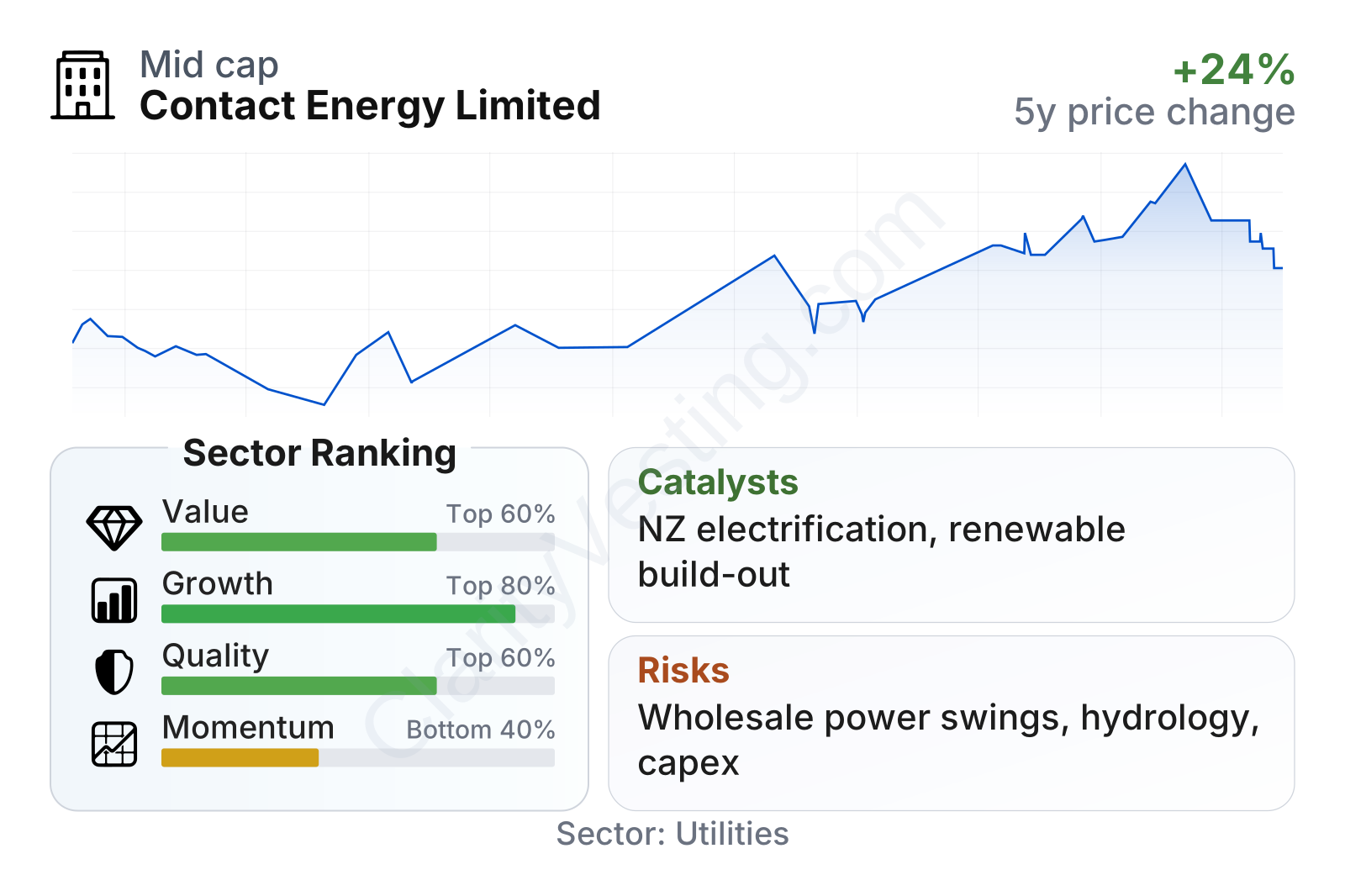
Contact Energy is a mid-sized utility by market value, and its share price behavior has been unusually calm for an equity, with a very low beta. That low volatility fits the profile of a regulated or defensive essential-service business.
The broader picture from the metrics is mixed but understandable for a utility. On quality, the company compares well with much of the sector: debt levels are clearly below sector medians, interest coverage is stronger than average, and asset profitability is solid. Free cash flow is also meaningful in absolute terms and the cash flow yield is notably above the sector median.
On growth, the headline is less strong. Recent revenue declined year over year, and five-year revenue-per-share growth has been modest. However, earnings per share and book value per share have grown much faster than revenue, which implies that improved efficiency, better pricing, or stronger asset utilization have mattered more than simple top-line expansion.
On momentum, the stock has lagged many peers over medium-term periods, even though it trades above its 200-day average. That usually points to a share price that has recovered recently but still does not have the strongest multi-year market enthusiasm behind it.
Growth
Contact operates in a sector with a favorable long-term backdrop. Electricity demand should benefit from electrification trends as transport, industrial heat, and some commercial energy use gradually shift away from fossil fuels. In New Zealand, this transition is especially relevant because renewable electricity already has a strong base, making additional electrification more practical than in many countries.
The company’s strategy broadly fits that direction. Its geothermal and hydro portfolio is aligned with lower-emission generation, and geothermal in particular is valuable because it can provide baseload power rather than intermittent output. That makes Contact relevant not only to rising electricity consumption but also to the need for reliable renewable supply.
A second growth angle is that utilities like Contact can benefit even without explosive customer growth if they improve plant performance, optimize pricing, and deploy capital into higher-return generation or electrification projects. The recent rise in operating income and net income shows that this is not just a theoretical possibility; it has already been visible in results.
Revenue per share has not moved in a straight line, which is normal for a power business exposed to commodity-linked pricing and generation variability. Still, the longer pattern shows the company has been able to build from earlier levels, even after a softer latest year. That suggests growth is present, but uneven rather than linear.
One important catalyst is the continued build-out of renewable generation and electricity demand in New Zealand. If supply stays tight while demand from electrification rises, owners of established renewable fleets are in a strong position. Another catalyst is execution: if Contact continues converting revenue into cash and earnings at recent rates, the market may place more value on the business than it did during slower-growth periods.
Recent company communications have also emphasized investment in renewable development and customer electrification solutions, which supports the idea that Contact is trying to grow alongside the energy transition rather than simply defend an existing utility base.
Risks
This article is for informational purposes only and does not constitute financial advice. Some content is AI-generated. See Disclaimer