Stock Analysis · Coronado Global Resources Inc (CODQL)
Overview
Coronado Global Resources is a coal producer focused mainly on metallurgical coal, also called coking coal. This is the type of coal used in steelmaking rather than in power generation. The company operates mining complexes in the United States and Australia and sells coal to steel producers and industrial customers in Asia, Europe, and the Americas. That business mix matters because metallurgical coal tends to follow global steel demand, not just electricity demand.
Its revenue is driven overwhelmingly by coal sales, with a smaller contribution from freight and related services when disclosed. Based on company reporting and the nature of the business, the revenue base is best understood as follows:
- Metallurgical coal sales: the large majority of revenue, generated from supplying coking coal and PCI coal used in blast furnace steel production.
- Thermal and other coal products: a much smaller portion, including lower-value coal streams and by-products when marketed.
- Other revenue: limited amounts tied to transportation, logistics, and miscellaneous commercial items.
Geographically, Coronado’s operating footprint is split between the U.S. and Australia, which gives it exposure to two established export basins. That provides customer diversification, but it also means results can move sharply with benchmark coal prices, mining conditions, and export logistics.
Over the last several years, the company’s profit flow has been highly cyclical. Revenue and earnings surged in 2022 when coal prices were unusually strong, then weakened materially as pricing normalized and costs remained elevated. By 2024 and especially 2025, the business had moved from strong profitability into losses, showing how sensitive the model is to commodity swings and operating execution.
The operating picture shows a business that once converted strong pricing into very large profits, but then saw margins compress quickly. Revenue stayed above $2 billion through 2025, yet gross profit and operating income deteriorated sharply, which suggests that weaker realized prices, cost pressure, and fixed-cost absorption became a major challenge.
Key Figures
| Metric | Value | Sector ⓘ |
|---|---|---|
| Date | Oct 17, 2026 | |
| Context | ||
| Sector | Basic Materials | |
| Industry | Coking Coal | |
| Market Cap ⓘ | $2.01B | |
| Beta ⓘ | 0.16 | |
Value (Cheapness) | ||
| P/E Ratio ⓘ | N/A | 16.90 |
| P/B Ratio ⓘ | 0.88 | 1.65 |
| FCF Yield ⓘ | -17.20% | 5.76% |
| Dividend Yield ⓘ | N/A | 2.13% |
| EBIT / EV ⓘ | -34.76% | 6.30% |
| PEG ⓘ | N/A | |
Growth (Business expansion) | ||
| Revenue Growth ⓘ | 9.90% | 11.10% |
| RPS Growth (5Y CAGR) ⓘ | 72.17% | 4.49% |
| EPS Growth (5Y CAGR) ⓘ | -42.10% | -13.47% |
| BVPS Growth (5Y CAGR) ⓘ | 54.14% | 5.51% |
| Margin Growth (5Y Trend) ⓘ | -31.71% | -1.54% |
| FCF Growth (5Y CAGR) ⓘ | N/A | 0.37% |
| DPS Growth (5Y CAGR) ⓘ | -26.41% | 6.08% |
Quality (Business durability) | ||
| ROIC (Latest) ⓘ | N/A | 9.26% |
| ROA (Latest) ⓘ | -27.79% | 4.91% |
| ROIC (5Y Median) ⓘ | 16.16% | 7.70% |
| ROA (5Y Median) ⓘ | 5.97% | 3.86% |
| Net Debt / EBIT (Latest) ⓘ | N/A | 1.40 |
| Net Debt / EBIT (5Y Median) ⓘ | -0.09 | 1.70 |
| Net Debt / EBITDA (Latest) ⓘ | N/A | 0.95 |
| Net Debt / Assets ⓘ | 31.84% | 13.69% |
| EBITDA / Interest ⓘ | N/A | 12.34 |
| Operating Margin (Latest) ⓘ | -17.47% | 13.20% |
| Operating Margin (5Y Median) ⓘ | 6.38% | 11.80% |
| Debt to Equity (Latest) ⓘ | 368.79% | 40.56% |
| Profit Margin (Latest) ⓘ | -33.65% | 6.43% |
| Free Cash Flow (Latest) ⓘ | -$346.09M | |
Momentum (Price trend) | ||
| 3Y Return ⓘ | -88.54% | +68.89% |
| 12M Return (excl. last month) ⓘ | -39.18% | +30.21% |
| 6M Return ⓘ | -48.50% | -4.16% |
| Price vs. 200-Day MA ⓘ | -40.31% | -1.27% |
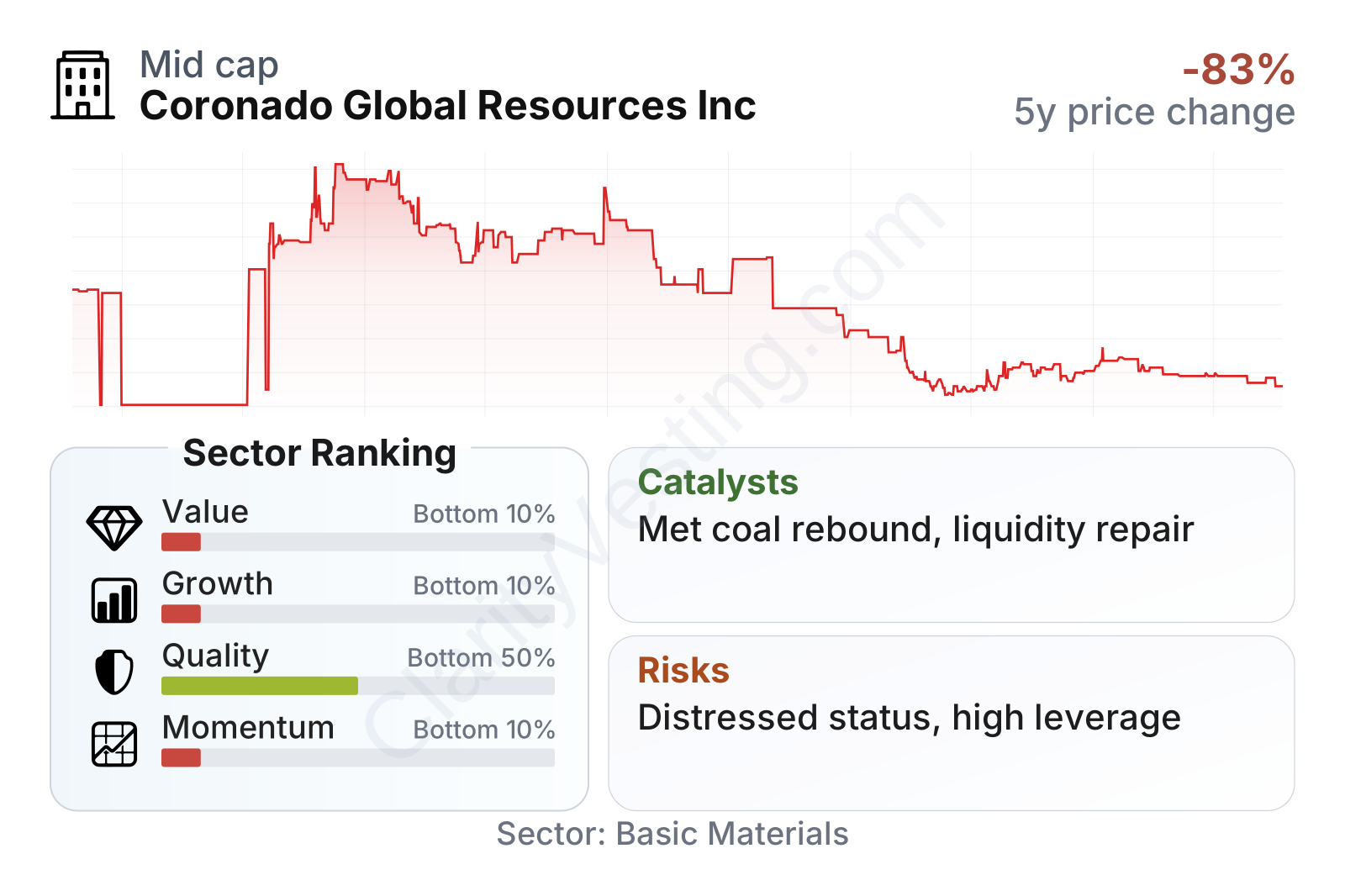
Coronado is now a small-to-mid-sized materials company by market value, and the broad factor profile is weak relative to much of its sector. Value metrics look superficially inexpensive on book value, but that is offset by negative free cash flow, negative EBIT-based valuation, and weak momentum. Growth and quality rankings are also under pressure because recent earnings and margins have deteriorated much faster than the sector median.
The share price history underlines that volatility. After trading near $1 at several points in 2022 through 2024, the stock moved much lower during 2025 and remained depressed in 2026. The low beta reading does not mean low business risk here; it mostly reflects how the stock has traded recently rather than the underlying cyclicality of the company’s operations.
Growth
Coronado operates in a sector that still has long-term relevance because steelmaking remains essential for infrastructure, autos, machinery, and construction. Metallurgical coal is harder to replace than thermal coal in today’s dominant blast furnace route, so demand does not disappear simply because the broader energy system is changing. That said, this is not a smooth secular growth market. It is a cyclical industry tied to steel output, industrial production, and Chinese and global trade flows.
The company’s strategy has logic in that it focuses on export-grade metallurgical coal assets in two important mining regions. In stronger pricing environments, that positioning can produce large cash generation because high-quality coal shipments benefit from global seaborne demand. The longer-term case also rests on Coronado preserving production from established mines, managing costs tightly, and capturing upside if coking coal prices improve.
Top-line growth has been uneven rather than consistently upward. Recent annual growth has lagged the sector median, and the longer-term picture is distorted by the exceptional coal market in 2022. In other words, the company can show very strong growth in peak years, but that growth has not translated into stable earnings power across the cycle.
Cash generation is the bigger issue. Coronado produced very strong free cash flow during the 2022 boom, but more recent results have reversed that pattern. The latest trailing figure is deeply negative, which weakens the growth outlook because internally funded expansion, debt reduction, and shareholder returns all become harder when cash is being consumed instead of produced.
As for catalysts, the most important one is simple: a recovery in metallurgical coal pricing. A second catalyst would be operational stabilization at the mine level, especially if productivity improves or cost inflation eases. Recent corporate disclosures have also kept attention on capital structure and liquidity actions, which can create a meaningful turning point if they successfully reduce financial pressure and give the company more room to benefit from any rebound in coal markets.
Risks
This article is for informational purposes only and does not constitute financial advice. Some content is AI-generated. See Disclaimer


