Stock Analysis · Chocoladefabriken Lindt & Sprüngli AG (COCXF)
Overview
Chocoladefabriken Lindt & Sprüngli AG is a premium chocolate company best known for brands such as Lindt, Ghirardelli, Russell Stover, Whitman’s, and Pangburn’s. The group makes and sells chocolate bars, pralines, boxed gifts, seasonal products such as Easter and Christmas items, spreads, and other confectionery products. It operates across Europe, North America, and other international markets through a mix of wholesale distribution, grocery and specialty retail channels, e-commerce, and its own store network.
The business is relatively simple at its core: Lindt turns cocoa, milk, sugar, and other ingredients into branded premium chocolate products, then captures value through brand strength, product innovation, gifting occasions, and broad distribution. Compared with many food companies, Lindt is more concentrated in one category, but it participates in several consumption moments: everyday indulgence, gifting, and seasonal purchases.
Its revenue sources are mainly organized by geography rather than by product line in public reporting. Based on recent annual disclosures, the broad revenue mix appears to be:
- Europe: about 45% to 50% — the company’s largest region, including mature premium chocolate markets and a strong seasonal gifting business.
- North America: about 35% to 40% — driven by Lindt branded products and the Russell Stover and Ghirardelli businesses, with exposure to both everyday chocolate and boxed seasonal offerings.
- Rest of World: about 10% to 20% — international markets outside Europe and North America, including Asia and other developing premium chocolate markets.
At the product level, exact percentages are not usually broken out in the same detail, but revenue is heavily tied to premium chocolate tablets and bars, pralines and boxed assortments, seasonal items, and other branded confectionery. The company also generates sales through its own retail stores, which help support brand visibility and premium positioning.
The financial profile shows a business that has steadily expanded revenue and operating profit over the last several years, while preserving strong margins for a consumer staples company. That combination is one reason Lindt is often viewed as a high-quality branded food business rather than a volume-driven commodity producer.
The long-term pattern is clear: sales and operating income moved upward from 2021 through 2025, and net income also increased over that period. Even with higher raw material and financing costs, the company has kept a healthy gap between revenue and profit, which points to meaningful pricing power and disciplined cost control.
Key Figures
| Metric | Value | Sector ⓘ |
|---|---|---|
| Date | Oct 17, 2026 | |
| Context | ||
| Sector | Consumer Defensive | |
| Industry | Confectioners | |
| Market Cap ⓘ | $33.95B | |
| Beta ⓘ | 0.47 | |
Value (Cheapness) | ||
| P/E Ratio ⓘ | 28.88 | 17.88 |
| P/B Ratio ⓘ | 7.56 | 1.29 |
| FCF Yield ⓘ | 3.44% | 12.39% |
| Dividend Yield ⓘ | 1.60% | 2.85% |
| EBIT / EV ⓘ | N/A | 6.43% |
| PEG ⓘ | 0.81 | |
Growth (Business expansion) | ||
| Revenue Growth ⓘ | -0.20% | 4.10% |
| RPS Growth (5Y CAGR) ⓘ | 7.84% | 6.18% |
| EPS Growth (5Y CAGR) ⓘ | -48.52% | -13.59% |
| BVPS Growth (5Y CAGR) ⓘ | -0.14% | 3.20% |
| Margin Growth (5Y Trend) ⓘ | 2.47% | -0.15% |
| FCF Growth (5Y CAGR) ⓘ | -19.40% | 4.10% |
| DPS Growth (5Y CAGR) ⓘ | 8.16% | 6.79% |
Quality (Business durability) | ||
| ROIC (Latest) ⓘ | N/A | 12.34% |
| ROA (Latest) ⓘ | 16.44% | 6.30% |
| ROIC (5Y Median) ⓘ | 12.54% | 10.49% |
| ROA (5Y Median) ⓘ | 7.89% | 5.44% |
| Net Debt / EBIT (Latest) ⓘ | 0.75 | 1.96 |
| Net Debt / EBIT (5Y Median) ⓘ | 0.84 | 2.35 |
| Net Debt / EBITDA (Latest) ⓘ | 0.56 | 1.38 |
| Net Debt / Assets ⓘ | 17.60% | 21.51% |
| EBITDA / Interest ⓘ | 18.04 | 9.46 |
| Operating Margin (Latest) ⓘ | 15.83% | 8.87% |
| Operating Margin (5Y Median) ⓘ | 15.70% | 9.53% |
| Debt to Equity (Latest) ⓘ | 42.02% | 72.35% |
| Profit Margin (Latest) ⓘ | 12.28% | 5.40% |
| Free Cash Flow (Latest) ⓘ | $1.17B | |
Momentum (Price trend) | ||
| 3Y Return ⓘ | +46.99% | +20.92% |
| 12M Return (excl. last month) ⓘ | +34.81% | +2.13% |
| 6M Return ⓘ | +3.26% | +1.26% |
| Price vs. 200-Day MA ⓘ | +1.30% | +1.39% |
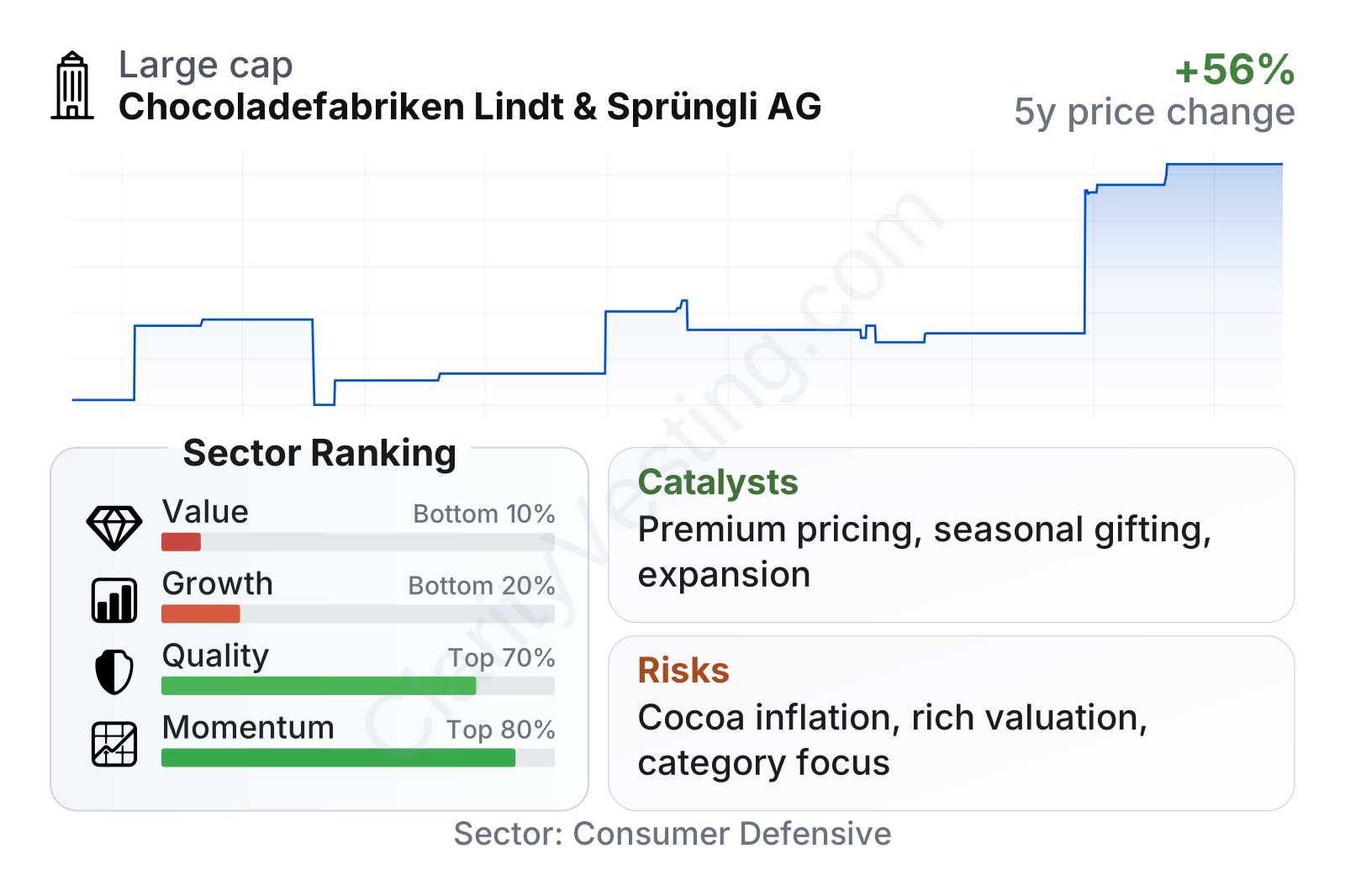
Lindt stands out more for business quality and market resilience than for low valuation. Profitability measures are comfortably above the sector median, with operating margin around the mid-teens and net profit margin around the low teens. Debt remains moderate, interest coverage is strong, and the stock’s beta is low, which fits the profile of a defensive consumer brand. On the other hand, valuation multiples are high versus the sector, while recent growth metrics look mixed because long-term margin improvement has been stronger than near-term revenue acceleration.
Growth
The confectionery sector is mature in developed markets, but premium chocolate remains one of the more attractive areas within packaged food. Demand is supported by affordable indulgence, gifting, and seasonal purchasing habits. Even when consumers become more cautious, premium chocolate can remain relatively resilient because it is a small-ticket treat compared with many other discretionary items.
Lindt’s strategy for future expansion is coherent. The company has spent years reinforcing premium positioning, broadening distribution, adding directly operated stores, and pushing product innovation around flavor, format, seasonality, and gifting. This matters because premium brands often grow less through sheer consumption volume and more through mix improvement, pricing, and trading consumers up to higher-value products.
Recent growth signals are mixed in the short run but better over a longer lens. Year-over-year revenue growth is roughly flat in the latest reading, which looks soft against the broader sector. However, five-year revenue-per-share growth remains ahead of the sector median, and operating margins have improved over time. That suggests the company has been creating value through pricing discipline, premiumization, and operational efficiency even when annual top-line momentum cools.
One important catalyst is Lindt’s exposure to premium gifting and seasonal products, where strong branding can support repeat purchasing and price increases. Another is international expansion, especially in markets where premium chocolate penetration is still catching up with Western Europe. North America also remains important because scale brands such as Lindt, Ghirardelli, and Russell Stover offer multiple ways to grow through everyday chocolate, e-commerce, and holiday assortments.
A broader industry catalyst is the continued tendency for consumers to favor trusted brands in indulgence categories. In a market crowded with private label and mainstream confectionery, premium brands with strong recognition can preserve shelf space and maintain customer loyalty better than weaker labels. For Lindt, that brand equity is likely one of the strongest growth supports available.
Risks
This article is for informational purposes only and does not constitute financial advice. Some content is AI-generated. See Disclaimer


