Stock Analysis · Hemab Therapeutics Holdings Inc (COAG)
Overview
Hemab Therapeutics Holdings Inc is a clinical-stage biotechnology company focused on rare bleeding and thrombotic disorders. In simple terms, it is developing new medicines for patients whose blood does not clot normally or clots in the wrong way. The company’s lead programs target areas such as Glanzmann thrombasthenia, a very rare inherited bleeding disorder, and other severe coagulation-related diseases with limited treatment options.
At this stage, Hemab is still in development rather than commercial production. That means the business is built around research, clinical trials, and drug development rather than product sales. Its value therefore depends much more on whether its drug candidates can move successfully through testing and eventually reach the market.
Main revenue sources are currently very limited:
- Product revenue: approximately 0%. The company reported no revenue in the latest full-year figures available.
- Collaboration, licensing, or other operating revenue: approximately 0% based on the latest annual results, with no meaningful recurring commercial contribution disclosed.
- Non-operating items such as interest income: present in some periods, but not a core business revenue stream and not enough to change the overall picture of a pre-revenue company.
This is an important point for long-term readers: Hemab is not yet a business supported by customer demand or established sales. It is a biotech platform financed mainly by investor capital while it tries to convert scientific progress into future approved products.
Its cost structure also shows where management is placing its bets. Research and development is by far the largest use of cash, rising from about $41 million in 2024 to nearly $60 million in 2025, while administrative spending remained far smaller. That is typical for a biotech trying to advance clinical programs, but it also means continued losses are expected until either a partnership, approval, or launch changes the revenue base.
The operating picture is straightforward: no revenue yet, rising development spending, and larger annual losses as the pipeline progresses. For a company like this, that pattern is not automatically negative, but it does underline that the investment case depends on future clinical and regulatory milestones rather than current business earnings.
Key Figures
| Metric | Value | Sector ⓘ |
|---|---|---|
| Date | Oct 17, 2026 | |
| Context | ||
| Sector | Healthcare | |
| Industry | Biotechnology | |
| Market Cap ⓘ | $1.40B | |
| Beta ⓘ | N/A | |
Value (Cheapness) | ||
| P/E Ratio ⓘ | N/A | 24.79 |
| P/B Ratio ⓘ | 2.16 | 3.08 |
| FCF Yield ⓘ | -5.19% | 3.15% |
| Dividend Yield ⓘ | N/A | 1.94% |
| EBIT / EV ⓘ | -6.54% | 0.57% |
| PEG ⓘ | N/A | |
Growth (Business expansion) | ||
| Revenue Growth ⓘ | N/A | 7.45% |
| RPS Growth (5Y CAGR) ⓘ | N/A | 8.61% |
| EPS Growth (5Y CAGR) ⓘ | N/A | -17.81% |
| BVPS Growth (5Y CAGR) ⓘ | N/A | 3.72% |
| Margin Growth (5Y Trend) ⓘ | N/A | -0.62% |
| FCF Growth (5Y CAGR) ⓘ | N/A | 1.04% |
| DPS Growth (5Y CAGR) ⓘ | N/A | 6.77% |
Quality (Business durability) | ||
| ROIC (Latest) ⓘ | N/A | 3.24% |
| ROA (Latest) ⓘ | N/A | 3.01% |
| ROIC (5Y Median) ⓘ | N/A | 4.60% |
| ROA (5Y Median) ⓘ | N/A | 1.89% |
| Net Debt / EBIT (Latest) ⓘ | N/A | 1.34 |
| Net Debt / EBIT (5Y Median) ⓘ | N/A | 1.84 |
| Net Debt / EBITDA (Latest) ⓘ | N/A | 1.00 |
| Net Debt / Assets ⓘ | -50.52% | 5.45% |
| EBITDA / Interest ⓘ | N/A | 9.64 |
| Operating Margin (Latest) ⓘ | N/A | 9.27% |
| Operating Margin (5Y Median) ⓘ | N/A | 7.38% |
| Debt to Equity (Latest) ⓘ | 0.23% | 28.58% |
| Profit Margin (Latest) ⓘ | N/A | 3.59% |
| Free Cash Flow (Latest) ⓘ | -$72.60M | |
Momentum (Price trend) | ||
| 3Y Return ⓘ | N/A | +42.80% |
| 12M Return (excl. last month) ⓘ | N/A | +18.50% |
| 6M Return ⓘ | N/A | +7.57% |
| Price vs. 200-Day MA ⓘ | N/A | +5.12% |
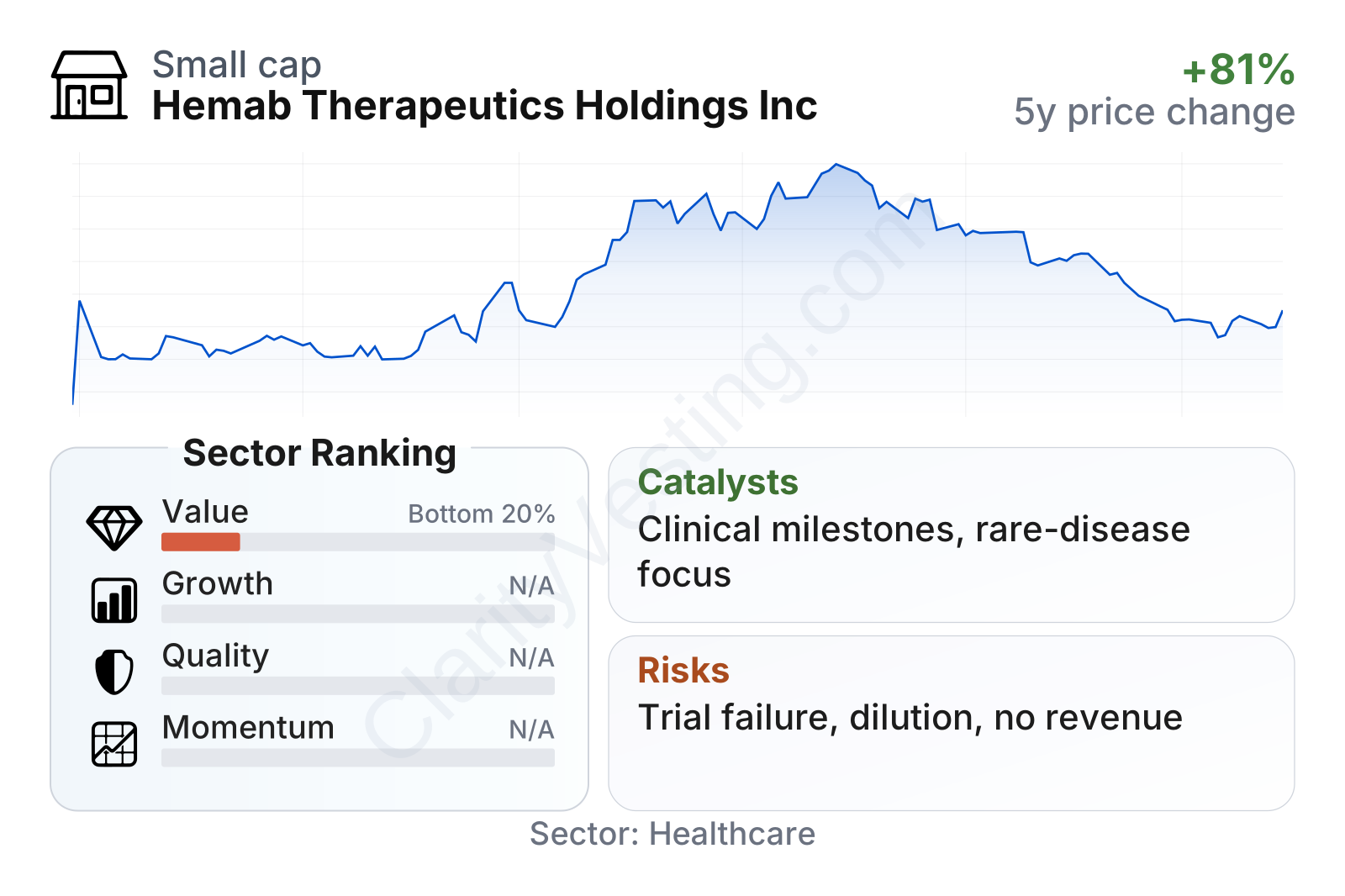
The market value places Hemab in the small- to mid-cap biotech range, which often brings sharp share-price swings around trial updates. The recent stock move has been dramatic, with the share price climbing strongly between late April and late July 2026, suggesting that expectations around the pipeline improved materially over a short period.
On valuation factors, the company screens poorly relative to much of the healthcare sector, but that is mostly because traditional valuation tools do not work well for a pre-revenue biotech. There is no meaningful earnings multiple, free cash flow is negative, and operating profitability is far below sector norms. Price-to-book is not especially stretched versus the sector median, but book value is only a rough anchor for a company whose real worth depends on unapproved drug assets.
Balance-sheet quality looks better than income-statement quality. Hemab carries almost no financial debt relative to equity and appears to hold substantial net cash, which is a favorable feature for a development-stage biotech. That said, cash burn remains significant, with free cash flow deeply negative, so financial flexibility matters only if the cash runway remains long enough to reach important milestones.
Growth
Hemab operates in a part of healthcare that can produce substantial long-term value when a company succeeds: rare disease biotechnology. Rare bleeding disorders are small markets in patient numbers, but they can still be commercially attractive because treatment prices are often high, competition is narrower, and physicians may adopt effective therapies quickly when unmet need is clear.
The broader sector backdrop is favorable. Regulators and large pharmaceutical companies have shown sustained interest in rare-disease medicines because they often qualify for incentives such as orphan-drug advantages, premium pricing, and potentially faster development pathways. That does not remove scientific risk, but it can improve the economics if a therapy works.
Hemab’s strategy is coherent for this type of business. Rather than pursuing crowded mass-market diseases, it is concentrating on severe disorders where current treatment options are limited and where a clinically meaningful therapy could stand out. For a smaller biotech, that focus can be more realistic than trying to compete directly in broad, heavily contested categories.
A major catalyst is pipeline advancement. For Hemab, progress in clinical studies, additional human data, regulatory designations, and any partnership with a larger drugmaker would matter more than short-term accounting results. In rare-disease biotech, one strong clinical readout can change the company’s trajectory much more than several quarters of financial statements.
The sharp stock appreciation in mid-2026 suggests the market has recently reassessed the company’s opportunity set. In practice, that often means investors are reacting to pipeline-related developments, financing clarity, or improving visibility on upcoming milestones. For long-term analysis, the main question is whether those expectations are supported by durable clinical progress rather than short-term enthusiasm.
Risks
This article is for informational purposes only and does not constitute financial advice. Some content is AI-generated. See Disclaimer


