Stock Analysis · Constellation Software Inc (CNSWY)
Overview
Constellation Software is a software company that mainly grows by acquiring small and mid-sized niche software businesses. Rather than building one large consumer platform, it owns hundreds of specialized software providers that serve very specific industries such as public sector agencies, schools, health care, utilities, hospitality, dealerships, construction, and other vertical markets. These businesses typically sell software that customers rely on every day to run operations, which tends to create recurring revenue and sticky client relationships.
The group reports its operations through several operating groups, with revenue spread across a wide collection of vertical market software subsidiaries. In its filings, Constellation does not present one simple product line split like many software companies. Instead, revenue is mainly generated from software and related services delivered by acquired businesses across end markets and geographies, especially in North America and Europe. Based on the company’s reporting structure, the largest recurring revenue sources generally come from maintenance, subscriptions, and other customer support activities, with professional services and license-related revenue making up the rest.
A practical way to think about the company’s revenue mix is the following:
- Recurring software and support revenue: approximately 70% to 80% of revenue. This includes maintenance, subscriptions, and other ongoing support tied to mission-critical software.
- Professional services: approximately 15% to 25% of revenue. This usually covers implementation, customization, training, and consulting.
- License and other revenue: generally less than 10% to 15% of revenue. This includes perpetual licenses and other non-recurring items depending on the subsidiary.
This model matters because it gives Constellation broad diversification: no single software product defines the entire company, and growth can come from both steady customer retention and a constant pipeline of acquisitions. The financial flow over recent years also shows a business that has scaled meaningfully, with revenue more than doubling since 2021 and gross profit rising strongly as the company adds more software assets. Even so, profit available to shareholders can be more uneven than revenue because acquisition activity, financing costs, amortization, and operating integration affect bottom-line results.
The long-term picture is one of expanding scale and cash generation. Revenue and gross profit have both moved up consistently over the past five years, while net income has been more volatile, highlighting a business that grows steadily at the operating level but can show accounting swings as it keeps buying companies.
Key Figures
| Metric | Value | Sector ⓘ |
|---|---|---|
| Date | Oct 24, 2026 | |
| Context | ||
| Sector | Technology | |
| Industry | Software - Application | |
| Market Cap ⓘ | $47.64B | |
| Beta ⓘ | 0.72 | |
Value (Cheapness) | ||
| P/E Ratio ⓘ | 48.87 | 29.68 |
| FCF Yield ⓘ | 5.82% | 4.28% |
| Dividend Yield ⓘ | 0.18% | 1.30% |
| EBIT / EV ⓘ | 3.72% | 2.70% |
| PEG ⓘ | 0.48 | |
Growth (Business expansion) | ||
| Revenue Growth ⓘ | 17.30% | 15.80% |
| RPS Growth (5Y CAGR) ⓘ | 22.83% | 8.56% |
| EPS Growth (5Y CAGR) ⓘ | N/A | -11.54% |
| Margin Growth (5Y Trend) ⓘ | -2.00% | 0.46% |
| FCF Growth (5Y CAGR) ⓘ | 20.32% | 9.76% |
| DPS Growth (5Y CAGR) ⓘ | -5.59% | 7.79% |
Quality (Business durability) | ||
| ROIC (Latest) ⓘ | 14.56% | 9.38% |
| ROIC (5Y Median) ⓘ | N/A | 8.32% |
| Net Debt / EBIT (Latest) ⓘ | 1.49 | 0.52 |
| Net Debt / EBIT (5Y Median) ⓘ | 1.82 | 0.46 |
| Net Debt / EBITDA (Latest) ⓘ | 0.78 | 0.28 |
| Net Debt / Assets ⓘ | 14.17% | 3.44% |
| EBITDA / Interest ⓘ | 11.82 | 13.20 |
| Operating Margin (Latest) ⓘ | 13.27% | 9.70% |
| Operating Margin (5Y Median) ⓘ | 11.28% | 8.51% |
| Debt to Equity (Latest) ⓘ | N/A | 33.40% |
| Profit Margin (Latest) ⓘ | 7.60% | 7.14% |
| Free Cash Flow (Latest) ⓘ | $2.77B | |
Momentum (Price trend) | ||
| 3Y Return ⓘ | N/A | +55.43% |
| 12M Return (excl. last month) ⓘ | N/A | +10.33% |
| 6M Return ⓘ | +19.07% | +7.97% |
| Price vs. 200-Day MA ⓘ | +12.84% | +5.41% |
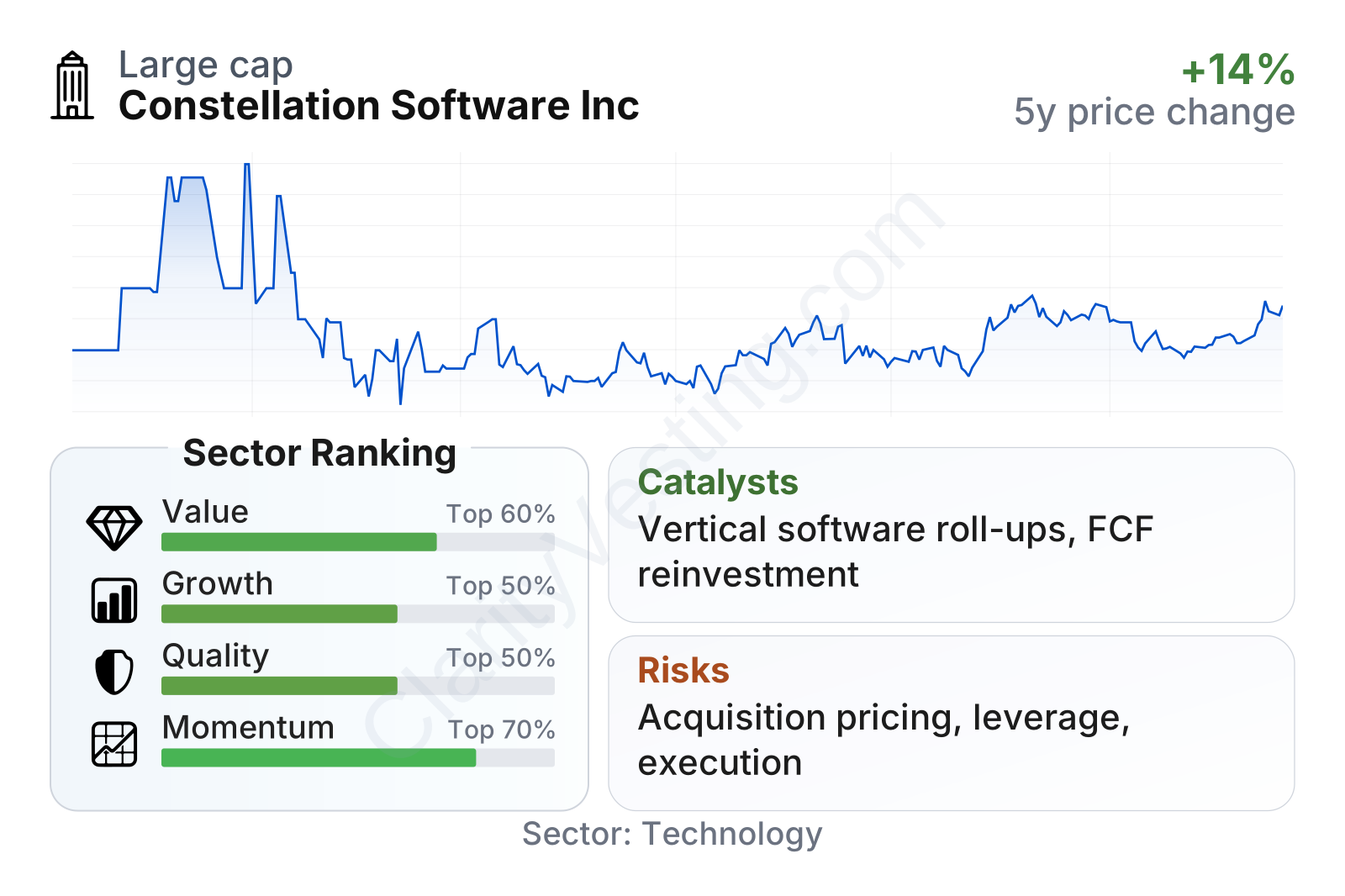
Constellation Software sits in the large-cap range and has shown lower share-price volatility than the broader market, with a beta around 0.7. The valuation is not cheap on earnings, with the P/E above the sector median, but cash-based measures look stronger than that headline multiple suggests. Free cash flow yield and EBIT relative to enterprise value are both ahead of the sector median, which is important for a company whose strategy depends on turning acquisitions into durable cash generation.
Growth metrics are solid rather than speculative. Recent revenue growth is in the mid-to-high teens, and five-year growth in revenue per share and free cash flow has been materially stronger than the typical software company in its sector. Quality is also supported by healthy returns on invested capital and operating margins above the sector median. The main trade-off is leverage: debt metrics are higher than sector norms, though interest coverage remains at a level that suggests the debt burden is still manageable.
On market performance, the stock has recovered well in recent months after earlier weakness, but its momentum profile still trails many software peers. That combination often points to a company the market respects for fundamentals, while still debating how much of its acquisition-driven growth should already be reflected in the share price.
Growth
Constellation Software operates in a favorable part of the software market: vertical market software. This segment is attractive because customers often depend on highly specialized applications that are difficult and costly to replace. That tends to support retention, pricing power, and recurring maintenance revenue. It is not the fastest-moving area of technology, but it can be one of the most durable because the software is deeply embedded in customer workflows.
The company’s strategy is unusually consistent. Instead of chasing one big transformational deal, it acquires many smaller software businesses that already have established customers, then leaves them relatively decentralized. This approach has worked for years because niche software markets are fragmented, creating a large universe of potential targets. Constellation has also developed a reputation as a disciplined acquirer, which can help it access deals from founders who care about long-term ownership and operational continuity.
A major growth catalyst is simply reinvestment capacity. With free cash flow in the billions of dollars and a long acquisition track record, the company has meaningful room to keep compounding through additional purchases. Another catalyst is the large installed base inside essential industries, where software spending tends to be resilient even when broader technology budgets soften. If more vertical software vendors seek succession or private exits, Constellation’s acquisition pipeline could remain active for years.
Recent corporate developments also support the long-term growth case. The company has continued to emphasize acquisitions as the core use of capital, and its operating model remains focused on decentralized execution rather than risky integration into one centralized platform. That reduces dependence on a single product cycle and creates many small growth engines inside the broader group.
Risks
This article is for informational purposes only and does not constitute financial advice. Some content is AI-generated. See Disclaimer


