Stock Analysis · Cohen & Steers Inc (CNS)
Overview
Cohen & Steers is a specialized asset manager. In simple terms, it manages money on behalf of clients such as institutions, financial intermediaries, and individual investors, and it earns fees based mainly on how much money it oversees. The firm is best known for investing in real assets and income-oriented strategies, especially listed real estate securities, preferred securities, natural resource equities, infrastructure, and related multi-asset solutions.
Its business model is straightforward: client assets are invested in funds and mandates, and revenue rises or falls mostly with assets under management, market performance, and net client inflows or outflows. That means the company does not depend on selling physical products; it depends on investment management fees, performance of financial markets, and its ability to attract and retain client capital.
Based on the company’s recent annual disclosures, revenue is heavily concentrated in investment advisory and administration fees, with a much smaller contribution from distribution and service fees and other income. A practical breakdown is:
- Investment advisory and administration fees: about 90% to 95% — recurring fees earned for managing open-end funds, institutional accounts, closed-end funds, and other vehicles.
- Distribution and service fees: about 3% to 6% — fees tied to shareholder servicing and fund distribution arrangements.
- Other revenue: about 1% to 3% — includes smaller items such as interest-related or miscellaneous income.
Within the asset base itself, Cohen & Steers has historically been most exposed to listed real estate, which remains its flagship capability, while preferred securities, infrastructure, and multi-strategy real assets add diversification. That focus makes the company more specialized than broad asset managers that cover nearly every asset class.
The income structure also shows a business with strong underlying profitability but some sensitivity to market cycles. Revenue and profit dipped in 2023, then improved in 2024 and 2025, reflecting a recovery in markets and client assets rather than a complete reinvention of the business model.
The long-term pattern is cyclical rather than linear. Revenue fell from the 2021 peak, bottomed in 2023, and then recovered in 2024 and 2025. Even through that volatility, operating profitability remained solid, which is typical of a well-established asset manager with a relatively flexible cost base.
Key Figures
| Metric | Value | Sector ⓘ |
|---|---|---|
| Date | Oct 19, 2026 | |
| Context | ||
| Sector | Financial Services | |
| Industry | Asset Management | |
| Market Cap ⓘ | $3.58B | |
| Beta ⓘ | 1.22 | |
Value (Cheapness) | ||
| P/E Ratio ⓘ | 21.42 | 12.26 |
| P/B Ratio ⓘ | 6.07 | 1.23 |
| FCF Yield ⓘ | 3.44% | 10.40% |
| Dividend Yield ⓘ | 3.81% | 3.02% |
| EBIT / EV ⓘ | 6.04% | 8.14% |
| PEG ⓘ | 1.69 | |
Growth (Business expansion) | ||
| Revenue Growth ⓘ | 11.10% | 9.25% |
| RPS Growth (5Y CAGR) ⓘ | -1.94% | 12.19% |
| EPS Growth (5Y CAGR) ⓘ | -9.71% | -9.36% |
| BVPS Growth (5Y CAGR) ⓘ | 16.24% | 4.99% |
| Margin Growth (5Y Trend) ⓘ | -11.73% | -3.86% |
| FCF Growth (5Y CAGR) ⓘ | N/A | 4.81% |
| DPS Growth (5Y CAGR) ⓘ | -4.91% | 8.79% |
Quality (Business durability) | ||
| ROIC (Latest) ⓘ | N/A | 9.49% |
| ROE (Latest) ⓘ | 30.31% | 13.87% |
| ROA (Latest) ⓘ | 19.77% | 1.54% |
| ROIC (5Y Median) ⓘ | 34.68% | 7.86% |
| ROE (5Y Median) ⓘ | 42.78% | 12.17% |
| ROA (5Y Median) ⓘ | 19.53% | 1.30% |
| Net Debt / EBIT (Latest) ⓘ | 0.34 | 0.99 |
| Net Debt / EBIT (5Y Median) ⓘ | -0.29 | 0.73 |
| Net Debt / EBITDA (Latest) ⓘ | 0.33 | 0.91 |
| Operating Margin (Latest) ⓘ | 36.76% | 22.30% |
| Operating Margin (5Y Median) ⓘ | 37.15% | 24.63% |
| Debt to Equity (Latest) ⓘ | 22.80% | 58.04% |
| Profit Margin (Latest) ⓘ | 28.16% | 26.57% |
| Free Cash Flow (Latest) ⓘ | $123.32M | |
Momentum (Price trend) | ||
| 3Y Return ⓘ | +36.27% | +88.26% |
| 12M Return (excl. last month) ⓘ | +7.44% | +19.24% |
| 6M Return ⓘ | +9.60% | +4.70% |
| Price vs. 200-Day MA ⓘ | -1.84% | +3.66% |
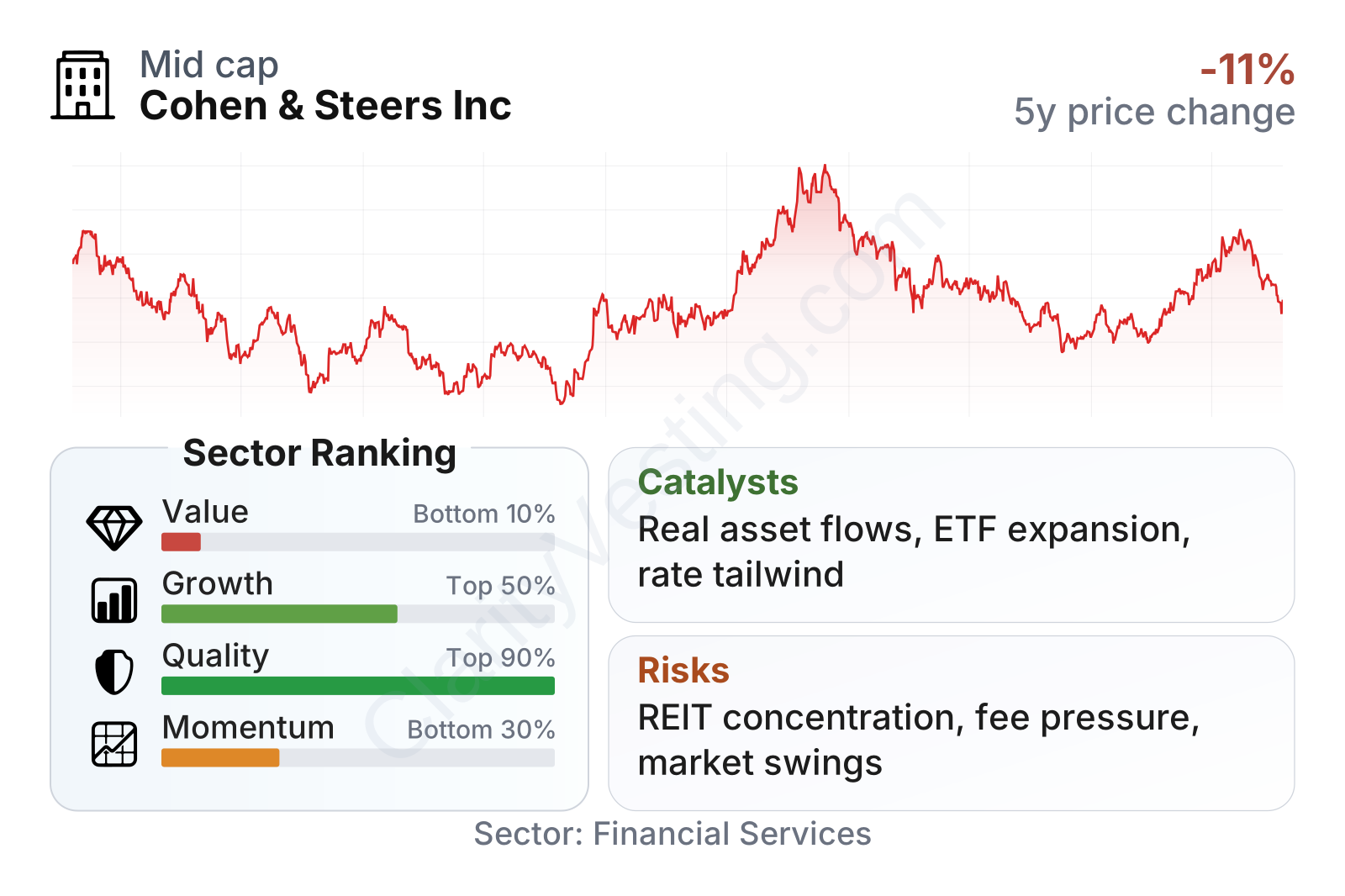
Cohen & Steers stands out more for business quality than for cheap valuation. Profitability metrics are strong relative to the broader financial sector, leverage is modest, and margins remain healthy. Growth is more mixed: recent year-over-year revenue growth looks respectable, but the longer five-year record is weaker, especially for earnings per share and revenue per share. Market performance has also been less impressive than the sector over longer periods, which helps explain why the shares have been volatile despite the company’s strong operating profile.
The stock has moved through large swings over the past several years, which is normal for an asset manager tied to interest-rate-sensitive categories such as real estate securities and preferreds. The business is medium-sized rather than a giant in the industry, and its share price behavior reflects both market cycles and changing expectations for those specialized asset classes.
Growth
Cohen & Steers operates in a sector that should remain relevant over the long run: asset management. More specifically, it is positioned in areas that can benefit from several durable trends, including demand for income-oriented strategies, increasing interest in infrastructure and real assets, and portfolio diversification away from traditional stock-and-bond mixes. These are not guaranteed growth engines every year, but they are segments with a clear role in institutional and wealth portfolios.
The company’s strategy also makes sense in the current environment. Real assets and listed infrastructure can become more attractive when clients want inflation sensitivity, income, or exposure to long-duration themes such as energy transition, power networks, transportation assets, and digital infrastructure. Preferred securities also have a place when investors are looking for yield and relative income stability.
One useful way to think about future growth is to separate market-driven growth from business-building growth. Market-driven growth comes from rising asset prices, which increase fee-bearing assets. Business-building growth comes from launching products, entering new distribution channels, and gaining client mandates. Cohen & Steers needs both. Because it is a fee-based manager, even moderate net inflows can have a meaningful effect when markets are favorable.
Earnings per share have not followed a smooth upward path. They were stronger in 2021, declined into 2023, and then began to recover in 2024 and 2025. That pattern suggests the company is capable of earning well through the cycle, but also that profits are highly influenced by market levels and asset mix. The recent rebound is encouraging because it shows earnings power can recover when conditions improve.
Book value per share has increased strongly over the past five years despite the earnings volatility. That matters because it shows the company has still been adding balance-sheet value over time, even while markets moved through a difficult period for many rate-sensitive strategies. In other words, the franchise has continued to compound internally, even if the income statement has been uneven.
Recent company updates have emphasized product expansion and broader distribution, including exchange-traded and institutional offerings tied to real assets, preferred income, and global infrastructure. Those developments are important because they can reduce dependence on any single vehicle or client channel. If flows improve in these newer or expanding product lines, the company’s growth profile could become more balanced than it has been historically.
Risks
This article is for informational purposes only and does not constitute financial advice. Some content is AI-generated. See Disclaimer


