Stock Analysis · Core Natural Resources Inc (CNR)
Overview
Core Natural Resources Inc. is a U.S. coal producer created through the combination of Arch Resources and CONSOL Energy. The company operates large-scale mining assets and sells coal to power generators, steelmakers, industrial users, and export customers. Its business is tied to two main end markets: metallurgical coal used in steel production and thermal coal used for electricity generation and industrial fuel.
The company’s revenue base is broader than a pure domestic coal producer because it serves both U.S. and seaborne markets. Based on recent company disclosures following the merger, revenue is mainly generated from coal sales, with logistics and other activities contributing only a small share.
- Metallurgical coal: approximately 55% to 65% of revenue. This includes high-quality coal sold primarily to steel producers, including export markets where pricing can be stronger but also more volatile.
- Thermal coal: approximately 35% to 45% of revenue. This includes coal sold to electric utilities and industrial customers, with a larger portion typically backed by contracted volumes than export metallurgical coal.
- Other revenue: generally a low-single-share portion of total revenue. This can include transportation, terminal, royalty, and other ancillary items, but it is not a major earnings driver.
What makes Core Natural Resources unusual within the energy sector is that it combines a cash-generative thermal coal base with exposure to metallurgical coal, which is more directly linked to steel demand. That mix can provide diversification, but it also means the company is exposed to both utility fuel trends and global industrial cycles.
Over the last several years, the business showed how sensitive coal economics are to pricing. Revenue and profit expanded sharply during stronger market conditions, then cooled as margins normalized. The recent financial profile reflects that cycle clearly: sales remain meaningful, but profitability is far below the peak levels seen earlier in the decade.
The long-term pattern is clear: revenue rose strongly through 2022 and 2023, eased in 2024, and then changed materially with the combination that created the current company. The more important takeaway is not the absolute revenue line but the compression in operating profit and net income after the earlier commodity upswing faded.
Key Figures
| Metric | Value | Sector ⓘ |
|---|---|---|
| Date | Oct 17, 2026 | |
| Context | ||
| Sector | Energy | |
| Industry | Thermal Coal | |
| Market Cap ⓘ | $4.54B | |
| Beta ⓘ | 0.25 | |
Value (Cheapness) | ||
| P/E Ratio ⓘ | 47.93 | 15.44 |
| P/B Ratio ⓘ | 1.22 | 1.73 |
| FCF Yield ⓘ | 5.71% | 8.20% |
| Dividend Yield ⓘ | 0.44% | 3.59% |
| EBIT / EV ⓘ | 1.71% | 7.46% |
| PEG ⓘ | 0.35 | |
Growth (Business expansion) | ||
| Revenue Growth ⓘ | 3.50% | 26.90% |
| RPS Growth (5Y CAGR) ⓘ | 22.91% | 6.90% |
| EPS Growth (5Y CAGR) ⓘ | -50.09% | -15.73% |
| BVPS Growth (5Y CAGR) ⓘ | 39.42% | 6.07% |
| Margin Growth (5Y Trend) ⓘ | -12.48% | 0.58% |
| FCF Growth (5Y CAGR) ⓘ | -40.84% | 1.86% |
| DPS Growth (5Y CAGR) ⓘ | N/A | 16.79% |
Quality (Business durability) | ||
| ROIC (Latest) ⓘ | 2.04% | 11.40% |
| ROA (Latest) ⓘ | 1.63% | 6.06% |
| ROIC (5Y Median) ⓘ | 11.86% | 10.30% |
| ROA (5Y Median) ⓘ | 10.31% | 5.42% |
| Net Debt / EBIT (Latest) ⓘ | -0.33 | 1.64 |
| Net Debt / EBIT (5Y Median) ⓘ | 0.11 | 1.83 |
| Net Debt / EBITDA (Latest) ⓘ | -0.04 | 1.08 |
| Net Debt / Assets ⓘ | -0.42% | 17.29% |
| EBITDA / Interest ⓘ | 16.06 | 9.64 |
| Operating Margin (Latest) ⓘ | 1.82% | 16.27% |
| Operating Margin (5Y Median) ⓘ | 16.42% | 20.39% |
| Debt to Equity (Latest) ⓘ | 12.04% | 54.76% |
| Profit Margin (Latest) ⓘ | 2.35% | 8.82% |
| Free Cash Flow (Latest) ⓘ | $259.50M | |
Momentum (Price trend) | ||
| 3Y Return ⓘ | -15.45% | +67.38% |
| 12M Return (excl. last month) ⓘ | +32.81% | +49.19% |
| 6M Return ⓘ | +2.49% | +7.07% |
| Price vs. 200-Day MA ⓘ | -1.46% | +9.56% |
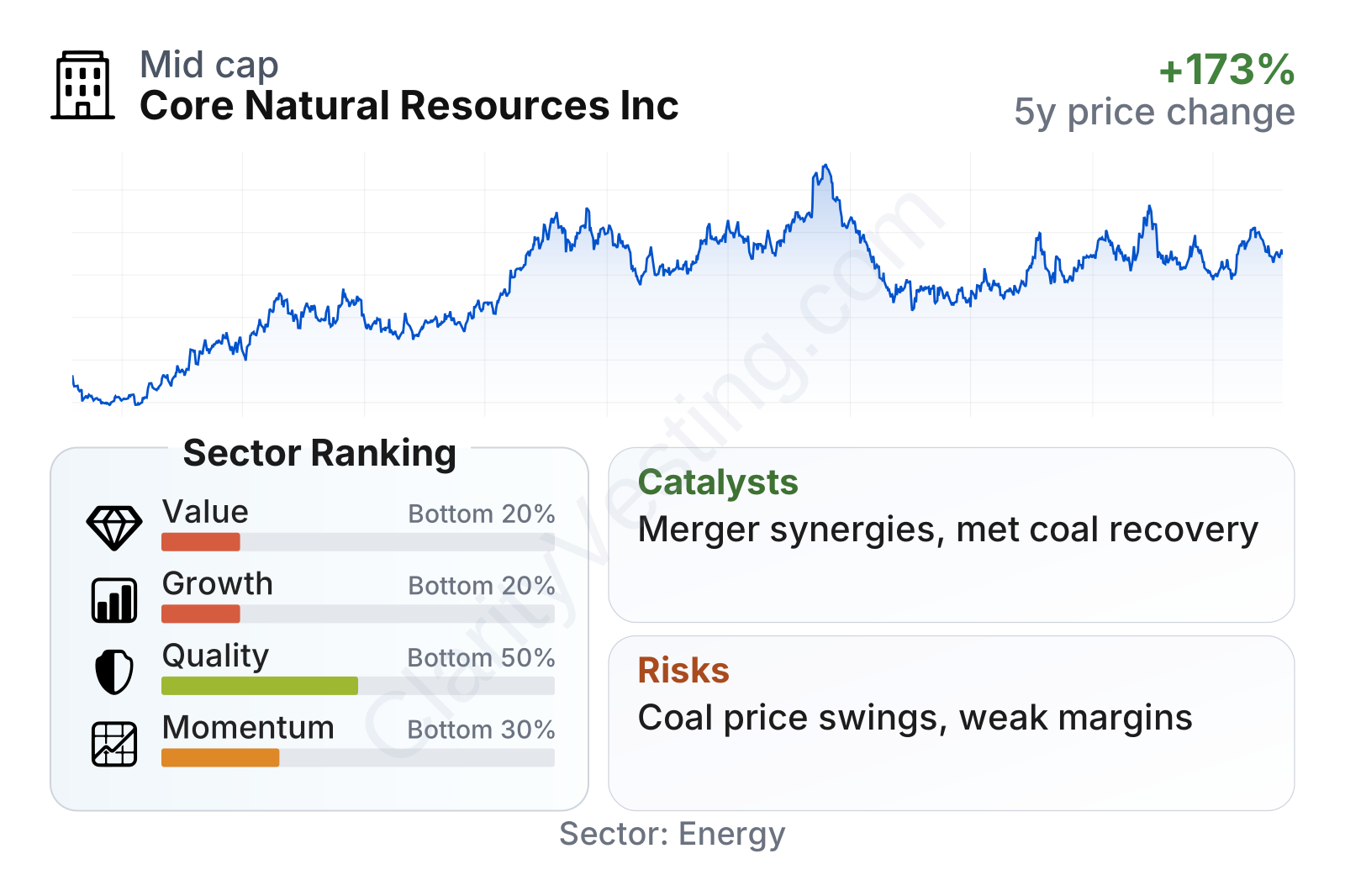
Core Natural Resources is a mid-sized energy company with a market value around $4 billion and an unusually low beta, although coal stocks can still be very volatile when market sentiment or commodity prices shift. The table points to a mixed profile. Balance-sheet strength stands out, with very low debt relative to equity and net debt metrics that remain better than most of the sector. By contrast, current profitability, growth, and valuation measures look weaker. Recent returns on capital and margins sit well below sector medians, and the company ranks in the lower part of the sector on value, growth, and momentum factors.
The most notable contrast is between short-term and long-term quality. Five-year median returns on invested capital and assets were solid, but trailing twelve-month profitability has fallen sharply. That suggests the business still has productive assets, yet current earnings power is being pressured by weaker market conditions and post-merger adjustment effects.
Growth
Coal is not a classic structural growth industry in the United States, especially on the thermal side, where power generation continues to face long-term pressure from natural gas, renewables, and environmental policy. That said, this does not mean every coal company lacks growth opportunities. Core Natural Resources now has scale across two distinct coal markets, and that matters. Metallurgical coal has a more durable industrial role because blast-furnace steelmaking still depends on it, while thermal coal can remain relevant where utilities need reliable baseload fuel and export demand stays firm.
The company’s strategy makes sense in a practical way: combine high-quality metallurgical assets with long-life thermal operations, preserve a conservative balance sheet, and use commercial scale to manage sales across domestic and export channels. The merger that formed Core Natural Resources is itself a major catalyst because it expands reserve life, broadens customer exposure, and creates room for cost savings, logistics coordination, and capital allocation flexibility.
Recent sales growth has slowed sharply from the extraordinary gains seen in 2022 and parts of 2025. The current pace is much more modest, which is a reminder that this is a cyclical business rather than a steady compounder. Even so, the longer five-year revenue-per-share trend remains strong, helped by the strong coal price environment earlier in the cycle and the larger combined asset base.
Cash generation also supports the growth case better than earnings alone. Free cash flow has come down from prior highs, but it remains positive on a trailing basis. For a commodity producer, that matters because internal cash can fund maintenance spending, reclamation obligations, debt discipline, and shareholder distributions without depending heavily on outside financing.
A meaningful recent opportunity is the company’s larger presence in metallurgical coal after the merger. If steel-related demand improves or export pricing strengthens, the combined company has more leverage to that recovery than either predecessor had on its own. In addition, scale can help with mine planning, transportation efficiency, and contract negotiations, which are realistic sources of improvement even without a major commodity rebound.
Risks
This article is for informational purposes only and does not constitute financial advice. Some content is AI-generated. See Disclaimer


