Stock Analysis · China Overseas Property Holdings Limited (CNPPF)
Overview
China Overseas Property Holdings Limited is a Chinese property management and community services company. Rather than developing and selling homes itself, it mainly earns money by managing residential communities, commercial buildings, and public facilities, and by selling services to property owners, residents, and developers. The business sits inside the broader real estate services industry, which means its performance is tied less to one-time home sales than to recurring management contracts and service fees.
The company’s revenue mix is generally centered on three activities, with property management remaining the core contributor. Based on its recent annual disclosures, the business can be understood as follows:
- Property management services: approximately 55% to 65% of revenue. This includes basic management fees for residential projects, commercial properties, government facilities, and other managed sites.
- Value-added services to non-property owners: approximately 20% to 30% of revenue. This typically includes services provided to developers and other corporate clients, such as pre-delivery support, sales office services, and related project assistance.
- Community value-added services to property owners and residents: approximately 10% to 20% of revenue. These services can include home-living support, repair and maintenance, community retail-related offerings, and other resident-focused services.
That structure matters for long-term analysis because property management fees are usually more recurring than traditional real estate development income. It also means the company can expand not only by taking on more managed area, but also by increasing services sold per household and per project.
Over the last several years, revenue rose strongly, while profitability also stayed positive. The flow from revenue to operating income and net income suggests a business that has scaled up meaningfully since 2021, even though margins have not expanded in the same way as sales.
Key Figures
| Metric | Value | Sector ⓘ |
|---|---|---|
| Date | Oct 17, 2026 | |
| Context | ||
| Sector | Real Estate | |
| Industry | Real Estate Services | |
| Market Cap ⓘ | $1.58B | |
| Beta ⓘ | 1.13 | |
Value (Cheapness) | ||
| P/E Ratio ⓘ | 8.01 | 17.38 |
| P/B Ratio ⓘ | 0.03 | 0.85 |
| FCF Yield ⓘ | 131.50% | 7.38% |
| Dividend Yield ⓘ | 36.41% | 4.85% |
| EBIT / EV ⓘ | N/A | 3.78% |
| PEG ⓘ | N/A | |
Growth (Business expansion) | ||
| Revenue Growth ⓘ | 4.50% | 5.30% |
| RPS Growth (5Y CAGR) ⓘ | 101.70% | 6.02% |
| EPS Growth (5Y CAGR) ⓘ | -15.29% | -11.37% |
| BVPS Growth (5Y CAGR) ⓘ | 112.80% | 0.45% |
| Margin Growth (5Y Trend) ⓘ | -1.00% | -0.22% |
| FCF Growth (5Y CAGR) ⓘ | 19.13% | 5.40% |
| DPS Growth (5Y CAGR) ⓘ | 126.51% | 5.02% |
Quality (Business durability) | ||
| ROIC (Latest) ⓘ | N/A | 5.69% |
| ROE (Latest) ⓘ | 49.73% | 7.56% |
| ROA (Latest) ⓘ | 22.39% | 2.85% |
| ROIC (5Y Median) ⓘ | 32.72% | 4.22% |
| ROE (5Y Median) ⓘ | 35.18% | 6.03% |
| ROA (5Y Median) ⓘ | 12.95% | 2.44% |
| Net Debt / EBIT (Latest) ⓘ | N/A | 7.59 |
| Net Debt / EBIT (5Y Median) ⓘ | -2.79 | 8.40 |
| Net Debt / EBITDA (Latest) ⓘ | -1.64 | 5.27 |
| Net Debt / Assets ⓘ | -43.45% | 37.76% |
| EBITDA / Interest ⓘ | 216.33 | 4.10 |
| Operating Margin (Latest) ⓘ | N/A | 35.29% |
| Operating Margin (5Y Median) ⓘ | 13.16% | 37.31% |
| Debt to Equity (Latest) ⓘ | 1.54% | 88.87% |
| Profit Margin (Latest) ⓘ | 8.49% | 19.61% |
| Free Cash Flow (Latest) ⓘ | $2.08B | |
Momentum (Price trend) | ||
| 3Y Return ⓘ | -52.70% | +30.75% |
| 12M Return (excl. last month) ⓘ | -26.60% | +4.36% |
| 6M Return ⓘ | -14.48% | -2.52% |
| Price vs. 200-Day MA ⓘ | N/A | -2.34% |
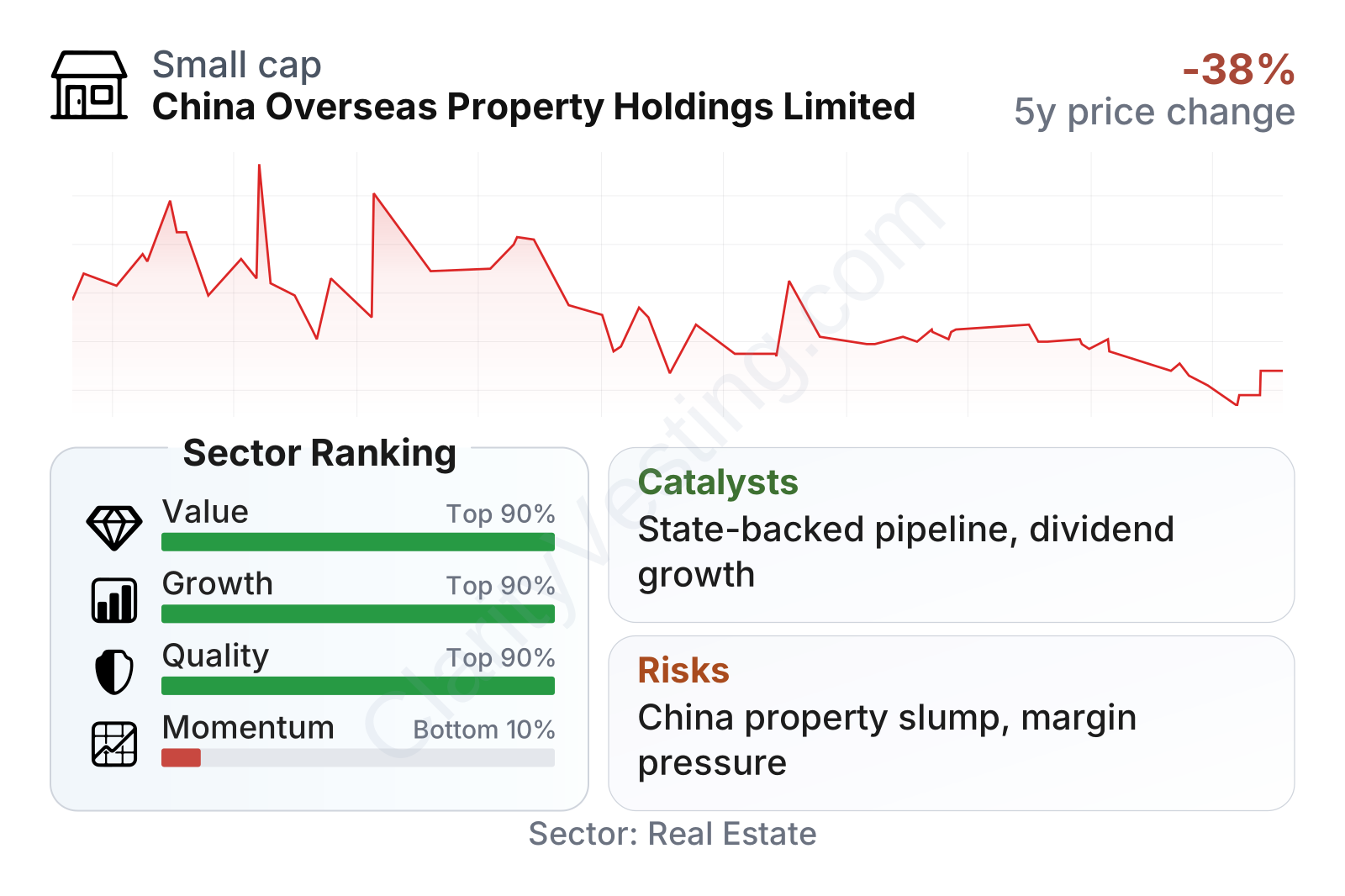
The company stands out on valuation, balance sheet strength, and cash generation relative to much of the real estate services sector. Profitability ratios such as return on equity and return on assets are unusually high, and leverage appears very low, with net cash rather than heavy net debt. At the same time, market momentum has been weak, with the shares materially underperforming the sector over the last one to three years. That combination usually reflects a disconnect between current operating metrics and market confidence in the durability of those results.
Growth
Property management remains a structurally relevant segment in China’s housing ecosystem because buildings and communities still need ongoing maintenance, security, cleaning, repairs, and resident services regardless of whether the property development market is booming or weak. That gives the sector a more defensive profile than homebuilding, although it is not completely insulated from stress in the broader real estate chain.
China Overseas Property’s strategy makes sense for long-term expansion because it combines recurring base management fees with additional services sold to both developers and residents. In practical terms, growth can come from three levers: winning more gross floor area under management, improving revenue per project, and raising service penetration within existing communities. This model can scale without requiring the same capital intensity as a property developer.
Revenue per share moved sharply upward across the period shown, indicating that the company has expanded its business materially. The latest jump is especially large and likely reflects either a major step-up in operations, capital structure changes, or reporting effects, so the broad trend is more informative than the last point alone. Even so, the longer pattern still points to substantial expansion.
Another notable feature is shareholder distributions. Dividend growth over five years has been extremely strong, and the trailing yield is far above the sector median. That does not automatically mean the payout level is permanent, but it does show that recent cash generation has been significant.
The dividend per share trend has been strongly upward, which aligns with the company’s high free cash flow and low leverage profile. For a long-horizon review, the more important question is whether this cash distribution can remain supported if China’s property market stays under pressure. Right now, the financial base looks capable, but the macro backdrop still matters.
As for recent opportunity, the company’s positioning within the China State Construction and China Overseas system is an important catalyst. That relationship can support project sourcing, especially in public buildings, commercial assets, and residential communities linked to affiliated developers and state-backed networks. In a difficult market, that kind of ecosystem access can matter more than aggressive expansion alone.
Risks
This article is for informational purposes only and does not constitute financial advice. Some content is AI-generated. See Disclaimer


